|

COVER
STORY | IN THE NEWS | GARDEN | FROM THE EDITOR | STAGE DOOR
THE
HUM | CALENDAR
Sept. 16, 2004

by BOB DORAN
Related Stories:
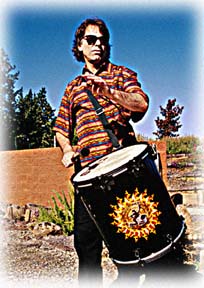
MICKEY HART [photo at left] HAS
A MISSION IN LIFE: "SPREADING THE rhythm seed," as
he puts it. "Rhythm connects us to ourselves and to other
people. It's the vibration, stupid. Without the right vibrations
we're in chaos or we're fighting," said Hart in a recent
conversation from his Sebastopol studio.
His "day job" as one
of two drummers for the Grateful Dead, now known simply as the
Dead, has given him the opportunity to sow that rhythm seed far
and wide, often setting tens or even hundreds of thousands of
music fans vibrating in unison.
But this weekend he has something
different in mind, something he calls "Drums for Peace."
Working in conjunction with the international music and dance
event, Earthdance, whose aim is to move towards peace by getting
thousands of people dancing together to one song, Hart has laid
plans for the world's largest drum circle, with anywhere from
3,500-5,000 drummers playing in one place.
"Ritual and rapture, a
rush of group noise, group rhythm, raising individual and group
power, sending it out around the world," he explained, in
an energetic rush of words.
Hart has arranged for Remo drums
to donate 3,500 drums for the occasion. "After it's all
over [the participants] will have the option of giving the drums
back to [be used] in the music in school programs in California,"
said Hart.
Part of the plan is to document
the event and submit it for a Guinness World Record. "It's
held by the Turks at 3,140," Hart noted. "They broke
the record, which was in the 2,000s. We didn't break the record,
but we had the largest in 1991 with 1,800 -- the biggest at that
time -- it wasn't validated but it was the largest."
In fact, in 1992, not long after
the '91 drum circle, this reporter interviewed Hart about plans
for a giant drum circle to be held in Arcata at Humboldt State.
At the time, Dead guitarist Jerry Garcia was ill and the band
had cancelled a number of shows leaving Hart with room to do
his own thing. Garcia recovered, the band resumed its tour and
the event never happened. "I never got to it," said
Hart, looking back. "I'm kind of busy."
Truth is, he's been "kind
of busy" for some time now. When we spoke he had just returned
from the Dead's "Wave that Flag" summer tour, which
as any Deadhead will recognize, took its name from the song,
"U.S. Blues."
This time the message was a
bit different, and according to Hart, simple. "Go out there
and fucking vote. Vote while you have a chance. This is probably
the most important election of your lifetime and if you want
to take America back -- which is kind of patriotic -- you'd better
get it on now. That's what "Wave that Flag" is about,
that and also about waving your personal flag. Beyond being patriotic
and taking back what's left of America, stand up for what you
believe in."
And when he's not out making
music, he's working on something he calls "The Anaconda:
the information snake," a massive collection of data about
world rhythm that so far has resulted in four books: Drumming
at the Edge of Magic, Planet Drum, Spirit into Sound: The Magic
of Music, and most recently, Songcatchers: In Search of
the World's Music, written in collaboration with National
Geographic.
Eventually he will complete
a really big book on rhythm. "I'm on it," he said.
"I've been working on it for years. It's a massive work,
a magnum opus. I've collected the information, put it into binary
code; it's data, metadata, data about data. And now I'm about
ready to get serious writing the narrative. I'm seriously into
it."
His search for the rhythm story
has taken him far and wide recording music, and revisiting the
work of others. His Songcatchers book examines the ethnographers
who left a legacy of recordings in the vaults of the Smithsonian
and the Library of Congress.
"They realized that these
songs were more than just sounds," said Hart, speaking passionately
about the "ethnos" who came before him. "The songs
they found were histories of great cultures, thousands of years
of evolution, and they recognized that [the music] was falling
off the edge of the world, that there was only a breath in time,
a moment to gather these things. They were hell-bent of catching
these songs -- that's why we call them songcatchers.
And Hart has joined their ranks.
"I've been all around the world looking into everything
from Koranic chanting to Native American music. And it's not
just recordings of rhythms -- it's our dance with the vibratory
world around us and where we're heading as a species in our dance
with the infinite, which is the rhythmic origin of the universe."
The Earthdance United Beats
of Peace Festival runs simultaneously in 130 cities in 50 countries
with the hub in Northern California at Black Oak Ranch from Friday,
Sept. 17 until Sunday Sept. 19. In addition to Drums of Peace
with Planet Drum, the event in Laytonville features a diverse
array of music on five stages, including Ozomatli, Michael Franti
and Spearhead, Blackalicious, Steve Kimock and the Everyone Orchestra,
Midnite, Panjea, Joanne Rand and many more.
The international Prayer for
Peace takes place at 4 p.m. Saturday; Drums of Peace follows
immediately after. Both will be broadcast live on the Internet
along with Earthdance events worldwide, with streaming services
supplied by Arcata-based Streamguys.
For a full schedule of
the local event and the international dances, go to www.earthdance.org.
For a history of the Earthdance event see "Dancing
for Peace," an interview with Earthdance founder Chris
Deckker from the Sept. 18, 2003 North
Coast Journal. Bob Doran's 1992 interview
with Hart is a related story, see below. Mickey Hart is online
at www.mickeyhart.net.
Bob
Doran
DANCING FOR PEACE - 2003
This Saturday, Sept. 20, people
in over 130 cities in 50 countries will join together for Earthdance
2003, dancing for peace in a world torn by war and strife. The
hub of this international event, "The United Beats of Peace
Festival," is here in Northern California, running all weekend
at the Black Oak Ranch near Laytonville.
"The event is actually
in its seventh year now," explained Earthdance founder Chris
Deckker. "It began when I was living in England; it was
a vision I had for uniting the music and dance culture as a vehicle
for world peace."
Originally from Australia, Deckker
is a percussionist whose musical journey began with Latin American
and African music. In the mid-'90s, he relocated to London where
he began investigating what he calls "a fusion of electronica
with ancient rhythms."
While running dance clubs, he
joined forces with synthesizer player Alex Newman and founded
a band, Medicine Drum. Part of the idea was to explore the healing
power of rhythm.
"People were dancing until
6 o'clock in the morning and having this incredible experience
on the dance floor that can only be described as shamanic. And
there was an extremely strong level of community connection.
We took that and distilled it into a philosophy. We saw it as
a new paradigm where people joined together once again to dance
all night," said Deckker in a call from his current home
base in Oregon.
As electronica evolved, Medicine
Drum moved towards creating more organic live music merging synthesized
sounds with primal tribal rhythms. At the same time Deckker was
thinking about the music as a tool for raising social consciousness.
"Using music as a vehicle
for positive change has been my life work, and that led me to
the idea of creating a one-world party, where at one moment in
time everybody could listen to the same track and feel that same
vibration in music at the same time, which is the whole focal
point of the Earthdance concept. So at 12 midnight London time,
no matter where you are at any Earthdance party, you're listening
to the same thing. In California that will be 4 p.m. Saturday
afternoon."
The track? "It's a five-minute
ambient piece of music with a spoken word universal prayer that
has been translated into different languages. I wrote the words;
my Medicine Drum partner, Alex, composed the music in England
all those years ago. We've been using it ever since."
At first Earthdance events were
mainly in the electronica vein - and the Northern California
"Global Festival for Peace" will include a large dome
with music by some of the world's top dance DJs including Toby
Marks of Banco De Gaia - but as Deckker explained, "Now
it's expanded. We've got musicians from all across the world,
from many, many genres getting together at the Black Oak Ranch.
It's conscious artists coming together to show that there are
no boundaries in music, which is intrinsically a powerful medium
for spreading the message of peace."
The line-up for Earthdance does
in fact cross many genre lines with dozens of bands on several
stages. Alongside the neo-tribal sounds of Medicine Drum, Lost
at Last and Panjea, there's musical activist Michael Franti and
Spearhead using hip hop and soul to spread the word, space music
by Sound Tribe Sector 9 and Trance Zen Dance, the liquid guitar
sounds of jam-master Steve Kimock, jazzy jams from the Slip,
reggae from Big Mountain, Midnite and Groundation, and sharp
political hip hop from the Coup.
The Southern Humboldt film collective
Earth Films is organizing an Eco-activist Film Festival for Friday
night. Other local participants include activist songwriter Joanne
Rand from Orleans, Arcata's Something Different and SoHum's the
Non-Prophets.
According to Deckker the common
thread in the acts booked is a commitment to social consciousness.
"If you look at society, music has been the spearhead of
many revolutions. In the '60s music was a major force in the
consciousness revolution. I think that's happening again as well.
There's a resurgence of music asking questions: Where are we
with our lives? What's happening with society? What's happening
with our government? All of this is reflected in the music of
our times and musicians are becoming more conscious and using
music as a vehicle for expressing that consciousness."
Does music have to power change
the world?
"Music has the power to
open your heart - and when you heart is open you can feel the
feel the positive vibration of change within yourself. And then
that can inspire you to be a better person in your life, a better
person in your community," said Deckker.
"Music has been a major
force since indigenous times. When we were just a tribal society
there was always the element of music galvanizing he community
into a moment. It might have been the full moon ritual then,
but now it's a dance party or going to a club. It's a very intrinsic
element, it's still present: People come together, they join
as a community, they dance together and feel a sense of community
power. And that is a powerful force."
On the Edge with the Dead's Rhythm Master: Mickey
Hart
You probably know Mickey Hart
as the percussionist for the Grateful Dead. That's his "day
job," which he says, "makes it possible to fully live
out my life of imagination." His "enthusiasms"
(as he calls them) include a major information gathering project
on rhythm which, so far, has resulted in two books, Drumming
on the Edge of Magic and Planet Drum. He has made
a number of albums on his own, including two that accompany his
books. October 11th [1992] he is scheduled to be in Arcata leading
a large drummers' circle, an event coordinated by CenterArts.
I spoke to him while he ate his lunch at the Grateful Dead Studios
in Marin County.
ENTRAINER ON THE EDGE
Bob Doran: What do you do?
Mickey Hart: I share sound.
I'm a rhythmist. I make rhythmic sound, and I'm a professional
entrainer. That's the big picture.
BD: What is an entrainer?
MH: It's someone who tries
to synchronize and to resonate. I like to do these things. Music
is a very special case of entrainment. I accomplish it through
drumming - the rhythmic manipulation of noise.
BD: You are usually referred
to as a percussionist.
MH: I play percussion instruments;
that's my method of entraining.
BD: How is a percussionist
different from a drummer?
MH: When you drum, you play
a drum: a stretched membrane, a vibrating membrane. Well, the
world is made up of a lot of kinds of percussive and concussive
sounds. I've explored the quality of a lot of these sounds over
the years. So, I percuss. I play other instruments besides membranes;
wood, metal, glass...
BD: So you're not limited
to drums. In describing the line-up of the Grateful Dead, you
would be listed as the percussionist and Bill Kreutzman as the
drummer.
MH: That's right, but Bill
plays lots of percussion as well. But yeah, the role I've chosen
is that of percussionist.
BD: In your book you refer
to his "ability to find the beat and lock into it."
MH: Yes! He's very intuitive.
He has the animal powers.
BD: You say he "finds
the beat." I think of drummers counting off the start of
a song, in effect setting the beat. The way you describe it,
it's like the beat is there and he discovers it.
MH: It sets you. It drums
you. That's the idea; connect with your inner-self with your
own body rhythms, not with some common time, where the song should
be, or where it could be. It has another kind of relation to
the human and the cosmic realities of what you're doing. What
I was talking about was consciousness.
BD: You also speak of "the
power of the drum." What is that?
MH: The power of the drum
is the sound that it sets up, the groove that it makes. It allows
us to dance and also to travel to other places, to other consciousnesses.
That's what the power is all about. It's an instrument of great
power; healing powers, the power to make you dance, and the power
to entrain. It's the thing we're encoded for as a species, to
find the most efficient way in nature and go with it.
BD: What is "the Edge"
you write about, with a capital E?
MH: It's the Edge of different
places and different people, strange places. The Edge is where
you push to the limits. It's where creativity is found, where
real-time art is found. The Edge is the outer limits of your
consciousness. When you stretch your consciousness you go into
this realm. It could be the sacred - some people call it the
sacred. It's where priorities change, things inside you click
over from just being yeah yeah, to being something more meaningful
and far-reaching. You make a connection. You connect. That's
what the Edge is all about. It's a metaphor of course.
BD: Do you see it as a boundary?
MH: Not a boundary, it's
just another line to cross. The flow state is at the Edge. Trance
is at the Edge; rapture, ecstasy, all of the altered consciousness
- focusing when you have an adrenaline rush. When your body is
shooting endorphins through it, that's the Edge.
BD: Is that what you try
to achieve with your music?
MH: That's what music does.
Of course, I'm just a musician trying to achieve that thing that's
been there inherent in music forever. It's nothing new. It's
just that some people have lost their connection to what music
really is. This is a reawakening of archaic techniques.
BD: You're saying that music
is...
MH: It's transformational.
It's a focusing technique, a way of practicing three-dimensional
space. It's a microcosm of what we live in, a true reflection
of the matter of the universe. That's why people have such a
strong attraction to it.
BD: What about the use of
music in society?
MH: Which society?
BD: One of the things I got
from your writing is that in modern Western civilization, we
have made music a separate thing instead of using it as a day-to-day
part of culture.
MH: Right. It's been ripped out. The rituals that
have music in them, which are most of the social rituals, have
been ripped out. In the West we don't get together and dance
and sing together. Mostly it comes to us across the airwaves,
on the stereo, on the TV, on a CD. The ritual has been taken
out of it. The ritual now is driving a car and getting off listening
in your head.
BD: The performer is separated
from the audience
MH: You don't participate
with a community in music anymore, unless you go to a big rock
concert; like I went to the Metallica and Guns 'N Roses last
night. That's ritual. They were banging their heads trying to
get stress out of their lives. It was a release; it was rhythm
and noise; it was very loud, auditory driving at it's finest.
Yeah! Those are the rituals that we wind up with. Rituals that
used to happen in our living rooms now are in stadiums. That's
a big difference in the experience of music. That's what these
drum circles are about...
DRUM CIRCLES, BIG AND SMALL
BD: Let's talk about what
you're going to do here in Arcata.
MH: It's all about fun.
It's about ritual - getting together and sharing sound with your
family.
BD: Who will you bring with
you?
MH: Some of my friends.
Some auditory drivers - we call them drivers. They'll help keep
the runaway drums in check.
BD: What's a runaway drum?
MH: People that get caught
up in their own world and aren't listening. They violate the
rhythm. The drivers will keep it even; keep a certain kind of
order. Remember we're playing with chaos, trying to order chaos.
BD: What instruments will
you bring?
MH: I don't know yet. It
doesn't matter what I'm going to be playing, what matters is
that we're all going to be making sound together. Everybody there
has to participate; the idea is that it's not a show.
BD: What should people bring?
MH: Anything, their personal
percussion if they have any. Anything that makes a sound that
they're interested in. If not, drums will be available. You can
buy one there. Remo will have a whole line of drums to purchase
if you don't have your own. You know, bring a frame drum a simple
single membrane drum, nothing fancy, or bring your fanciest instrument
if you like. But, the idea is: it's not a "show." It's
not a virtuoso performance by me.
BD: It's not a concert.
MH: No, it's not a concert!
We're trying to find our own rhythm there. It's a unique event.
BD: Have you done this other
places?
MH: Yeah, I've done a couple
of them. Each one was so different. They take on a personality
of their own because it's a living event. Those people will never
come together and will never play like that. It's a special thing.
It's something to share with your family. I do it with my family.
I should add [the drummer's circle] is not for "musicians."
This is not necessarily "music." We're not trying to
make music. There'll be nothing fancy about this. It's strictly
entrainment, and focus. It's having a good time playing in a
big hairy groove.
BD: It sounds exciting.
MH: When you hear 1,800
drummers playing it's something that will shoot your adrenaline
through your body. We did one with 1,850 drummers. We could have
more at this concert.
BD: You probably haven't
heard about it, but there's been some local controversy lately
concerning drummer's circles. Groups assemble on the Plaza in
Arcata. They bring congas and...
MH: They say it's too loud?
BD: Shopkeepers complain,
the mayor complained...
MH: There has been persecution
of these drum circles forever. It's thought of as a lesser form,
because it makes a lot of noise. It's very strong and powerful
and attractive, and it's chaos. It shakes the empires. This is
really noise. Rhythm and noise, one of the strongest elements
on the planet. Of course the government doesn't like it.
BD: The City Council is thinking
about some sort of ban on drums on the Plaza.
MH: They might be able to
do that, but they can't stop drumming. They can't stop drum circles
- there's nothing illegal. They can pass noise ordinances, but
we'll work around them.
PLANET DRUM
BD: On your last album, Planet
Drum, you assembled a group of musicians from four continents
and four different cultures. Was there any difficulty in getting
the ideas to mesh?
MH: Not the ideas. It was
more difficult getting everyone in the same place.
BD: The logistics of assembly.
MH: Yeah, getting all the
scheduling worked out, you can imagine the horror.
BD: Once you had everyone
together...
MH: Piece of cake.
BD: Does this imply rhythm
as some kind of universal language?
MH: I'm glad you mentioned
that. That's exactly what I am implying. I think I wrote about
that (laughs). I think you might be paraphrasing from my book
(laughs more).
BD: Perhaps unconsciously...
MH: Okay, well that's exactly
right. That's the one thing we can share. We can't share language.
We don't share foods. We share rhythm... Any place I go I can
play with any musician. There's never a problem. [On the Planet
Drum session] most of it was spirit and personality. Everybody
had to want to be here and to entrain. The idea was not to play
as virtuosos. We were trying to find a new groove. Not necessarily
the groove of our ancestors or even who we were, but to bring
our experience to this but not to be stiff - to listen to each
other and try to find those new rhythms, and have fun. That's
the idea.
BD: I think it worked really
well. I really like it a lot.
MH: Yeah, you're not the
only one. It was really well received.
THE WORLD & ENDANGERED MUSIC
BD: You are the "executive
producer" of a series of recordings called The World from
Ryko. What is your role in that company? What do you do?
MH: Well, I record all of
them.
BD: You actually make the
recordings, hands on?
MH: I do all of this. I
don't just push the pen. These are my field recordings from around
the world.
BD: This is the stuff you
talked about in your book, when you would go out with your Nagra
[tape recorder] and...
MH: That and more. The book
is history; it was years ago. Now we have the Endangered Music
Project from the Library of Congress. It's a treasure trove.
We're mining the vaults of the Library of Congress.
BD: You quoted ethnomusicologist/folklorist
Alan Lomax. He fears "the cultural greyout" he said,
"In another generation nothing will be left but their artifacts
packed into metal cabinets at the Smithsonian." So, is this
series your way of unpacking some of those cabinets and sharing
what you find?
MH: That's what it is. It's
music that is on the precipice or has fallen off the precipice
of existence. What I'm trying to focus on are the cultures that
are endangered with this music, because music and culture go
together. You can't have one without the other.
BD: The recordings are from
the tribes of the Rainforest?
MH: I'm talking about indigenous people. Like when
somebody puts a pipeline through your forest and wipes your whole
culture out, and you're standing there in the middle of the 21st
century. It's the plight of the Indians that I'm concerned with.
This is a good time to expose them for who they are. A time to
sing with them, to dance with them, join their pow-wows, and
to understand them through their music and their cultures and
their rhythms. What's going on now is a resurgence of their own
ethnicity. They're getting back into their dance, their singing,
their drumming and they invite the world to come and join with
them. [The pow-wows] are happening all around. Everyone should
take advantage of it.
BD: You also sit on the Board
of Directors for the Smithsonian's Folkways label. Is there some
connection between that and your Rykodisc series, The World?
MH: They're independent,
but they do the same things. We're talking about two separate
gigantic institutions. The Folkways collection went to Folklife
at the Smithsonian. Over time they will be re-releasing 2,000
titles on CD... We don't know what's in the Library of Congress.
It's so deep. It's uncharted territory. It's not like a re-releasing
thing. I had to go through 80 hours of Amazon Basin music to
come up with one hour. These 80 hours included everything from
cylinders - You know the Library of Congress has the first recording
ever made, March 1st, 1890 - until the present. They have all
these recordings; everything that has been copywritten is there.
There are vaults 1/4 mile long of records and tapes.
BD: If everything's there,
it must be hard to find what you need.
MH: It's a matter of knowing
what you're doing, where you want to go and what you want. These
recordings will further the cataloging of the library. The proceeds
will go back into the library, and to the descendants of the
people who played on the recording. It will also create a public
archives for this material. This is important work as far as
I'm concerned.
THE ETHNOS & THE ANACONDA
BD: You wrote about your
encounters with a group of people involved in ethnomusicology.
You called them "the Ethnos." Have you become one of
these Ethnos?
MH: I think of self as such,
yeah. I'm into the exploring of the Edge. I have a lot of ethnomusicological
friends and...
BD: You seem to be pretty
active in this yourself. Are you doing more new field recordings
or are you overwhelmed with re-archiving the past?
MH: Whenever they come up.
It's an ongoing process. It doesn't stop anywhere. It keeps going.
I just recorded the San Quentin Mass Choir inside the walls of
the prison.
BD: Let's talk about this
thing you call "the Anaconda." [The Anaconda is a mass
of information about the history of drums and rhythm.] So far
the Anaconda has resulted in a book called Planet Drum and another
on the making of that book Drumming on the Edge of Magic [also
a partial autobiography]. I get the impression that there's lots
more of the Anaconda that we haven't seen yet.
MH: You better believe it!
BD: What's the future of
the Anaconda?
MH: It's mutated again.
It's assuming grid-like proportions. It's become electronic and
because of the information, it's so vast. It's leading me into
the larger work on rhythm - rhythm as a metaphor for life. That's
what's going on now. I'm researching interlocking rhythm worlds.
That's where I'm heading. More on this later...
BD: I'm trying to figure
out where you find the time to learn and do all this stuff.
MH: I get up early in the
morning and I read.
BD: Then sit at your computer?
MH: I lock in on the computers
worldwide. We have this thing... My friends are sort of a tribe
of hunter/gatherers.
BD: Electronic hunters.
MH: Yeah, yeah, guys like
Tom Vennum, Fred Lieberman, guys in Paris. Wherever, there are
a few people around who are really interested in exploring these
cubbies, these little holes... we talk. This keeps a dialogue
moving and keeps it ongoing. If you compartmentalize too much
and you don't mix it up intellectually and research wise, not
much happens... I just came back from a week in Vermont locked
up in a house with Jay Stevens. We went to work on the big picture.
BD: Your next book?
MH: Yeah, this is the big
book.
BD: Bigger than the other
two...
MH: Oh - big book, big book,
big book. It's the book on ants.
BD: On what??
MH: Well, it's like Ants.
Did you read the book on ants that won the Pulitzer Prize two
years ago. It's the complete book on ants. It's an amazing book.
This is the same kind of book, but on rhythm.
RAVES & DEAD SHOWS
BD: Our body's natural rhythm
is around 120 beats per minute. What do you think about techno/rave
music which has pushed the bpm to 135?
MH: We're moving to faster
rhythms. The young folks are speeding up. They have to be. You
can entrain with any rhythm. It's just that 120 is closer to
most people's body functions. Any rhythm is entrainable. Some
are too fast or too slow for you to perceive. Like the sun or
the moon, you can see those cycles, but it's long. There are
cycles of nature, cycles of the body, and cycles of culture.
You can lock up with these rhythms. Rave music is played for
sped-up people. They're taking psychoactive drugs, and experiencing
auditory driving, loud music, and they're dancing, using motion
and having a trance inducing experience.
BD: A lot of what you just
described could apply to a Grateful Dead concert, but with the
pace a bit slower.
MH: That's right. It's the
same thing, but we're not 18- or 19-years-old. What we've learned
is the infrastructure. It's in the details with the Grateful
Dead. It's the stuff that's inside the bigger groove. There's
a lot going on in there. It's a finite tapestry. Something that
has taken years to develop. This mosaic is all detail.
BD: What are you working
on now? I mean new music from Mickey Hart.
MH: Well, me and Billy are
doing a record with Bob Ravelove. He's our MIDI expert and tech
wiz. We're in the middle of a project.
BD: Will this be pure rhythm,
or rhythm and synthesizer?
MH: It's going to be rhythm,
a lot of rhythm. Let's put it this way, I doubt if there'll be
any guitars or keyboards or bass (laughs).
BD: Your Planet Drum album
is pure rhythm but very musical with the Beam...
MH: That's all sophisticated
stereo digital processing. That's taking all the archaic instruments
and just bumping them up into a digital space. We've got a foot
in the archaic and a foot in the future. This one is a continuation
of that. We don't know how it's going to turn out, but we know
it will have a lot of drums. It will be full of rhythm, there
will be melody, and there probably won't be any voices.
BD: I think that covers everything
I was going to ask.
MH: I'm going to the studio
to make that record we just were talking about.
[After talking more about the drum circle and about his book,
the cycle of our conversation returned to drumming...]
MH: [Drumming] relieves stress. I try to play the
drum every day at least for 15 or 20 minutes .
BD: Well, that's your job.
MH: No, not really. (laughs).
It is a job - bit I do it for my own personal focusing. It's
like I go to the gym, then I drum. It's like eating breakfast.
It's important for my balance.
BD: It's more than a job
then.
MH: (Laughing) It's way
more than a job! Man, it's what I'm supposed to be doing here.
Bob Doran's interview with Mickey Hart
appeared in a slightly different form in the Oct. 1992 issue
of Edge City magazine.
OVER
STORY | IN THE NEWS | GARDEN | FROM THE EDITOR | STAGE DOOR
THE
HUM | CALENDAR
Comments?
© Copyright 2004, North Coast Journal,
Inc.
|