|
 
by BOB DORAN
AT THE END OF 1999
the Humboldt County Board of Supervisors adopted a document called
"Prosperity! -- The North Coast Strategy" as the county's
Comprehensive Economic Development Strategy and appointed Supervisors
John Woolley (photo at right) and Bonnie Neely to a subcommittee
to plan ways to put the strategy into action.![[photo of John Woolley]](cover0907-woolley.jpg)
About the same time
the board shifted responsibility for economic development from
the County Administrative Office to the Planning and Building
Department, creating a new department called Community Development
Services.
What does "Prosperity"
-- a document that addresses such quality-of-life issues as small
town friendliness, pace of life, and the growing income gap between
the rich and poor -- have to do with building permits? And what
does any of this have to do with the $22 million the county received
from the state and federal government from the public acquisition
of the Headwaters Forest?
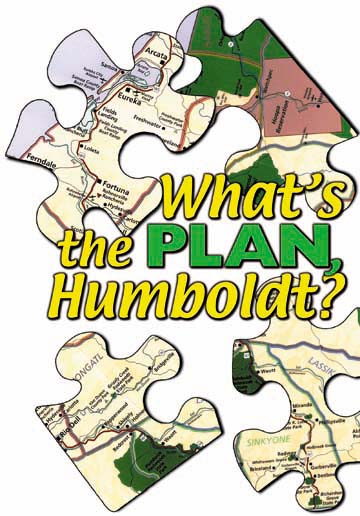
They are all pieces
to the same puzzle, a puzzle that will begin to take shape in
the coming weeks as the county presents a series of community
workshops.
![[photo of Bonnie Neely]](cover0907-neely.jpg) "This is the first time the
county is going to have an economic development component in
the General Plan," said Supervisor Bonnie Neely (photo at
left). "We felt that it was important that we tie it in
with spending the Headwaters money. Those two things are dovetailed
together. It's exciting to have the opportunity to update the
General Plan and have this money that we can put into the economy." "This is the first time the
county is going to have an economic development component in
the General Plan," said Supervisor Bonnie Neely (photo at
left). "We felt that it was important that we tie it in
with spending the Headwaters money. Those two things are dovetailed
together. It's exciting to have the opportunity to update the
General Plan and have this money that we can put into the economy."
"Even before
Headwaters came into the mix, the concept of blending land use
decisions with economic decisions made sense," said Supervisor
John Woolley. "Oftentimes they were seen as two disparate
trains of thought. Businesses go forward and land use planning
is seen as separate. We want to unite them.
"The General
Plan principles and framework are going to be key in making sure
that our policy decisions are guided by the community. These
meetings will give us some important input about how we should
judge our future growth."
Five regional public
workshops will begin next week. Each will have one or two county
supervisors in attendance. The workshops will begin with the
topic of how to spend or invest the Headwaters revenue, from
5:30 to 7 p.m. After a half hour food break, the workshop topic
will shift to discussion of the General Plan update from 7:30
to 9 p.m.
"What better
way to decide how we should spend this money in terms of developing
our community than to have a public process where everyone gets
to participate? We're dying to hear what people have to say about
their vision for the future of the county," said Neely.
The meetings will
be Tuesday, Sept. 12, at Trinidad City Hall; Wednesday, Sept.
13, at the Agricultural Center on South Broadway, Eureka; Thursday,
Sept. 14, at Masonic Temple in Garberville; Tuesday, Sept. 19,
at Mad River Grange in Blue Lake; and Wednesday, Sept. 20, at
Humboldt Bank in Willow Creek.
For more information
contact the Humboldt County Community Development Services Department
at 445-7541.
An interview with
Kirk Girard
![[photo of Kirk Girard]](cover0907-girard.jpg) Kirk Girard is director of the new
Humboldt County Community Development Services Department, formerly
the Planning and Building Department. The department is responsible
for traditional duties such as issuing building permits and conducting
inspections. It is also responsible for overseeing planning and
development for the Humboldt County Board of Supervisors under
state law and the county's own General Plan, which will be updated
over the next four years. As of last December, the department
was handed the addition charge of administering economic development
grants and programs. Kirk Girard is director of the new
Humboldt County Community Development Services Department, formerly
the Planning and Building Department. The department is responsible
for traditional duties such as issuing building permits and conducting
inspections. It is also responsible for overseeing planning and
development for the Humboldt County Board of Supervisors under
state law and the county's own General Plan, which will be updated
over the next four years. As of last December, the department
was handed the addition charge of administering economic development
grants and programs.
The Journal spoke
with Girard last week about plans for the future.
Let's begin with
this series of meetings coming up to discuss the Headwaters Fund
and the revision of the General Plan. What`s the plan?
The first part of
the meeting will be to tell the public what the supervisors have
done to date with the Headwaters Fund. Basically they've said
that they want all of it or almost all of it to be used for economic
development for the county. A small fraction went to pay off
some law enforcement costs and some timber yield tax losses,
but the bulk of the fund has been set aside in an endowment account
to be used for economic development.
How much money?
At 6 percent interest,
the $22 million endowment should generate $1.3 million in interest
a year.
The second thing
we'll do in these meetings is get input on where those monies
should be spent in the county. We'll provide everybody with an
opportunity to put in their two cents. There will be some descriptions
of the possible alternatives that are being considered for use
of the money, everything from infrastructure development to loans
to mini-grants in various areas such as reforestation, investment
in land for manufacturing uses. A whole range of options have
been talked about and contemplated. We'll talk about some of
those things to spark thinking. The results of those meetings
will be written up and presented to the Board in December offering
some alternatives about how the Headwaters Fund can be invested
or spent.
To what degree
is your department going to be involved in planning how the Headwaters
money will be spent?
This is under our
new department organization, Community Development Services,
which includes planning and the General Plan effort and also
economic development.
Is this actually
a reorganization or is it just a change in titles?
Economic development
used to be managed out of the County Administrative Office. At
the beginning of this year that division was moved over to the
Planning and Building Department and we changed the name.
Most people think
of the Planning Department as the place you go for building permits,
zoning questions -- land use issues. But you're talking about
something broader.
You may have heard
of "Prosperity," the comprehensive economic development
strategy. The plan was adopted by the Board of Supervisors about
the same time as our department was reorganized. It charts a
course for the economic development of the county.
In the end game
the spending of the Headwaters Fund should be consistent with
and linked to Prosperity!, the economic strategy. The board made
that clear. In comes the General Plan, it will ultimately be
consistent with "Prosperity." The two will work in
a complementary way.
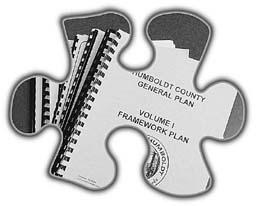 Isn't
the General Plan essentially a land use document? Isn't
the General Plan essentially a land use document?
It's better to call
it a development document. Believe it or not, land use is just
one chapter. Anything that has to do with growth or physical
development in the county needs to be addressed in the plan.
That's everything -- transportation, schools and education, safety
including geologic hazards, earthquake preparedness, tsunami
hazards, public services and utilities -- all of those things
are related to the growth of the county.
When you say
the county, does that exclude the incorporated cities?
In terms of jurisdiction,
yes it does. Each incorporated city has its own general plan
that is the constitution for development within the city. The
county's general plan has to consider all of the general plans
within the county and try to develop some sort of coherent whole
to the planning.
Isn't McKinleyville
just about done with its own General Plan that will be part of
the larger plan?
That's technically
a "community plan" within our General Plan. But you
take a situation like Arcata where they have sole jurisdiction
to adopt their own general plan. The county reviews it and there
is a mechanism to deal with the area right around the city, it's
called the "sphere of influence." We work very closely
with the city to make sure that what the county is doing is consistent
with what the city wants to do in the long run. We have these
spheres of influence around each city and those are coordinated
in our general plan.
Prior to the
upcoming public meetings you have been meeting with some community
groups. Which ones have you talked to?
We've met with the
Farm Bureau, we had a pre-meeting the Northern California Homebuilders
and will have another meeting, Humboldt Economic Prosperity Forum,
the Humboldt Watershed Council, the Sierra Club. ... It's quite
a long list. I think we have seven or eight groups under our
belt so far. We're meeting with the Manila Community Services
District Board some time soon. [Other groups include the Audubon
Society, North Coast Growers Association, the Board of Realtors,
Northcoast Environmental Center, the Agriculture Advisory Committee
and the City of Trinidad.]
Those are all
special interest groups, each with its own agenda.
That's right. Let
me draw an analogy. We just completed a community plan for the
Avenue of the Giants, Miranda, Phillipsville, that area. It was
an action-oriented plan. As you can imagine the growth rate down
there is not that large. So we got together with the whole community
and asked, What projects would you like to see? A few rose to
the surface. One was, "We need a summertime bridge to Stafford,"
another was "We need better emergency protection services,"
"We need trails," "We'd like to work more closely
with the park [Humboldt Redwoods] on its planning." We formed
these committees with people who really wanted to do something
for the community.
Then we came in
with the planning document to make it so they could attain their
goals rather than have to fight with an adopted plan. The idea
was to assess the dynamic in the community and reflect that in
the plan. We're trying to scale up that basic model to the county
level. We're going to groups that have agendas, that have ideas
and a vision for where they would like the county to go. We're
saying, "What is it? Can we accommodate your vision in the
overall plan?"
What are some
of the things that have come up in your advance meetings?
One is having a
regulatory framework that recognizes the needs and impact of
micro-businesses. There are a lot of businesses with just one
or two people trying to make a go of it, yet they have to go
through the same regulatory process and comply with the same
guidelines as a well-heeled business. That can stop a business
in its tracks. Say they can't afford a $3,000 permit process,
or it drives them underground. They end up working out of their
garage because they can't really legitimize themselves. Often
for micro-businesses the regulations are overkill, but we've
got a one-size-fits-all regulatory process.
Another common theme
is quality of life. What is that? How do we identify it and preserve
it with land use policies? That includes questions like, What
do we do with the forest lands immediately surrounding our towns?
What about subdivisions design? Trails? What kind of retail should
we have? Do we have viable downtown centers?
You're talking
about what people would like to see in the future, but isn't
the General Plan essentially a regulatory framework?
That's a good question.
The General Plan is the big picture trying to -- as clear as
we can -- describe what we want the county to be like in 20 years.
The regulatory framework gets you there. That actually comes
later. The basic package consists of a vision of the future and
the policies that will get you there, and the policies are fairly
broad. It could be something like we want a subdivision where
people can ride bikes and walk around, that's part of the subdivision
design. Then you get to the next level, what you call "regulatory
framework." After policies, you develop specific standards.
If someone wants to come in and design a subdivision, you can
give them a piece of paper that says, "For a subdivision
of four lots or greater we would like to see individual trails
linking every lot." That's linked to the community plan.
But when it says,
`We would like to see,' it doesn't mean you have to do it?
That's right. You
put "shall." In fact in the regulatory framework we
have now and even in our policies, some are advisories and, "Gee,
wouldn't it be nice?" One way to clean up the documents,
so that you're clear on what goes and doesn't go, is to have
clear understandable rules that people know they will have to
abide by. We're going to move to try to eliminate all of the
advisory "feel good" policies and stick to those that
are going to be implemented, rules that are going to get us where
we want to go. And we think that in doing that we will be able
to reduce the volume of documents dramatically.
 When
it comes to something like zoning, it seems that getting around
the General Plan is easy. Variances are routinely granted. Once
you make these new planning rules, will people actually have
to follow them? When
it comes to something like zoning, it seems that getting around
the General Plan is easy. Variances are routinely granted. Once
you make these new planning rules, will people actually have
to follow them?
The best way to
make sure that decisions are made according to plans is to have
good, viable, fresh plans that everybody has subscribed to. Our
framework plan now is a 1984 document, so it's somewhat out of
date. And it didn't necessarily benefit from a sense of vision
about where the county is going to go. I'd say it was intended
to meet state mandates for regulatory framework land use decisions,
but it didn't capture people's imaginations in the sense that
we do have things to preserve in Humboldt County. We want to
make sure that we don't turn into another -- pick a town -- Sacramento,
Roseville, Santa Rosa, some people are even starting to say Ukiah.
The trend is somewhat clear in terms of the effects of development
pressure in California when you don't have a plan that you abide
by, one that suits the circumstances.
How long do you
expect this process to take?
We want to be done
in three or three and a half years. The plan will have a 20-
to 30-year time horizon. We're calling it "Humboldt 21st
Century."
A citizen's advisory
group has been working on a revision on the McKinleyville General
Plan for years. Will there be a similar community-based committee
working on this?
We're not going
to have that sort of advisory committee on the policies. We are
working with an informal group of people talking about the process,
how public involvement occurs, the format of the reports and
communications. So we are getting advice on the process from
citizens at large. But we're putting the Planning Commission
and the Board [of Supervisors] in the position of being `the
committee' instead of just being decision makers at the end where
they are sort of the final judge and jury that sorts out all
the controversy. We'll have them attending the community meetings,
the workshops, the summit meetings that we'll have. I think we'll
get better decisions at the end if they're involved in the process
from the beginning.
IN
THE NEWS | GARDEN | ARTS! ARCATA | CALENDAR
Comments? E-mail the Journal: ncjour@northcoast.com
© Copyright 2000, North Coast Journal,
Inc.
|