|
 
Story & photos by ARNO HOLSCHUH
THE INTERNAL COMBUSTION ENGINE
WORKS BY HARNESSING miniature explosions. Gas, mixed with air,
is ignited by a spark plug and blows up, providing energy that
moves the wheels of a vehicle.
One isn't often reminded about
exactly how engines work since the average commuter vehicle has
been muffled and tamed to the point where it can barely be heard.
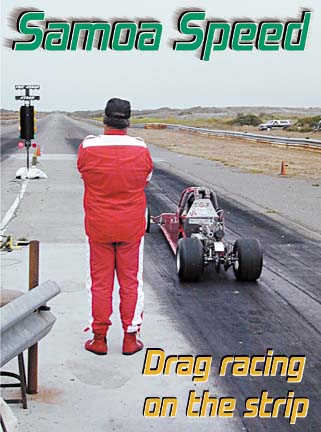
But sit by the starting line at the Samoa drag strip and the
engine's explosive nature is brought home. The cars and motorcycles
lining up to test their speed on the quarter-mile track are so
loud you not only hear the noise, but you feel it in your guts.
In the final second before the green light releases the racers,
the deafening staccato reports of individual cylinders blur into
a growl.
Then they take off. It seems
that your mind must be playing tricks on you, because there's
no logical way that cars that were 30 feet away mere moments
ago could now be tiny little specks at a distance of a quarter
mile.
It happens hundreds of times
during each of the 10 days every summer when the drag strip is
open: Two cars or motorcycles line up to race, and seconds later
one wins and the other is eliminated. Gradually it dawns on you
that yes, these cars really are that fast.
It is for those seconds between
starting light and finish line that more than 100 drag racers
from across California, Oregon and Washington gather on the Samoa
Peninsula.
![[photo of Butcher]](cover0830-butcher.jpg) "Your eyes get about that big when
you're going down the track," said Bill Butcher (photo at left) as
he holds his fingers an impressive three inches apart. A teacher
from Nice, Calif., near Ukiah, Butcher came to Samoa Aug. 19
to race his canary yellow '69 Chevy Nova. "Your eyes get about that big when
you're going down the track," said Bill Butcher (photo at left) as
he holds his fingers an impressive three inches apart. A teacher
from Nice, Calif., near Ukiah, Butcher came to Samoa Aug. 19
to race his canary yellow '69 Chevy Nova.
"You can't think, it's
such an adrenaline rush. It's like an amusement park ride, only
with automobiles," Butcher said. "And I'm driving."
For Butcher, racing at Samoa
is more than just a thrill. A Eureka native, he used to come
watch the races as a young man.
"I was so poor going to
high school and college. We didn't have the money for a car.
A lot of my friends had cars, but I could never afford one."
Instead of racing a car, he
and a friend would sneak up over the sand dunes that surround
the drag strip to watch. He would marvel at the cars that went
by and the sounds they made. "It was awesome, just awesome,"
he said.
Drag racing lay dormant in Butcher's
life for the next three decades. He eventually had the resources
to buy a drag racer but let it slip from his list of priorities.
A few years ago, he realized
that racing "was still something I wanted to do. It was
something I had wanted to do for more than 30 years. I decided
I'd go drag racing. I ended up going to Sacramento and buying
this car."
![[Photo of Glan Terry]](cover0830-vegaman.jpg) While Butcher waited 30 years to
fulfill his fantasy, Glen Terry (photo
at right) has spent almost 50 continuous
years behind the wheel of dragsters. The Oklahoma native and
Oroville resident started racing in 1953 and has been building
and racing dragsters ever since. While Butcher waited 30 years to
fulfill his fantasy, Glen Terry (photo
at right) has spent almost 50 continuous
years behind the wheel of dragsters. The Oklahoma native and
Oroville resident started racing in 1953 and has been building
and racing dragsters ever since.
"I've been drag racing
all my life," he said in a flat drawl. "I don't fish,
don't hunt, don't drink, don't bowl -- I just race."
And he's still good at it. Don't
let his kind smile or his 67 years fool you; this man still has
what it takes. He's cleared $2,800 in prize money in his '71
Vega this year alone.
Even with a winning season like
that, Terry said drag racing is not a profitable venture. He
constantly works on his car and said a dragster is a serious
investment of time and money. Add to that the cost of towing
the car to a drag strip -- the stripped down and rebuilt car
is illegal to drive on the street -- and "you're doing all
right if you make back expenses," he said.
"If you're in this to make
money, you're in the wrong business," he said.
Terry said it is the human factor
which keeps him in racing. "I do it for the people,"
he said. Drag racers are "a good bunch. If you break a part
or something, they're there to help you figure it out. After
the races, you go have pizza together. Good people."
That is especially the case
at Samoa, Terry said. He has to drive 300 miles to reach the
strip, but he comes here "more than any place else I race."
His motivation is more than
humanistic, however. Part of the reason racers love Samoa is
the atmosphere -- literally. The cool wind blowing in from the
ocean helps the cars work harder without overheating. The air
at sea level is richer in oxygen than that in high-altitude locales.
Both factors translate into faster times.
"They run pretty fast out
there," he said.
Just how fast is "pretty
fast"?
"Well, my dragster runs
about 126 miles per hour by the time I reach the quarter mile,"
said Dale Waddell. What's even more amazing than his speed is
how quickly he reaches it -- in about 10 seconds.
![[photo of Waddells with dragster]](cover0830-waddell.jpg) Dale and Cody Waddell work on the family dragster Dale and Cody Waddell work on the family dragster
Waddell achieves that performance
in a car that could have come out of Dr. Frankenstein's laboratory.
It has the body of a roadster, the large engine of a full-size
pickup truck, a homemade front suspension, giant back wheels
and a steering system harvested from a Volkswagen Rabbit.
The relationship Waddell has
with his drag racer is quite different from the one most people
have with their cars. He knows it from the inside out -- he has
to in order to keep it running. While Waddell claims that his
car was built to be "low-maintenance," he still has
to climb under it regularly to make sure all the bolts are tight.
And the engine gets a lot of
wear. Often it isn't driven for weeks, then it's taken out and
pushed to the absolute limit. Waddell said the motor is currently
in need of what he calls a "freshening up," which includes
checking the bearings, piston rings, and gaskets -- in
other words, a major overhaul.
![[photo of Waddell family]](cover0830-family.jpg) The
Waddell family with their racing The
Waddell family with their racing
trophies. From left to right, Cody,
Robbie, Debbi and Dale.
How long can an engine go between
"freshenings"? After some quick mental math, Waddell
answers: About 100 miles.
Waddell is good at driving his
creation -- he won the overall points championship in his bracket
for three years straight in the late '90s. He's currently in
second place.
But he's more than a champion
racer; Waddell is also president of the Samoa Drag Strip. That
puts him in a unique place to wax philosophical about the nature
of drag racing.
"You don't get second chances
in drag racing," he said. Because the entire race is over
in a matter of seconds, "you get no time to make up for
mistakes. You win suddenly and lose suddenly."
That makes one thing key to
success in a drag race: concentration. Getting off the starting
line as soon as you get the green light often wins a race.
"You think to yourself,
`How hard can it be to wait for a light to go?' Thing is, you
have nothing in your mind for 15 seconds except waiting for that
light. That's hard -- the hardest part of drag racing. You really
have to pump yourself up."
When you are sitting at the
starting line staring at the light and waiting for it to turn
green, "what you're trying to do is look into the light
bulb and see the filament as it lights up. If you're not looking
at that, you're too late. If your focus isn't incredibly intense,
you lose."
Waddell is trying to pass his
keen focus and concentration on to his two sons, Cody and Robbie.
Both come to Samoa not only to watch their father race but to
race themselves.
Cody, 17, races the same '68
Chevy Nova his mother drives to the grocery store. Robbie races
in a "junior dragster," a miniature version of a dragster
powered by a lawn-mower engine.
"Drag racing is very family-oriented,"
said the elder Waddell. "You can start your kids as young
as 8 years old."
Many do. When the junior dragsters
race, parents -- many of whom are waiting to race in their grown-up
cars -- stand along the fences to cheer their kids on. While
the junior dragsters don't achieve anywhere near the speed of
a their full-size cousins, the same rules apply: Two people start
the race, but only one can win and go on to the next round.
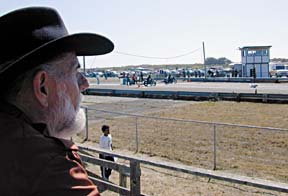 Whether
junior or full-size, drag racing brings the spectators on the
weathered bleachers next to the track to the edge of their seats.
Like the drivers, they've come to experience that brief snatch
of time between start and finish. Whether
junior or full-size, drag racing brings the spectators on the
weathered bleachers next to the track to the edge of their seats.
Like the drivers, they've come to experience that brief snatch
of time between start and finish.
Being a spectator lets him relive
his days as a racer, said Fortuna resident Darell Arrasmith (photo at right).
Arrasmith, now 62, said his
drag racing days are over --"It's what I did in the '50s
and '60s" -- but he still loves to come out to watch the
cars run.
And the noise?
"It's good. You can hear
the power."
How to win
a drag race in a Geo
WATCHING THE FAST CARS ZIP down
the stripe of asphalt in Samoa as if they were fired from a slingshot,
you can see the love of speed. These are cars with engines modified
beyond recognition, cars whose seats have been removed and body
panels replaced to save weight, cars that were built to transport
exactly one person exactly a quarter of a mile -- nothing more
-- all in the name of speed.
And the funny thing is that
speed doesn't matter. The type of drag racing done on the Samoa
strip levels the playing field for slower cars through a handicap
system.
Each driver estimates the amount
of time required to run the quarter mile, a process called "dialing
in" a time. When two cars race, the slower car gets a head
start equal to the difference between the faster car and slower
car's estimated times. If a driver finishes faster than the estimated
time, he or she loses.
It sounds complicated, but try
this example: Joe, driving a Geo Metro with a leaky head gasket,
can putter his way through the quarter mile in 20 seconds. Jane,
in a supercharged Mustang, can make it in 10 seconds. That means
that Joe's light will turn green 10 seconds before Jane's.When
Jane's light turns green, she has to try to catch up. If Joe
finishes in 20.01 seconds and Jane finishes in 10.02, Joe still
crosses the finish line first.
Of course, Jane could have simply
have fibbed and said she would finish in about 11 seconds --
that way, Joe would only get a nine-second head start and Jane
could easily beat him to the finish line. But if she did so by
finishing in less than 11 seconds -- if she was quicker than
she said she would be -- she loses.
It is a system that rewards
people who know how fast their cars are and then drive them consistently.
It doesn't really matter how fast you are; as long as you finish
in exactly the amount of time you said you would, you are almost
invincible.
![[photo of race]](cover0830-handicap.jpg) The
handicap system in place at the Samoa drag strip often results
in odd matchups, like this one between Mike Hagedorn's Datsun
batchback and Victor Ruelas' Thunderbird. The
handicap system in place at the Samoa drag strip often results
in odd matchups, like this one between Mike Hagedorn's Datsun
batchback and Victor Ruelas' Thunderbird.
Important to a good estimate
is getting off the starting line exactly when the light turns
green. As soon as you get the green light, the clock is ticking.
If you sit for half a second at the light after it turns green,
you have to make that half a second up before the end of the
quarter mile.
Good racers, said track President
Dale Waddell, will have a reaction time measured in hundredths
of seconds.
"Consistency and a good
light win the race," he said.
That said, few racers could
be convinced to give up their souped-up cars and motorcycles
for sensible sedans with good gas mileage. It goes against the
grain of the sport. Even if it's not necessary for winning, driving
fast is the heart of drag racing.
"It's an adrenaline roller
coaster," Waddell said.
IN
THE NEWS | ARTS ALIVE! | CALENDAR
Comments? E-mail the Journal: ncjour@northcoast.com
© Copyright 2001, North Coast Journal,
Inc.
|