 
by BOB DORAN
ALMOST EVERYONE TAKES ALONG
THEIR CAMERA WHEN THEY GO on vacation. We shoot photographs of the places
we go and the things we see to preserve the memories for ourselves and to
share them with others.
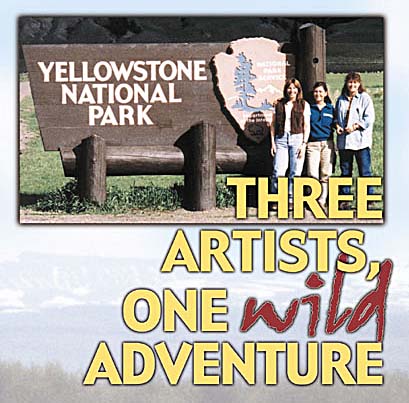
When Paula Golightly, Linda
Parkinson and Susan Fox took off together last year on an adventure into
the wilds of North America, they took their cameras along. But they also
took sketch pads, brushes and paints. The three women are wildlife artists
and the images they gathered on their journey would become reference material
for later paintings.
Throughout the month of August
their paintings will be on display at William F. Cody Gallery in Eureka
along with some of the sketches and photos that inspired them. Saturday
night, Aug. 5, as part of this month's Arts Alive!, the gallery will host
a reception for Fox, Parkinson and Golightly.
The story of their journey begins
in 1997 when the women met at a painting workshop held by world famous wildlife
painter John Seerey-Lester.
"It was in -- of all places
-- a Holiday Inn in Livermore," said Fox. "I went down and on
the first day we were going around the room doing introductions. I said,
`I'm Susan Fox, I'm from Arcata,' and then there was Paula Golightly from
McKinleyville and Linda Parkinson from Arcata.
"We all looked at each
other -- Paula and Linda had known each other for a number of years and
had come down together -- I had known their names but I had never met either
of them."
Parkinson and Golightly met
at Humboldt State University where both were pursuing degrees in wildlife
studies. Both women did wildlife painting on the side and, by coincidence,
they shared another common experience: Golightly was exhibiting her work
at Mad River Community Hospital, Parkinson was showing at General Hospital
and each had a painting stolen off the wall.
![[photo of artists on location]](cover0803-artists.jpeg) "We called each other up to compare notes
and commiserate wondering if there might be some connection [between the
thefts]," said Parkinson. "Unfortunately we never did get our
paintings back. I hope whoever took them appreciates them." "We called each other up to compare notes
and commiserate wondering if there might be some connection [between the
thefts]," said Parkinson. "Unfortunately we never did get our
paintings back. I hope whoever took them appreciates them."
As a friendship developed they
started doing shows together.
"It's a lot easier that
way," said Parkinson. "Paula was working full time as a wildlife
biologist so that didn't leave her a lot of time, and I would encourage
her by inviting her to come join me. It was a lot more fun putting on a
show with someone else."
Fox was delighted to find not
just one but two women from her own neighborhood with common interests and
as the workshop progressed they became friends. The bond continued when
they returned to Humboldt and led to several group exhibits.
In the spring of 1999 the women
heard about a workshop with Seerey-Lester and another wildlife artist, Paco
Young, at the Beartooth School of Art in Montana. The setting seemed perfect
-- a camp along the Boulder River north of Yellowstone National Park near
a town called Big Timber.
It only took a couple of phone
calls for the three artists to agree that they should go together. And instead
of flying they decided to take a leisurely drive allotting four days travel
time each way.
"We wanted to take the
long way there, stopping at different areas where there is wildlife,"
said Golightly.
Fox said that one of the things
that made the journey so much fun was the fact that, "We all wanted
to stop at the same places. We were so in tune with each other. It was wonderful
being on the road with people who were willing to stop for any little song
bird."
One of their first stops was
the Malheur National Wildlife Refuge near Bend, Ore., a large wetland area
where they spent a day and a half communing with the birds.
"We looked through our
binoculars and identified the birds we saw -- white pelicans, sand hill
cranes, white-faced ibises, all types of waterfowl, geese and ducks,"
said Golightly.
One of the images she chose
to put on canvas was a trio of ibises she sketched at Malheur. "They
were in large groups eating in the tall grass areas in the marsh. We stopped
and watched them preening and displaying to each other. They were in their
breeding plumage. We watched their behavior and interactions and did sketches
and photographs.
"We were there in the late
afternoon and in the morning and I tried to capture the feel of the light;
it sets a mood and helps portray the essence of these birds."
![[art]](cover0803-art.jpeg)
Left, "Nervous New Parents"
by Linda Parkinson;
top right, "Ibis Afternoon"
by Paula Golightly;
bottom right, "Brown Velvet"
by Susan Fox.
While all three women shot scads
of photos all along the way the paintings they created afterwards are more
than photo perfect reproductions of what they saw.
"I use photographs as one
of the tools to help jog my memory," said Golightly. "It's usually
more to capture something about the lighting or a suggestion of what some
of the colors were.
"You see something striking
like that and you get ideas. Basically you want to create a sense of what
you saw, but the painting is based on what's in my head, not what's in a
photograph."
"I take pictures of everything
I can," said Fox. On the journey to Montana she took along two Nikon
camera bodies, a 500mm mirror reflex lens and a 28-200 zoom with a macro,
"and as much film as I could carry."
Fox says she was more restrained
than usual on the northwestern trip -- she only shot 20 rolls. Most of the
pictures will go into the massive reference files she keeps in her studio.
Some -- like the picture of
the elk -- are just the image she wanted. It became a painting almost as
is. Almost. The painting has a heightened realism and a depth that a photo
does not.
Fox feels a bit uneasy when
someone admires one of her pieces by saying, "It looks just like a
photograph."
"It's not a copy of a photograph.
This is my point of view. This is my opinion about what I saw. My training
as an illustrator is to always do everything at 110 percent. If you are
doing a picture of an apple you make it the most wonderful, juicy, appley
apple that anyone has ever seen.
"Sometimes I want to paint
a specific animal, sometimes it's the shapes I see in a landscape. In others
I want to try to capture a particular light quality: morning light or afternoon
light or a day when the rain is coming in, cloud shadows and sun on the
mountains and all sorts of different light effects.
"And as a painter -- especially
when I'm painting an animal -- I always try to paint the individual -- not
just a generic elk, I want to paint that elk, at that moment -- in his velvet,
coming up over the road in the morning light -- remembering how it felt
to be there watching him."
Most of the paintings that come
from the trip will draw from several pictures while others begin with a
sketch. An example is Parkinson's painting of a bison in Yellowstone, a
painting that draws reference from six photographs and from her memory.
![[photos and painting]](cover0803-buffalo.jpeg)
All three artists shot and swapped photos for reference.
These photos contributed to Linda parkinson's painting, "Last Season's
Survivors" at right. (Acrylic, Yellowstone National Park)
"I've studied
anatomy and physiology extensively so these creatures are familiar to me
and I know their habitat. It gives me an advantage over someone who likes
art and wants to be a wildlife artist but who doesn't know about the reality
of the creatures: what they look like and how they move. Just looking at
photographs you get a totally different impression from when you see a living,
breathing creature."
One of Parkinson's reasons for
taking the Montana workshop was to learn more about acrylics after working
for years in watercolors. The transition was not too hard, particularly
since Seerey-Lester uses thin glazes of acrylics almost as if they were
watercolors. Her plan paid off: She has produced 11 new acrylic works for
the Cody Gallery show.
All three women agreed that
even though the workshop in Montana was the reason for the journey, it was
not exactly the highlight of the trip.
"One thing we were looking
forward to was going out in the field to watch the instructors paint plein-air,"
said Parkinson, "but the weather didn't cooperate."
It rained most of the time they
were there and in fact one day it even snowed. As a result the classes were
all held inside. With 60 students in the group there was not much one-on-one
contact.
The images and experiences they
gathered on the way to and from Montana more than made up for any shortcomings
of the workshop itself. In the course of the trip they saw 84 species of
birds and examples of most of the large mammals that still survive in the
northern states.
One of the things they all wanted
to see was the wolf population that had been reintroduced to Yellowstone's
Lamar Valley.
"We got up at 5 in the
morning -- no coffee, no breakfast, no nothing. We dragged each other out
of the motel in Gardner and piled our stuff in the car for the drive to
the Lamar Valley," Fox recalled.
"We got there around 6
and all the wolf groupies were already there with their spotting scopes.
There's one pack of wolves that doesn't seem to care how visible it is.
About a week before we were there the pack had run an elk down the length
of the valley, killed it and ate it in front of 20 or 30 people.
"It's this wide glacial
valley with gently sloping sides and trees growing on some parts. The sky
was blue. Everything was frosty. The foreground was still in shadow and
the sun was sparkling off the hoarfrost on the sage. It was absolutely spectacular.
"We didn't see any wolves
that morning but directly across from us we saw a grizzly bear sow with
her two cubs on an elk kill. We watched them for awhile, then drove into
Silver City for breakfast."
In the evening they returned
to search for the wolves and actually caught a glimpse of them before the
crowd of avid wolf watchers chased them off.
Driving on into the night talking
about the day's activities they were surprised by three female elk standing
idly in the middle of the road. The elk ambled into the brush and, with
Golightly at the wheel, they resumed the journey.
"We were just about to
the point where our heart rates were back to normal when all of a sudden
-- boom -- there's something else in the road: a full grown mountain lion
with a radio collar and a tail about 10 feet long. It just goes -- whoop,
whoop, whoop -- across the road in front of us, never hesitating, not even
in a hurry. That's something you don't see every day."
After returning home the three
artists have embarked on another joint journey. Besides working together
to assemble the show at the Cody Gallery they have become partners in a
small business called Huckleberry Arts, marketing art cards of their wildlife
paintings.
"Having artist friends
who like to paint together and do things together is one thing," said
Parkinson, "being able to work out the business end is better. We pool
our resources, our time and our finances, and it makes it all so much more
workable. It's easier -- and it's more fun."
IN THE NEWS | CALENDAR | ARTS ALIVE! | EDITORIAL
Comments? E-mail the Journal: ncjour@northcoast.com
© Copyright 2000, North Coast Journal, Inc. |