|
 
by ARNO HOLSCHUH
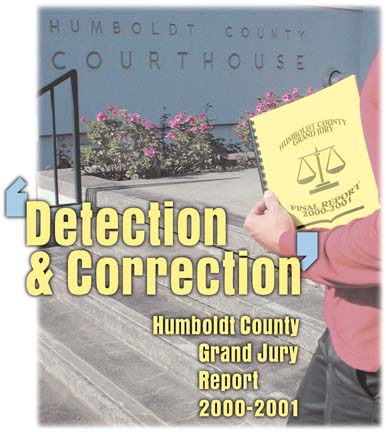
 According to the introduction to its 2000-2001
report, the Humboldt County Grand Jury is "an investigative
body having for its objective the detection and correction of
flaws in government." According to the introduction to its 2000-2001
report, the Humboldt County Grand Jury is "an investigative
body having for its objective the detection and correction of
flaws in government."
But how does one do that?
Endowed with powers far exceeding
that of a member of the public, the Grand Jury has access to
all government records except personnel files and can subpoena
witnesses. Acting on the basis of complaints from county residents,
the body reviews correctional facilities, interviews officials
and explores those corners of government that the ordinary citizen
has neither the time nor the resources to inspect.
"We are an arm of the Humboldt
County Superior Court, but we are servants of the citizens of
Humboldt County," said John Westrick, foreman for the 2000-2001
jury.
Westrick said that for all the
jury's powers to investigate, its efficacy as a government watchdog
is being hampered this year. The jury wasn't budgeted enough
money by the county it investigates to publish its annual report
as it normally does -- as an insert in the Times-Standard.
This year for the first time the Grand Jury is distributing
copies at the library and over the Internet.
When included in the daily newspaper,
more than 23,000 copies of the report were printed and distributed.
This year, Westrick said, just 120 hard copies are in circulation.
Karen Suiker, assistant county
administrative officer, said, "It certainly wasn't the intention
of the county to reduce availability." She said the availability
of the report on the Internet should offset the lack of printed
copies.
Westrick's response is that
many civic-minded people -- including himself -- do not have
easy access to the Internet.
"I think it's a mistake,"
he said. "There's an awful lot of people out there who won't
get the information."
In an attempt to get information
gathered by the Grand Jury over the last year in wider circulation,
the Journal takes a look at three of the 18 topics covered
in the report. While not complete, this report takes some of
the topics the jury considered important to Humboldt County and
shoves them into the limelight.
Which, Westrick will tell you,
is right where they belong.
Misinformation Services?
![[photo of computer]](cover0719-computer.jpg) What would you say about a computer
services firm that delivered products late, wrote programs that
didn't work, lost data crucial to your job and billed you in
an erratic fashion? What would you say about a computer
services firm that delivered products late, wrote programs that
didn't work, lost data crucial to your job and billed you in
an erratic fashion?
"Goodbye," probably.
But imagine this: You cannot fire the firm and look for help
elsewhere, because your company requires you use this firm and
this firm alone.
Workers at various county agencies
have been living in just that digital nightmare, according to
the Grand Jury report on the Information Services Division of
County Administrative Services. The report alleges theft, incompetence
and inefficient organization at the county's in-house information
technology service, listing 21 separate problems identified by
interviewing county staff.
"It appears to me that
it has caused county workers confusion and a loss of efficiency,"
said Westrick.
That appearance of inefficiency
and incompetence is false, said Lindsey McWilliams, Humboldt
County's administrative services director who is responsible
for overseeing Information Services.
"I've been involved with
Grand Jury reports for 10 or 11 years," he said, "and
my general observation is that sometimes they do a halfway decent
job and sometimes they don't. This is an example of one of the
times they didn't."
The allegation that there have
been reports of missing or stolen equipment, for example, may
be true but is unconnected to Information Services, he said.
There was a recent case where a courthouse custodian had been
stealing computer components. Not only did those thefts occur
outside of Information Services, but the person responsible "has
been tried and convicted," McWilliams said.
The report further states that
programmers take too long to install or modify software. But
McWilliams said that while isolated incidents of computer glitches
are inevitable, Information Services has generally done a good
job. A programmer working with the Social Services branch of
the Health and Human Services department, for instance, will
be trying to please hundreds of different users at the same time.
"The programmer may be
wrong with a few of the users, but not all of them," McWilliams
said. "To take a specific complaint and apply it generally
is grossly unfair."
One of the most serious allegations
is that Information Services lost warrant information for the
sheriff from the state's computer system, which could result
in "false arrests or incorrect booking of a subject,"
according to the jury's report.
But it isn't true, said Brad
Walden, manager of Information Services. "There wasn't any
warrant information lost."
Walden said the allegation that
warrant information was lost originated during the county's year
2000 -- Y2K -- conversion. For about a week the computer program
that the county used to receive information from the state failed
to show all of warrant information. Although the information
was not displayed, it was not lost and "not critical. It
was stuff like a person's mailing address."
"Everyone was well aware
no information was lost," Walden said. "I was amazed
when I saw this [in the jury's report]."
"Misinformation and misunderstanding"
lay at the root of the Grand Jury's report on Information Services,
Walden concluded. "I don't want to be impolite, but they
[Grand Jury members] are all retired. Computers are over their
head."
But some of the jury's ongoing
concerns are echoed by others in the community who do understand
computers. Chris Crawford, owner of an Internet consulting company,
Justice Served, and an unsuccessful candidate for 1st District
Supervisor last year, said he learned through his own business
dealings with the county that its information technology system
is outdated, inefficient and costly to maintain. The county continues
to waste money by being so slow to innovate, he said.
There has been some improvement.
Five years ago the Grand Jury -- and an independent consulting
firm hired by the county -- were highly critical of information
services and its outdated mainframe system. The county has moved
to a system where many smaller servers perform the function of
the old central mainframe, which has been removed. Most of them
are located at Information Services, just across 4th Street from
the courthouse.
Even though the mainframe is
gone, the Grand Jury still receives complaints about the availability
and reliability of the information stored at Information Services.
When he ran for office last
year, Crawford recommended that the county contract out to a
private firm for information services, a suggestion he said was
not well received by county union employees.
This year's grand jury suggests
a less drastic solution -- more decentralization. Instead of
storing information with Information Services, individual departments
would have their own independent servers. Some departments, like
the tax collector's and auditor's offices, have already moved
to such a system. Treasurer/Tax Collector Stephen Strawn said
that working apart from Information Services has been good for
his department.
"Working somewhat independently,
we are able to get timely deliveries and installation of our
hardware and able to get more timely upgrades of critical software,
like virus protection; and able to manage either development
or changes to existing software programs within the department,"
Strawn said.
McWilliams said decentralizing
by installing independent servers in each department was "stupid."
"It's the most expensive
way to organize the county." If you give the sheriff an
independent server, "how many technical staff are you going
to give him to support it?"
Walden agreed, saying said the
Grand Jury simply hadn't understood much of what it was faced
with.
"I think information technology
is very complicated and Information Services is not a simple,
straightforward fast-food type service," he said. "I
haven't seen a grand jury in the last 10 years that had a grasp
on information technology."
Parking & Access
![[photo of disabled symbol in parking lot]](cover0719-parking.jpg) The Americans
with Disabilities Act has created fear and uncertainty in the
business community since it took effect in 1992. The ADA law
can make building users and/or owners liable for large legal
settlements but it is notoriously hard to understand and often
prohibitively expensive to comply with for small business owners.
(See Access
and Dollars, Journal cover story,
March 8.) The Americans
with Disabilities Act has created fear and uncertainty in the
business community since it took effect in 1992. The ADA law
can make building users and/or owners liable for large legal
settlements but it is notoriously hard to understand and often
prohibitively expensive to comply with for small business owners.
(See Access
and Dollars, Journal cover story,
March 8.)
The rules governing handicapped
parking, however, are "easy to understand," said Jim
Hogue of the Humboldt Access Project.
"This is not a complicated
issue; it is not one of the vague sections of the ADA. It is
clearly stated," Hogue said. There are exact ratios of handicapped
to regular parking that are to be maintained in all public lots.
Why, then, hasn't the city of
Eureka included enough handicapped-accessible spaces?
The Grand Jury report shows
that 32 of the city's 37 lots are out of compliance with the
ADA, either because there aren't enough spaces reserved for handicapped
individuals or not enough of those spaces are usable by vans
that lower wheelchairs to the ground.
The city is trying, said Brent
Siemer, city engineer for Eureka.
"We have an ongoing program
of resurfacing parking lots, and as they come up we evaluate
the ADA standards at the time," he said. Some lots are out
of compliance because they haven't come up in the resurfacing
rotation.
"I'm not expecting it to
take a terribly long time," Siemer said. He guessed Eureka
would be able to bring all its lots into compliance within three
years.
Arcata "meets and in some
cases exceeds" ADA requirements for parking lots, said Frank
Klopp, public works director for the city.
Eureka's northern neighbor has
already provided the legally necessary spaces as part of a transition
plan authored in 1992. The plan details and prioritizes the steps
necessary for the city to come into compliance with the ADA.
"We've already done the
easiest things," Klopp said, including repainting parking
lots.
There are more difficult things
on the horizon. The Grand Jury report found that while Fortuna,
Arcata and Eureka all have transition plans, none of the three
cities is in compliance. Eureka's transition plan, written in
1994, showed the city removing all barriers to accessibility
by 1998. According to the Grand Jury report, 10 of 40 barriers
have been removed to date.
But the cities are not turning
a blind eye to accessibility, Hogue said. He has started serving
on the Eureka parking committee and said he sees "a willingness
in the city government" to accommodate disabled parking.
And Arcata is considering a
plan that brings handicapped parking to the Plaza but reduces
the number of parking spaces -- already at a premium.
Klopp noted there is no requirement
to put handicapped parking on the street, but the city was willing
to designate up to six spaces as handicapped -- reducing the
total number of spaces on the Plaza by three. The plan is on
hold until downtown merchants can be polled, Klopp said.
More rooms, more money
The good news is that most of
the problems the Grand Jury identified at Juvenile Hall have
been fixed. The kitchen was cramped; it's being remodeled. There
was no secure intake area; one is being built. Improvements are
on the way that should make the facility safer and more effective.
None of which addresses the
over-crowding.
![[photo of cots in juvenile hall]](cover0719-juvicots.jpg) "We provide cots
in our day rooms and sometimes double them in the single rooms
when we find two people who can live together," said Jim
Fairbanks, manager of the facility (In bottom photo).
He said Juvenile Hall, designed to hold 26, regularly has four
to six children too many. (See
photo at right) "We provide cots
in our day rooms and sometimes double them in the single rooms
when we find two people who can live together," said Jim
Fairbanks, manager of the facility (In bottom photo).
He said Juvenile Hall, designed to hold 26, regularly has four
to six children too many. (See
photo at right)
The crowding isn't just about
the comfort of the individuals housed in Juvenile Hall, Fairbanks
said -- it is having an effect on the function Juvenile Hall
serves.
"Normally it is someplace
to hold a person while they are going through the court process,
or to provide a wake-up call and some time away from controlled
substances," Fairbanks said.
Now, he said, "There are
so many violent offenders that we have to let property crimes
go." Fairbanks said he has a "population meeting"
with the rest of Juvenile Hall staff once a day to "assess
which minors could safely be released.
"The unfortunate part is
that there are many kids who are not receiving enough of a consequence
for their criminal activity because of the overcrowding."
"We don't really have a
plan at this point for dealing with the overcrowding," said
Karen Suiker, the assistant administrative officer. The county
is so strapped for cash that needs like that at Juvenile Hall
get pushed out of the picture, she said.
![[photo of Jim Fairbanks]](cover0719-juvihall.jpg) There are grants available. The
improvements taking place at Juvenile Hall are mostly being funded
by a grant from the state Board of Corrections. There are grants available. The
improvements taking place at Juvenile Hall are mostly being funded
by a grant from the state Board of Corrections.
The Board of Corrections even
offers a grant to expand the capacity of Juvenile Hall facilities
in small counties. This February, Fairbanks tried to lobby for
the county to apply for such a grant, but was told no by the
county.
"I think that proposal
was universally supported by the whole board," said 1st
District County Supervisor Jimmy Smith. "Unfortunately,
we were going through this budget thing."
The budget "thing"
is an ongoing crisis that has reduced budgeting to crisis-aversion.
The 25 percent local match the grant application required was
too much for the county.
That local match would have
come to about $643,000, Suiker said. While that was a daunting
amount of money for the county to spend, even more troubling
were the ongoing staffing costs associated with expanding the
facility.
To Fairbanks, who has worked
in Juvenile Hall for 24 years, all those complexities are stripped
away by the simple necessities he faces in his job -- "more
rooms and more money for intensive supervision."
"We have a real need,"
he said.
`Questions average people would
ask'
It would be easy to take it
for granted that computers don't always work as you would hope,
governments are slow to complete projects and incarceration facilities
are overcrowded. But when you open your eyes and look past the
obvious, details pop out.
A city may not yet have finished
retrofitting its parking lots -- what's unusual about that? City
officials said they would be finished three years ago, that's
what.
It sounds sadly normal that
Juvenile Hall is crowded and the county is too poor to expand
it. What's unusual is that county government passed up a chance
for grant funding because of the cost of the local match.
"It's the job of the grand
jury to ask naive questions, questions average people would ask.
Why does this cost so much money? What's the return on this investment?
Are we wasting money?" said Crawford.
That is the role of the Grand
Jury: To examine the complex and everyday problems of government
with the common sense of a layperson.
"To suggest to elected
officials how to do their job is beyond the scope of the jury,"
Westrick said.
Serving on the Grand Jury --
and ferreting out places where government might do a better job
-- on the other hand, is, according to the report's introduction,
"one of the greatest honors a citizen can receive."
IN
THE NEWS | CALENDAR
Comments? E-mail the Journal: ncjour@northcoast.com
© Copyright 2001, North Coast Journal,
Inc.
|