 

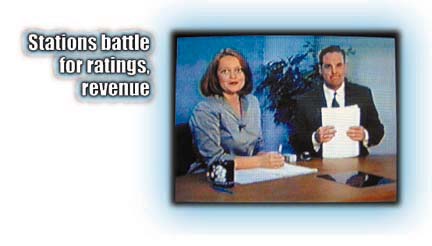
by BOB
DORAN
(Photos above, top: Jane Rodgers &
Jim Moritz of KIEM channel 3
Middle: Dave Silver brand of channel 6
Bottom: Cheryl Broom & Brandon Dunn of KAEF Channel 23.)
THERE'S A WAR GOING ON -- A
BATTLE FOR VIEWERS.
Over the last two years local
television affiliates have been pumping revenue into their news departments
in an effort to lure viewers away from competitors --at least to hold their
ground.
"Every station looks for
a way to define itself, to make itself important to the viewer in relationship
to the overall choices out there," says Bob Browning, station manager
of KIEM, the NBC affiliate. "If you're smart you try to find that local
niche. It's the only thing that distinguishes your station from anything
else that they can flip on in the cable realm. Most any station today is
interested in establishing a strong local presence -- and the easiest way
to do that is through news."
Jeanne Buheit, general manager
of CBS-affiliate KVIQ, sees local news as a primary focus of the station's
individuality.
![[photo of Jeanne Buheit]](cover0629-mgr6.jpeg) Jeanne Buheit, general manager of CBS-affiliate KVIQ
Jeanne Buheit, general manager of CBS-affiliate KVIQ
"If all we did was run
network and syndicated programming there would be no point in being a local
affiliate. What makes us stand apart is that we are providing local information.
That's how local broadcasters will stay in business."
Browning took over as general
manager of KIEM two years ago and became news director six months later.
His 30 years of experience in television broadcasting began after receiving
his journalism degree from Sam Houston University in Huntsville, Texas,
"where Dan Rather went to school."
KIEM is owned by the Memphis-based
media Pollack-Belz, LLC. The company owns one other television station,
KLAX in Alexandria, La., and 10 radio stations including KCRE in Crescent
City. Since Pollack bought the station the staff of KIEM's news department
has doubled. An increase in equipment allocation includes the purchase of
a remote broadcast truck.
Around the same time Browning
was taking over management of KIEM, Buheit was doing the same at KVIQ. She
came with the Ackerley Group which purchased the station in January 1999.
For Buheit the new job was a homecoming. Born and raised in Eureka, Buheit
attended Humboldt State University before finishing her education at Chico
State and spending over 12 years working for an Ackerley station in Salinas.
Chairman and CEO Barry Ackerley
founded the company 25 years ago beginning with a small regional outdoor
media company. In layman's terms: He owned and operated billboards.
Today the group is involved
in what it calls "multiple media industry segments," including
the sixth largest outdoor media company in the nation, five radio stations
and two basketball teams: Seattle Supersonics and Seattle Storm.
The television division includes
17 network affiliated and independent television stations clustered in two
regions: seven in central New York state, seven in smaller markets in California
with the remainder in Oregon, Washington and Alaska.
Buheit says the purchase of
KVIQ has meant major changes at the station, mostly focused on the news
department.
"Since the purchase of
the station they have invested over $1 million in capital and equipment
with the directions that we are here to be a news provider. We've gone from
providing five hours a week of news programming to 22 hours a week."
The station's news department
has grown to 20, outnumbering the cross-town rivals at KIEM where 15 people
produce news programming. (By comparison, the Times-Standard has 21 on its
editorial staff.)
![[photo of Bob Browning]](cover0629-mgr3.jpeg) Bob Browning, station manager of NBC-affiliate KIEM Bob Browning, station manager of NBC-affiliate KIEM
Playing by `the book'
It may have a larger staff and
a lot of new equipment, but KVIQ is still playing catch up. According to
the all-important Nielsen ratings, a lot more people watch the news on Channel
3. In fact in the February book KIEM had the highest rating and share of
any market in California for early news.
Browning states flatly, "Nobody
dominates their market like we dominate this market."
Browning concedes that Eureka
is a small market --very small market.
"Out of (Nielsen's) 210
`designated markets' in the United States ranked based on population, ours
is 189th," he said.
"Sure they're ahead,"
Buheit concedes. "But they're not nearly as far ahead as they were
a year ago. The big picture is that their shares are dropping and ours are
rising."
"If you look at the 6 o'clock
news, they do a 32 (share) and we do an 8, that seems like a pretty big
disparity, although a year ago they were doing a 43 and we were doing a
7."
In Nielsen-speak the rating
is the percentage of the population in the "designated market area"
(DMA) watching a given show. The share is the percentage of "households
using television," or how many of the sets that are turned on are watching
a specific program. The local DMA includes Humboldt and Del Norte counties,
where out of 60,400 households 56,650 have televisions with 71 percent of
those televisions hooked up via cable.
The Neilsen ratings are issued
four times a year in what is known in the trade as "the book."
The most recent was issued last week based on statistics from May's "sweeps"
month.
In the new book KIEM's 6 p.m.
news has a 15 rating and a 32 share; KVIQ has a 3 and an 8. (The Simpsons
falls in between them with a 6 and 14 share.)
The spread is similar at 5 p.m.
when KIEM has a 7 rating with a 22 share and KVIQ has a 2 rating with a
7 share. KAEF comes in third in the news game. The 5:30 newscast received
a 2 rating and 4 share up against the other two major networks' national
news.
`Doing something right'
Buheit said, "Competition
brings up the level of the product," and she has her own spin on the
figures.
"When you take all of the
news we produce in a given week and count up the amount of rating points,
we get 69 and they get 81 in the key demographic for advertisers, adults
25-54. Since I've been here we haven't had one book where I've been disappointed.
We're doing something right."
As each new book comes out,
the ratings are translated into rates as in advertising rates. More viewers
equal higher rates. How much higher? More than three times as much: The
rate card shows KIEM charges as high as $250 for a 30 second spot on the
6 o'clock news while a 30-second spot on KVIQ goes for $75. That rate drops
when advertisers sign up for longer contracts or for package deals.
The reason Buheit likes to add
up ratings -- the cumulative hours of news broadcast -- is because Channel
6 broadcasts more news per week. Both stations have local news shows at
5 p.m. and again at 6 p.m. KVIQ adds another half hour of news at 6:30 p.m.
-- essentially a repeat of the previous half hour -- an hour program each
day at 6 a.m. leading into the CBS Early Show and an half-hour of news at
noon.
Browning does not think much
of the competition's attempt at interpreting the statistics.
"There are people who will
tell you that more is always better," he said. "I'm not sure that's
true. If you're not going to bring new information, if all you're going
to do is recycle what you had in the last show you did or the night before,
what's the purpose?
"Obviously we're doing
something right," he said, echoing Buheit's sentiments, "because
people are endorsing our efforts with their viewership. That's really what
we're out there for, to draw people to us, to have them depend upon us as
their source of information."
A new face
While News Channel 3 touts itself
as "The Spirit of the North Coast," and the Action News 6 team
presents "Coverage You Can Count On," at the ABC affiliate, KAEF,
the offer is "A New Face for News."
The new face is Channel 23's
News Director Cheryl Broom. She came on board in April after the station's
news director and assistant manager, Leslie Lollich, moved over to run the
expanding news team at KVIQ.
Broom is originally from the
San Diego area. Her last job was as a producer at an ABC affiliate in Redding,
owned by the same company as KAEF. California Broadcasting Inc. is a subsidiary
of LAMCO Corp. that owns eight other television stations around the country.
![[photo of Cheryl Broom]](cover0629-cheryl.jpeg) Channel 23's news director Cheryl Broom took over in April
Channel 23's news director Cheryl Broom took over in April
when news director Leslie Lollich moved to KVIQ.
"Our news department is
pretty small," said Broom. "We have myself, a full-time sports
(reporter), one full-time reporter, Shannon Garcia, and two reporters who
work a lot more than part time but only get paid for part time. It would
be nice to get another reporter or some new equipment, but we're hanging
on."
KAEF news runs a half hour at
5:30 p.m. Monday through Friday. At 11 p.m. it runs three minutes of news
and a two-minute weather report that leads into a Dating Game-style
program called Blind Date. "I actually think Blind Date
beats out the other local channels," Broom said with a laugh.
(In fact Blind Date's
9 share edges out KVIQ's "Eleven at 11" news share of 8, but KIEM
is still on top with a 30 share.)
When Broom moved here she said
she was surprised at how much interest the community shows in local current
events.
"When I go get my haircut
everybody in the salon is talking about (Eureka City Manager) Harvey Rose.
When I lived in San Diego I had no idea who my city manager was. People
here like their news, they want to know what's going on."
Familiar faces, entry level
market
Broom is enjoying her new position,
but if she had her choice she says she would like to work in news in San
Diego to be closer to her family. And there are financial incentives. San
Diego is one of the top 20 markets and Broom points out, "The amount
you get paid increases as you move up from market to market."
Since this is the 189th ranked
market, those with tendencies toward upward mobility often move on quickly.
Lollich, who has worked here for 17 years and has taught journalism, remembers
many who "wanted to get out as soon as they could put a résumé
tape together."
"There will always be people
who, for whatever reasons -- advancing their own careers or whatever --
people will come and go in the more visible positions. That's just the way
the game is played," said Browning.
"This will always be an
entry -level market where we introduce promising young people to the world
of television, and journalism in general, and there are a lot of responsibilities
that go along with that. The tenure that these people spend with us in this
market will form habits, opinions and character that will last for the rest
of their careers."
![[photo of Leslie Lollich]](cover0629-leslie.jpeg) KVIQ News Director Leslie Lollich.
KVIQ News Director Leslie Lollich.
Familiar faces, brand loyalty
The downside of the turnover
is that around the time the viewers get used to an on-air news reporter,
she may disappear. There are several exceptions.
"We have key people in
the news department who are not leaving," said Buheit. "Dave Silverbrand
is not leaving, DeDe Stirnaman isn't leaving."
"And I'm not going anywhere"
Lollich adds. She lives in Eureka with her husband and two sons.
And at least a few of the familiar
faces at KIEM are here for the long haul, according to Browning.
"Jane Rogers is not interested
in moving. She settled her family here. ... Of course, Jim Bernard's the
same; he's been here long term and will be here a long time. And there are
others. ..."
Bernard, the popular KIEM weatherman,
has recently taken on co-host duties with Jane Rogers on the 5 p.m. show.
A few years back KVIQ, under different ownership, made the mistake of laying
him off. KIEM snapped him up and many viewers switched channels.
The loyalty of all those "weather
fans" means more viewers for his station, Browning said, emphasizing
the fact that familiar faces are important.
"The information is the
information. There are degrees of how well the information is gathered and
there are degrees about how well it is presented. Beyond that it's a personality
business. Every station has its personality. If it didn't, we'd all hire
zombies to read the newscast."
Another tool for increasing
public visibility is through community involvement. Describing her plans
for KVIQ, Buheit said she has set three goals for her station -- to excel
in news, in sales service and in community service.
![[photo of Jim Bernard]](cover0629-bernard.jpeg) (LEFT) KIEM Channel 3 weatherman Jim Bernard
(LEFT) KIEM Channel 3 weatherman Jim Bernard
"The community service
component is not something taken lightly," she said. "We donate
air time to help support community efforts, and the people who work here
are involved in community organizations."
Both channels 6 and 3 are listed
as sponsors of highly visible public events like Blues by the Bay and the
Relay for Life. Often the ads traded for sponsorship offer an opportunity
to reinforce a link with the news department.
KIEM also has a symbiotic trade
relationship with the Times-Standard. Besides exchanging ads the station
teases the paper's headlines in the evening news and the paper plugs Jim
Bernard's nightly reports on its weather page.
Some might find this strange
since the two media are competing in the same market for the same ad revenue.
But Browning says he doesn't want people to get all of their news from the
tube.
![[photo of Adam Gerber]](cover0629-weather6.jpeg) Weatherman Adam Gerber of KVIQ Channel 6
Weatherman Adam Gerber of KVIQ Channel 6
"Television is not the
absolute medium. There are things that we can't do that print does extremely
well. There are things that we can do extremely well that print can no longer
approach -- things like the immediacy -- transporting you to the scene with
sight, sound, motion and color. As good as they are, papers can't do that.
"But what papers can do
is give you voluminous detail and background information on any given subject.
We can bring it to the light of day, pique your interest and give you the
short rap on it. But if you really want to know the ins and outs of an issue
you need to go to whatever print you respect and get that side of the story,
too.
"I feel just as bad for
the person who gets all of his news from television as I do for the guy
who does not watch TV and gets all of his news from the newspaper. Both
of them are severely deprived because the print guy is always late. He may
have the story but he's 48 hours late with it. And the guy who depends strictly
on television gets the highlights and doesn't get real depth of the story."
Reporter Rick Lathan or KVIQ 6 at digital
video editor.![[photo of Rick Lathan]](cover0629-digital.jpeg)
![[photo of channel 6 news team]](cover0629-news.jpeg) The Channel 6 news team gets ready to go on air.
The Channel 6 news team gets ready to go on air.
Rhett Bice in the Channel 3 production room.![[photo of channel 3 producation room]](cover0629-prod.jpeg)
IN THE NEWS | CALENDAR
Comments? E-mail the Journal: ncjour@northcoast.com
© Copyright 2000, North Coast Journal, Inc. |