|
 
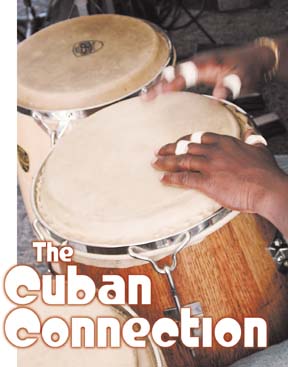
Story & photos by BOB DORAN
THE CUBAN BEAT IS HOT. THE LATIN SOUND IS EVERYWHERE.
In the mass culture you might
blame the interest in Latin music on the Buena Vista Social Club,
on Ricky Martin, on Carlos Santana.
"It's a virus that's infecting
Americans; it's a severe situation we have here," declares
David Peñalosa, leader of Kachimbo, an Afro-Cuban band
that calls Humboldt County home. Humboldt is also the home of
Bembé Records, a label that specializes in Cuban music.
And for the last five years the county has been home to a world-class
workshop on Cuban folkloric music and dance.
Peñalosa:
Rhythm instigator
![[photo of David Penalosa]](cover0621-pena.jpg) Peñalosa says he was infected
with the virus even before he knew what Cuban music was. He recalls
a visit to his sister in Berkeley when he was 12 years old. Peñalosa says he was infected
with the virus even before he knew what Cuban music was. He recalls
a visit to his sister in Berkeley when he was 12 years old.
"I remember walking across
Sproul Plaza and hearing the conga drums. It put a bounce in
my step and I had this idea I could do it."
That was back in the '60s when
Carlos Santana had just started spreading the Latin bug. "Carlos
did more than anyone to bring Cuban music to America," said
Peñalosa.
But wait, Santana isn't Cuban,
and his band doesn't play Cuban music.
"But the rhythms are Cuban.
The Cuban connection has been denied and downplayed in this country
since the Revolution, but before it was common knowledge. Even
as far back as World War II, Johnny Otis was using Cuban musicians
and fusing the rhythms with rhythm and blues.
"The fact is the African-Americans
were denied drums and their rhythms. They expressed their African
roots with European instruments and basically that's why we have
jazz. In Cuba they were allowed to use the drums and because
of that they kept their cultural heritage. African-American music
was re-inoculated with the African musical sensibility via Cuba
and the Cuban rhythm instruments."
Peñalosa started out
playing jazz on flute and clarinet, but then someone brought
congas to a jam session at his house. "I just flipped out.
I totally bonded with the drums even though I didn't know what
I was doing. I had been into Coltrane and Eric Dolphy and I was
enamored with percussion -- but I hadn't made the switch until
someone put the instruments in my hands."
The indirect result was an end
to the jam sessions. "The neighbors never complained about
the squeaky horns upstairs, but when they heard me play the congas
it was like (he beats out a tap, tap, tap on the table)
and they shut down the sessions right away. The drums evoke strong
emotions. Traditionally in Africa the rhythms activate the libido
or they induce trance, and not everybody wants their base chakra
activated. But that's really the appeal. So when Carlos Santana
put that into his music it was like, `Ye-eah, I like it.'"
He decided to learn more. And
when he moved to Humboldt County in the late '70s he brought
along his drums and looked around for others who were interested
in exploring the Afro-Cuban sound. He played in a world beat
band called Tombo and in a salsa dance band called Guateque,
but neither one focused on the Cuban folkloric music he was most
interested in, so he put together a band to do just that.
"The reason I started Kachimbo
was that I felt like I finally had a core of people who were
really devoted to the music," he said, "people who
would stick with it and last. I was up in Arcata for 6 months
and started working with Howie (Kaufman). He played steel drums,
but he also played traditional batá drums with me. His
friend John Lewis had been playing drums with me, and of course
I'd been playing with Jimmy (Durchslag) for many years. I felt
like, `Okay. We're all on board; we're all into this.' It was
the right combination of people at the right time."
Kachimbo plays a wide range
of Afro-Cuban music ranging from the folkloric music played on
the island in the '20s to the modern style known as timba. But
the band makes the music its own -- and in the end does not really
sound like any Cuban band.
"Salsa is dependent on
call-and-response singing where a lead vocalist or sonero sings
in counterpoint to the chorus -- the style of singing is very
specific," said Peñalosa. "The singer must have
a mastery of the rhythms and be able to create spontaneous poetry
on the spot. The dilemma of starting a salsa band in Humboldt
County is that there are no soneros here. I didn't want someone
to sing the songs just because they knew Spanish."
The solution: other instruments
cover the vocal parts. The trombones may take the chorus part
and the flute or sax will handle the counterpoint, turning a
vocal style into instrumental music.
"So we are the only instrumental
salsa band anywhere, at least as far as I know," said Peñalosa.
They add contemporary touches to the old tunes and put a different
spin on everything by adding Trinidadian steel drum.
"The parts that Howie and
Eugene (Novotney) play are typically handled by a violin section
or by the tres, an Afro-Cubanized guitar. The parts are still
there, but on instruments that my buddies play. It's a real nice
sound and it makes it more a statement of who we are," said
Peñalosa.
"We are also one of less
than half a dozen American salsa bands that play timba, the newest
style of Cuban salsa that blends hip hop beats and funky bass
lines with salsa. It's a style that most Americans are not aware
of because when they see something like the Buena Vista Social
Club or the Afro-Cuban All Stars, they're hearing music from
the '20s to the '60s.
"Timba is Cuban salsa of
the new millennium. It's influenced by jazz as far as harmonies,
but it also draws a lot of inspiration from Afro-Cuban folkloric
music, the traditional music brought from Africa. The Cubans
have this deep well of African folklore with rhythms that have
been passed down from generation to generation. What they're
doing now is taking traditional African rhythms and making them
into hip hop beats."
The ancient rhythms live on
in part because the music is tied to religion. Cuba has always
been a Catholic country and the Catholic response to the rituals
that came over from Africa with the slaves was incorporation
rather than suppression.
"As the slaves would celebrate
their different deities, the priests would say, `Oh, that's Saint
So and So, fine...' This created a facade of Catholicism behind
which the African traditions were preserved. In Puritanical America
on the other hand, a slave seen with a drum might be killed on
sight. There was no tolerance and the drum traditions were lost.
The African-Americans have been able to reclaim their rhythmic
heritage by borrowing from the Afro-Cubans."
Durchslag and the
birth of Bembé
![[photo of Jimmy Durchslag]](cover0621-durchslag.jpg) Jimmy Durchslag moved to Southern
Humboldt in the early '70s after graduating from Yale. He had
played trombone before attending college. Jimmy Durchslag moved to Southern
Humboldt in the early '70s after graduating from Yale. He had
played trombone before attending college.
"I was involved in jazz
in high school," he said. "I got back to playing trombone
shortly after I started working with Redwoods Rural Health Center
(where he served as executive director for 9 years). That was
around '76. I knew something about Latin music, but I didn't
really get into it deeply until I met David. He was way into
it."
Durchslag played along with
Peñalosa in Tombo and Guateque, then joined him as a founding
member of Kachimbo.
After running the Health Center
for nine years, Durchslag went to work for Lieb Ostrow running
Music for Little People, a rapidly expanding catalogue company.
As the business grew they added records to the mix, starting
a label also called Music for Little People. A world music label,
Earthbeat, spun off from that and Peñalosa was hired to
do some promotional work.
"David and I worked on
some Latin releases through Earthbeat," said Durchslag.
"That was when we decided to go off on our own. We proposed
a sub-label with a focus on Cuban music -- if we could keep total
creative control. They weren't that into it, so we decided to
do it on our own."
Bembé Records got off
the ground with a record called Musica Yoruba by the traditional
Cuban combo, Conjunto Folklorico Naçional de Cuba.
"David knew this guy from
Berkeley who was the founder of Leopold's Records," said
Durchslag. "He would go down to Cuba and come back with
boxes of vinyl to sell. They would just pack the stuff up for
him. It was like, unknown territory. He was never sure what he
was getting.
"One time he came back
and found they had packed a bunch of the reel-to-reel masters.
One set was an album by Conjunto Folklorico Naçional de
Cuba. He didn't have any rights to it, but the tapes were there.
"People have always ripped
off the Cubans because of the gray area involved in releasing
this music because of the relations between the U.S. and Cuba.
It's not illegal to license the Cuban music, but there are limits
on what you can do and there are tax restrictions.
"We got the masters and
went to Cuba to negotiate a licensing deal with EGREM (Cuba's
national record label). We could easily have taken the tape and
put out an album and they couldn't have done much about it. But
we didn't want to start our relationship that way so we made
a deal with EGREM to make it all official."
Durchslag utilized the marketing
and distribution skills he had learned at Music for Little People
and Bembé was on its way. Since then they have released
15 more albums, including Babalú Ayé by
Chucho Valdes and Irakere, an album that was nominated for a
Grammy for "Best Tropical Latin Performance."
Somewhere along the line there
was a burst of interest in Cuban music brought on by Ry Cooder's
Buena Vista Social Club album and the related film. Durchslag
has mixed feelings about their effects on the marketing of Cuban
music in the U.S.
"People have a very jaded
view of Cuban music now because of the Buena Vista Social Club.
It's old guys doing old music. There's nothing wrong with it
-- it's roots music -- but it's not the current state of Cuban
music.
"When Buena Vista came
out there was a boom, but there was also a flood of Cuban recordings
on the market. All these old recordings were re-released as compilations
-- EGREM is notorious for licensing the same music over and over
again to different companies. As a result the stores were flooded
by a bunch of crap.
"It's very hard for an
independent label like Bembé to survive today in general.
There's so much out on the market and sales are driven by popular
taste. I think (Buena Vista) has kept an interest in Cuban music
alive, but we've been promoting a more modern type of music.
"The identity we're trying
to establish is top quality and cutting-edge and we're very focused
in what we put out. Whether it's folkloric, Latin jazz, timba
or the popular dance music, it's all the progressive creative
stuff, not just more of the same."
Kaufman: Explorations
in dance and drum
![[photo of Howie Kaufman]](cover0621-howie.jpg) Howie Kaufman grew up in the San
Fernando Valley and moved to Arcata in 1982 to study math at
Humboldt State. He had been playing drums since he was a teenager
-- but not hand drums. In 1984 he met Peñalosa when David
came up from Southern Humboldt to teach a percussion workshop. Howie Kaufman grew up in the San
Fernando Valley and moved to Arcata in 1982 to study math at
Humboldt State. He had been playing drums since he was a teenager
-- but not hand drums. In 1984 he met Peñalosa when David
came up from Southern Humboldt to teach a percussion workshop.
"By that time I had changed
my major to music," said Kaufman. "I had been playing
with the percussion ensemble and a couple of the other guys from
the music department would get together every Friday afternoon
and play. We'd get the congas out and play these rhythms we had
found. We were looking at every source possible."
Kaufman shared a house with
one of the other drummers, John Lewis. "John had written
down all the rhythms David taught at the workshop and we had
been using that to practice."
Peñalosa was intrigued
when he heard that a group of drummers in Arcata was serious
about studying Latin rhythms. "He decided to teach our group
as a private class," said Kaufman.
"Up here Kate Bean -- who
everyone knew as Cat -- was teaching world beat dance classes
at the Creamery. World beat was a term being used all over. Eventually
John and I and a couple of other guys became the core drummers
for her class.
"The Afro-Cuban scene had
started earlier in Southern Humboldt. People were playing batá
drums, learning about the Afro-Cuban religion and Brazilian rhythms.
It was very focused. The scene here was a little less specific.
When David came up it kind of bridged the two communities. Around
1985 he started teaching us just Afro-Cuban. He had a huge collection
of recording and videos. We were just devouring the rhythms he
was showing us. We had a little group that met every week."
Peñalosa was a strong
drummer and a good teacher, but even he wanted to learn directly
from Cubans. Eventually they would all get the chance.
"In 1988 a woman from Southern
Humboldt, Estrella Quiroga, helped organize a drum and dance
workshop in Tijuana, Mexico with Cuban masters. At the time they
couldn't come to the U.S. -- there was no way. David and John
Lewis went down the first year. I went the second year. It was
the first time I had hands-on instruction with someone from Cuba.
That really changed everything."
With the classes as a boost,
a group of serious drum/dance students from both ends of the
county coalesced and gave itself a name: the Afro-Cuban Studies
Collective.![[photo of shekere]](cover0621-shekere.jpg)
"That was around the time
when we brought the Muñequitos here," said Kaufman.
Los Muñequitos de Matanzas is a Cuban folkloric rumba
troupe, one of the first to tour the United States.
"Some woman from New York
called me to say they were bringing them to the U.S. They had
heard there was a scene here in Arcata and asked if we wanted
them to come here. I called David and he ended up producing the
show. We put up the money and offered our homes as a place for
them to stay and it was a big success."
Two years later the Studies
Collective brought Muñequitos back but the visit was not
so successful. Concert attendance was poor and collective members
ended up losing money. But that didn't end their desire to learn
from the Cuban masters.
"We thought maybe we could
go through the university to bring groups here," said Kaufman.
"Then in 1996 the Summer Arts workshops, which had been
held at HSU, were moved to Long Beach, creating a void at HSU."
Kaufman got a call asking if
he would be interested in starting up some sort of drum workshop.
With sponsorship from HSU's Extended Education, a week of drum
and dance classes was held.
Kaufman is currently signing
up participants for the 6th annual "Explorations in Afro-Cuban
Dance and Drum" to be held July 2228 at HSU. The program
has grown to the point that participants travel from all over
the world to come here and study with 11 instructors, most of
them straight from Cuba.
"Howie has created something
that's pretty remarkable," said Peñalosa. "It's
the biggest assemblage of Afro-Cuban folkloric masters in the
country and it's right here in Arcata."
![[photo of Luis Cepeda]](cover0621-cepeda.jpg) "Some of our faculty members
are as important in folkloric music as Miles Davis is in jazz,"
said Kaufman. "Those who know anything about this music
honor the abilities of Lazaro Galarraga as you would a Miles
Davis. And some of the other drum teachers are just as highly
respected." "Some of our faculty members
are as important in folkloric music as Miles Davis is in jazz,"
said Kaufman. "Those who know anything about this music
honor the abilities of Lazaro Galarraga as you would a Miles
Davis. And some of the other drum teachers are just as highly
respected."
Another drum instructor, Luis
Cepeda, (in photo at left) is an expert in Afro-Puerto Rican
music from the world-renowned Familia Cepeda. "His father
and his mother are responsible for keeping the bomba rhythm alive
in Puerto Rico. Luis knows more about bomba than anyone in the
U.S.," said Kaufman.
After coming to teach in Humboldt
County, Cepeda has decided to settle here. He has also become
the newest member of Kachimbo.
In the summer of 1999 Peñalosa
decided to take advantage of all the assembled drum talent and
make a record.
"I had this crazy idea,"
he said. "We would take these guys into the studio on their
day off to see what happens. It was risky, but we pulled it of.
We took everyone down to Big Bang Studio in Loleta and put together
this album that just features an orchestra of drums."
Most of the members of Kachimbo
are on the resulting album, Drum Jam, by the group Peñalosa
dubbed Grupo Exploracion.
"I feel amazed at all the
amazing people who I have had the opportunity to play music with,
beginning with the Muñequitos," said Kaufman. "I
had studied their music for years and there they were playing
in my living room.
"It's the same thing with
Luis. I look over at him when he is soloing and we're playing
together. He's smiling and it's -- well it's just amazing. How
lucky we are here in Arcata to have these kinds of experiences."
![[photo of Kachimbo]](cover0621-group.jpg) Kachimbo back row, from left,
Howie Kaufman, Sebastian Link, Luis Cepeda, Rama Boyd, Michael
Stephenson, Eugene Novotney; front row, Jimmy Durchslag, David
Peñalosa and Daryl Strom. Kachimbo takes its name from
the sound made by the shekere, a beaded gourd (photo is above
right) Kachimbo back row, from left,
Howie Kaufman, Sebastian Link, Luis Cepeda, Rama Boyd, Michael
Stephenson, Eugene Novotney; front row, Jimmy Durchslag, David
Peñalosa and Daryl Strom. Kachimbo takes its name from
the sound made by the shekere, a beaded gourd (photo is above
right)
Kachimbo performs at 4:30
p.m. June 23 at the Mateel Summer Arts and Music Festival at
Benbow; July 6 at Six Rivers Brewery Old Town and July 7 at the
Iguana in Redway.
To learn more about Bembé
Records go to www.bembe.com.
Explorations in Afro-Cuban Drum
and Dance runs July 22-28 at HSU. For complete information,
go to www.humboldt.edu/~extended/afrocuban.
For registration information contact the Office of Extended Education
at 826-3731. The workshop concludes with a public performance
by students and faculty on July 28 at 8 p.m. at HSU's Fulkerson
Recital Hall.
IN
THE NEWS | CALENDAR
Comments? E-mail the Journal: ncjour@northcoast.com
© Copyright 2001, North Coast Journal,
Inc.
|