|
 
IN
THE NEWS | GARDEN
| CALENDAR
Story & photos by BOB DORAN
NORTH
COAST OPEN STUDIOS TOUR LIST below!
THE MOVEMENT IS GROWING. ALL
OVER CALIFORNIA, all over the United States, artists are banding
together to organize open
studio tours: days or weekends
when the artists throw open their doors and invite the public
in -- to look at new work and old, to observe the creative process
in its natural environment and (the artists hope) to take some
art home.
In urban areas the tours can
be overwhelming. In San Francisco, where the tours have been
happening for over 25 years, some 750 artists open their studios
every weekend in October.
Artist Sasha Pepper participated
in the San Francisco tour in its early days. After relocating
to Humboldt County, she joined forces with a small group of area
artists four years ago to organize a tour. Pepper, who paints
and does monotypes, lives in Arcata and works in a space above
the Art Center in Old Town Eureka. She's helping coordinate this
year's tour, set for June 8 and 9.
"It just keeps growing,"
said Pepper in a conversation in the art-filled living room of
her Arcata bungalow. "We have 80 artists this time, up from
65 last year."
The ad-hoc group of artists
that puts on the North Coast Open Studios tour gets free practical
assistance from the Humboldt Arts Council and the Ink People
Center. But the artists arrange the tour themselves and publish
the essential tool, a map. What was once a one-page newsprint
fold-up has grown into a 12-page booklet, all financed by artist's
fees and ads.
A show of the participating
artists' work is going up at the Morris Graves Museum of Art
on May 31 and will be on display through June 30. The opening
is this Saturday and is a featured destination in the monthly
Arts Alive!
While most tour participants
are painters of one sort or another, a number work in a growing
field known as fine crafts. Among them:
Nancy Kennedy
"ART
UNDER FOOT"
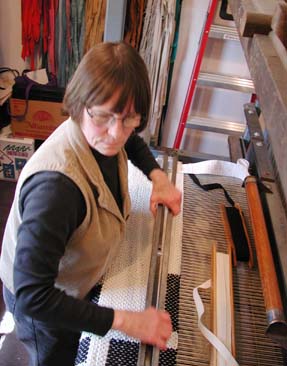 The
path to Nancy Kennedy's High Fiber Designs leads around an old
Eureka Victorian with an overgrown garden to a detached room.
Her large floor loom almost fills the studio space. Strips of
cloth hang on one wall for use in rag rugs; shelves hold skeins
of yarn for her fine wool weavings. The
path to Nancy Kennedy's High Fiber Designs leads around an old
Eureka Victorian with an overgrown garden to a detached room.
Her large floor loom almost fills the studio space. Strips of
cloth hang on one wall for use in rag rugs; shelves hold skeins
of yarn for her fine wool weavings.
On an afternoon in early May,
Kennedy works at the loom, tromping on treadles to shift the
warp, throwing a shuttle trailing a long strip of cloth down
the channel of threads called the shed, then whacking the strip
into place with a heavy beater. A shift of the treadles raises
a new set of threads and the process begins anew. A black and
white rug with a complex geometric pattern is taking shape.
Kennedy moved from Southern
California to Humboldt County in 1982 with her husband, Ron,
a former metallurgic engineer who had switched careers to become
a woodcarver. Ron crafted birds and ducks that Nancy painted.
"We came up to visit friends
who were having a show of decoy carvings," Kennedy recalled,
taking a break from the loom. "They said, `You're nice people,
why are you still living in Southern California?' We were working
for ourselves doing these birds, so we figured, why not move
up here?"
When did you start weaving?
It was fall of 1989; it was
kind of on a whim. My friend said, "How'd you like to take
weaving class with me?" The class was at the Camel, a yarn
shop that used to be in Arcata. I came home the first night and
told my husband, "I need a loom." He said first I needed
to finish the class. I said, "No, I need a loom." So
I bought one. I didn't start out focusing on this particular
weave structure, but my work evolved.
Can you describe the work
you're doing now?
All of my rugs have a summer
and winter weave structure. That means they have a light and
dark side. I think it's based on old coverlets that were woven
in the Appalachians, in Tennessee and Kentucky. My loom has a
specific device for shaft switching, which means I can arrange
the patterns any way I want by flipping the levers.
Do you earn a living with
your weaving?
(She chuckles.) I'm trying.
That's my aim. I can't say that I'm there yet.
How do you get there?
You get your face out there,
and you keep producing better things. You have to find the right
market. That means doing more shows. I did an American Craft
Council show in St. Paul last month. It's a juried show, and
it's expensive to get into; the fees are $900 and up. And I'm
doing the Craft Council show in San Francisco in August. I did
that one last year and did OK.
These are competitions?
Right. And it's really an honor
to be accepted. And the more you do them, the more people seek
you out. I'm in my third year of the Arts Furnishing Show in
Pasadena. It's a very nice show, all high-end art furnishings.
What exactly are "art
furnishings"?
Handcrafted furniture, accessories,
ceramics, anything except wearable art or jewelry. It's all home
or office furnishings.
What else do you do for marketing?
You do local shows and things
like this open studios tour, and pretty soon your name gets known.
I have a webpage (www.woodguild.com) and I've gotten invitations
through that.
Are you taking your work
to all of these shows because there is not a market for it here?
Not enough of a market. There
are great places to show our work here, but it's hard to sell.
I had a big show this winter at Hurricane Kate's -- filled all
the walls -- and that was nice. It was a great place to show
-- I got great feedback -- but no sales.
Do people buy the rugs to
hang on the wall?
Some do. I call them "art
under foot," that's my slogan. They're made for a floor,
but people can do what they want with them.
When you think about hanging
one on the wall it brings up the question: is there a line between
art and craft?
I think it's a very fine line.
And the American Craft Council, a national organization, is involved
in promoting the fact that fine craft is art.
Fine craft?
The term distinguishes fine
craft from traditional craft, things like making crocheted doilies
and the kind of things you see at craft bazaars.
Do you think of yourself
as an artist?
Um hum.
What does that mean to you?
I create original things, pieces
that I put a lot of my own spirit into. That's it basically.
That's what art is all about.
Peggy Loudon
THROWING
FORMS WITH
INTEGRITY
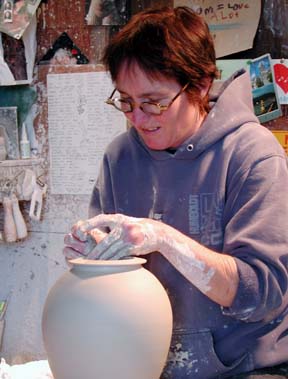 Peggy
Loudon's studio is in the garage of a suburban home on Fickle
Hill. The space is open, allowing the sunshine to glint off numerous
pieces, mostly vases arrayed on a table and filling a shelf on
one side of the room. They range in size and shape; several have
Loudon's trademark blue glaze with metallic rims. A few recent
pieces show a new direction in her work. Peggy
Loudon's studio is in the garage of a suburban home on Fickle
Hill. The space is open, allowing the sunshine to glint off numerous
pieces, mostly vases arrayed on a table and filling a shelf on
one side of the room. They range in size and shape; several have
Loudon's trademark blue glaze with metallic rims. A few recent
pieces show a new direction in her work.
"I'm using a new clay body,
a translucent porcelain called babu," says Loudon. "You
can see through it, and it's light as a feather. It's difficult
to throw, but it's worth it. I love the idea that when the sun
shines, I can see the light coming through these pots. I've been
doing this white scaly glaze on them so they have these rough
scales on the outside and celadon glaze, a pale, pale green,
on the inside."
When she's not throwing, glazing,
trimming or firing pottery, Loudon teaches ceramics at an after
school program for "at risk teens" and at Fire Arts
in Arcata. Her website is www.peggyloudon.com.
How did you become a potter?
After high school I took a class
at College of the Redwoods, where I learned throwing from Reg
Mintey. I fell in love with it, but I felt like I needed a real
job. So I went to (the University of California at) Santa Cruz
and got a kind of alternative degree as an art therapist.
That got me a job working at
Napa State Hospital with adolescents who were mentally ill and
had constant pressing needs. I decided my heart just wasn't in
it. I was frustrated. It seemed like an exercise in futility;
so many of them were medicated.
I had an opportunity to go to
Europe and travel for six months. That gave me perspective and
helped me solidify what I really wanted to do: I wanted to be
a potter. So I came back to Humboldt County, enrolled at Humboldt
State and worked there for four years with Jim Crawford (a professor
of fine arts) honing my skills.
Jim was excellent. He was critical
and helped me develop an eye and be critical of my own work.
He really was instrumental in helping me find direction. He hired
me to fire kilns so I wouldn't be intimidated by flames and gas.
That gave me a lot more confidence, and eventually I shared a
studio with other people until I was able to buy my own kiln.
What does it take to be a
potter? It seems to be much more than just throwing pots.
It takes a lot of hard work.
You have to be a jack-of-all-trades, because it's not only throwing,
trimming, firing, mixing glazes; you're marketing your work too.
It takes a lot of tenacity and it takes a spirit of adventure
because you're self-employed.
I look at a lot of other artwork,
look at magazines and try to stay on top of colors that are contemporary.
At the same time I have to have continuity in my identity as
a potter -- continuing the same forms and throwing forms with
integrity, creating objects that can last beyond my lifetime.
I have a list of things I need
to make. I sit down and, with discipline, I crank them out. You
know how it is that the more you do the better you get? I love
that, the sense of getting in the zone and just throwing and
throwing. I love it. I love transforming this -- (she holds up
a lump of clay) -- into a vase.
Are most of your sales person-to-person?
I sell through my shop at events
like Open Studios, and people just come by, then there are the
fairs. And I sell through stores like Plaza Design and at a gallery
in Mendocino. I'm in the process of exploring other galleries.
I'm at a point where I'm not
sure if galleries are a good venue. They typically take 50 percent
-- when I do fairs I take all the money. It's more lucrative
to set up your booth and do it yourself, but it's a hassle. I'm
trying to find the balance point. Open Studios is great; I don't
have to go anywhere and I can do demos. People can watch me make
pots and get educated about the process. I think it enhances
the experience of buying and owning a pot when you know how it
came into being.
Peggy Dickinson
FIRE
ARTIST
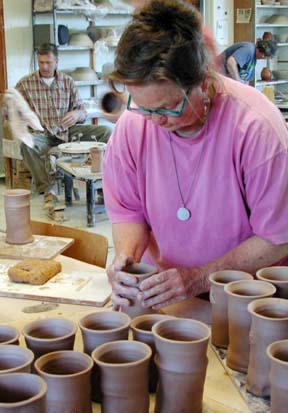 On
a Wednesday evening the Fire Arts Center buzzes with activity.
Peggy Dickinson, one of the center's founders, holds an unfinished
drinking vessel, one of many that she has embellished using a
scraping tool and a set of ornamental stamps laid out on a large
work table. On
a Wednesday evening the Fire Arts Center buzzes with activity.
Peggy Dickinson, one of the center's founders, holds an unfinished
drinking vessel, one of many that she has embellished using a
scraping tool and a set of ornamental stamps laid out on a large
work table.
Dickinson is part of a crew
of volunteers cranking out tall cylinders that will be fired,
glazed, then sold as lemonade glasses at fairs to raise money
for Fire Arts. She explains that they are made from recycled
clay. Trimmings from over a dozen wheels at the studio are gathered
in a slurry bucket (essentially a garbage can full of loose clay
mud), dried, then run through a food-processor-for-clay called
a pug mill.
Rob Davis, another Fire Arts
Member, works at a table wedging the clay, a process akin to
kneading bread that removes air bubbles. He forces large lumps
through a device mounted on the wall that extrudes gray tubes.
Then he slices them to appropriate lengths with a wire.
Another Fire Arts' founder,
Peter Brant, sits at a potter's wheel truing the tube sections.
A young potter, Parker Habron, helps Dickinson smooth the pieces
and add decorative touches.
They set the unfinished glasses
on a rack, one of many in the Arcata studio. Some hold greenware
-- teapots, cups, plates, bowls, vases and who-knows-what --
air-dried and awaiting bisque firing. Other shelves hold fired
work ready to be glazed. Tables, including one out front, are
covered with finished pieces, ready for sale.
Dickinson is one of several
Fire Arts potters listed on the open studios tour. She took a
break from what seemed to be a whirlwind schedule for someone
who recently turned 70, to talk.
How long have you been in
Humboldt County?
I came here for graduate school
in the '60s and studied with Reese Bullen, (a renowned potter
who taught art at Humboldt for 30 years). When I was finished
with school I went up to Olympia, Wash., to teach at Evergreen
College for six years. Then I started my own studio. I was getting
along in years and thought I wouldn't have the energy to do what
I wanted to do if I kept teaching.
Where did the idea for Fire
Arts come from?
I was working as a studio potter,
and I kept getting students who wanted to do apprenticeships.
I didn't have the space or the time. I thought, "What these
people need is a place to work."
I had blown glass one summer
and wanted to blow glass again, so I had this idea to start something
like what we have at Fire Arts, a place where you could do ceramics
and glass and possibly blacksmithing. It seems like every university
town needs a place where students who start with ceramics can
continue after they're done with school -- a place where they
can hone their skills, or maybe discover that it's so much work
they don't want to do it. They need a place where they can develop
their own style and designs and head towards some kind of marketing
thing, so they can earn a living as fine craftspeople. I didn't
follow through with the idea up in Washington; instead I did
it here.
How did you end up back here?
I really wanted to move back
to the Humboldt Bay area; I love it here. So in 1979 I moved
back and set up a ceramics studio. I still wanted to blow glass,
so I resurrected this idea of a ceramics and glass studio. The
Arcata City Council and the planning department were very receptive.
We spent two or three years searching for an appropriate location,
one that was properly zoned. Then Peter Brant invited Fire Arts
to set up in one of his buildings on South G Street.
Peter had a shop for his
electric business there?
He wanted a foundry (to do metal
casting) so he set up the Fire Arts Foundry. That's in one building,
then he lets us use another building for ceramics and kiln-fired
fused glass. We don't have glass blowing yet, but Fire Arts is
still evolving.
The whole thing took a long
time to get going. You can see the amount of equipment it takes
and the set-up it takes, including an industrial-size gas line.
It's incredibly capital intensive.
Where did the money come
from?
Originally we did a feasibility
study funded by a $25,000 grant from the Telesis Foundation.
We were going to form a non-profit. Unfortunately just about
the time the study was completed (1994) all kinds of arts funding
dried up. There was no money for arts grants, which was what
we had intended to go for. The California Arts Council budget
was cut by (Gov.) Pete Wilson. NEA (National Endowment for the
Arts) was hurting. Everything was slashed. So Fire Arts is actually
a private corporation. Board members became shareholders. We're
supported by money from classes, by open studio memberships and
the rental of individual studios.
What is an open studio membership?
You pay a monthly fee and you
can use all of the equipment, once you're checked out on it.
Anyone with a membership can come in any time day or night and
work.
What's the focus of your
own work now?
I make my living from my pottery,
but my focus is turning increasingly to sculptural work. I'm
interested in form more than in surface. Right now almost everything
in ceramics is focused on surface decoration. The kind of thing
I'm interested in is not really the focus of what's happening
in modern ceramics; I don't do what's "au currant."
But you know what? I'm 70-years-old, I'm not interested in promoting
myself. I want peace and quiet and a chance to work undisturbed.
I have a button I wear when I go to meetings, which I rarely
do any more. It says, `I'm 70-years old. Don't waste my time.'
I don't want to waste time talking about myself. I'd rather talk
about Fire Arts.
Fire Arts Center is located
at 320 So. G St. in Arcata. For information about classes and
memberships call (707) 826-1445.
The Fourth Annual North Coast
Open Studios Tour takes place Saturday, June 8, and Sunday, June
9, from 11 a.m. 5 p.m. at 80 studios from Trinidad to Fortuna.
The Open Studios Preview Exhibition runs May 31 through June
30, at the Morris Graves Museum of Art, 636 F St., Eureka. An
opening reception for the artists will be held Saturday June
1 from 6 - 9 p.m., during Arts Alive! Tour maps will be available
at the Graves. See below for a list of participating artists.
North Coast Open Studios - June 8-9, 11 a.m.-5
p.m.
Pamela Becker, monoprints, mixed-media altars, 24 Esther Lane,
Blue Lake, 822-1080.
Julia Bednar, watercolor, acrylics, 4938 Herron Rd., Eureka.
Elaine S. Benjamin (Blue Chair Press), printmaking, mixed-media,
239 Railroad Ave., Blue Lake, 668-0112.
Glen Berry, painting: acrylics, 29 Raypa Lane, Trinidad,
677-3601.
Harry Blumenthal, painting, drawing, maskmaking-mixed
media,207 G St. #106, Eureka.
Frances Boettcher, painting: oils; ceramics, 110 Perch
St., Eureka, 442-2832.
Susan Bornstein, printmaking, painting, mixed-media, 537
G St. #204, Eureka, 822-7927.
Jay Brown, watercolor, pastels, mixed-media on paper,
147A Melvin Way, Manila.
Kathrin Burleson, painting: acrylics and watercolors,
1828 Patricks Point Drive, Trinidad, 677-0490.
Ellen Clague, mixed media collage, assemblage, altered
books, 537 G St., Ste. 200, Eureka, 268-8471.
Kristen Cohen, painting and mixed-media, 827 Villa Way,
Arcata.
Caryn Michele Couey, watercolor and acrylics, 4959 Lundblade
Dr., Eureka.
Gail Crosby, ceramics, Fire Arts520 S. G St., Arcata,
826-1445.
Paula Cunningham, pastel (canine portraiture), 1042 J
St., Eureka, 443-9685.
Kit Davenport, sculpture, 1431 Whitmire Ave., McKinleyville.
Robert Davis, ceramics, Fire Arts520 S. G St., Arcata,
826-1445.
Joy Dellas, painting, ceramics, mixed media, 1915 Locke
St., Manila, 443-2339.
Natalie Di Costanzo, ceramics, Fire Arts520 S. G St.,
Arcata, 826-1445.
Peggy Dickinson, ceramics, Fire Arts520 S. G St., Arcata.
826-1445.
Richard Duning, paintings and sculpture, 1922 A Ave.,
McKinleyville, 839-2500.
Jill Juree Faulkner, painting: oils, 1220 Creek Ct., McKinleyville.
Marie Foley, painting: oils and watercolors; drawings,
1100 Seascape Ln., Trinidad.
Kay Harden, Ink drawing, mixed-media, 207 G St., #102,
Eureka, 725-2427.
Parker Havron, ceramics, Fire Arts 520 S. G St., Arcata.
Christian Henry, painting: watercolors and acrylics, 940
Samoa Blvd., #207, Arcata.
Geta Hershberger, watercolors, 95 Anker Rd., Fieldbrook,
839-0970.
Jane K. Higley, paintings, sculpture, 207 G St., #112,
Eureka,
Cynthia Hooper, painting: oils, 2890 Main St., Eureka,
443-5414.
Joyce Jonte, painting: watercolors, oil pastels, 940 Samoa
Blvd., Arcata, 822-6102.
Marie Kellenher-Roy, oil painting, sculpture, 83 Rayipa
Ln., Trinidad, 677-3866.
Nancy Kennedy (High Fiber Designs), weaving 1042 J St.,
Eureka, 445-8204.
Mary Ann Kirtley, stone and wood works2320 Albee St.,
Eureka, 445-8584.
Tom Klapproth, painting: acrylic, 208 C St., Eureka.
Susan Kohl, pastels, 514 Opera Alley, Eureka.
Beverly Soja Longaker, art glass, 3458 Old Arcata Rd.,
Bayside.
Peggy Loudon, ceramics, 148 Myrtle Ct. Arcata, 822-1925.
Carol Lucas, painting; oils and watercolors, 2320 Albee
St., Eureka, 445-8584.
Janita McClay, ceramics,2616 Knox Cove Dr., McKinleyville.
Margaret McCullough, watercolors, 600 Seascape Ln., Trinidad,
677-9251.
Elsie Mendes, painting: oils, watercolors and acrylics,
4938 Herron Rd., Eureka.
Linda Mitchell, painting: oils, 208 C St., Eureka,
Kathy O'Leary, painting: oils, 208 C St., Eureka, 442-3213.
Linda Parkinson, painting: watercolor, acrylics, oils,
207 G St., #102, Eureka.
Rachel Parti, 3-D tantric watercolors, 940 Samoa Blvd.,
#210, Arcata, 840-9829.
Sasha Pepper, painting: oils; monotypes, 207 G St., #105,
Eureka, 825-7579.
Cathy Ray Pierson, ceramics, 132 Azalea Way, Eureka,443-1665.
Steve Porter, painting: oils, watercolors, 208 C St.,
Eureka.
Jennifer Poser, photomontage, 1743 R St., Eureka.
Kate Purcell, ceramics, 2572 Myrtle Avenue, Eureka, 442-7490.
Bob Raymond, ceramics, Fire Arts, 520 S. G St., Arcata,
826-1445.
Anayansi Ricketts, photography, paintings, 1324 B St.,
#B, Eureka, 616-4522.
Elaine Rowan, painting: oils and acrylics, 207 G St.,
Eureka, 443-3110.
Alan Sanborn, watercolors; iris prints, 1491 H St., Arcata,
822-7958.
Stock Schlueter, painting: oils, 208 C St., Eureka.
Bob & Donna Sellers, photo montage, 920 K St., Eureka,
442-2123.
Patricia Sennott, painting: watercolors; monotypes, 16th
St. between H and I sts., Arcata. 822-7497.
Jack Sewell, sculpture: wood, metal and other materials,
748 W. Carson St., Eureka.
Alice Shaw, watercolors, prints, painted furniture, 1402
G St., Eureka.
Frank Shelley, ceramics, 520 S. G St., Arcata, 826-1445.
Andrea Siatkowski, ceramics, 520 S. G St., Arcata, 826-1445.
Douglas Sievers, painting: oils, 208 C St., Eureka.
Emily Silver, painting: watercolor, Shaw Ave. between
Main & Berding, Ferndale, 786-4209.
Ned Simmons, painting: acrylics 490 Trinity St., Trinidad.
Suzanne Simpson, painting: watercolor and whimsical art,
940 Samoa Blvd., Arcata.
Laurel Skye, Italian glass mosaics, 948 11th St., Arcata,
822-6677.
Bea Stanley, oil paintings, prisma pencil drawings, 1765
Patrick's Point Dr., Trinidad, 677-9150.
Kirk Stratman, ceramics, Fire Arts 520 S. G St., Arcata.
Dorothy Swendeman, bookmaking: contemporary & traditional
structures,4498 Little Fairfield St., Eureka, 444-3085.
Dolores Terry, painting: oil and acrylics, 4938 Herron
Rd., Eureka.
Mary Ann Testagrossa, watercolors and giclée fine
art prints, 2521 E St., Eureka, 445-8546.
Lalanya Thomas, painting: oils & acrylics, 3136 Glenwood
St., #2, Eureka, 476-9147.
Nic Timmerman, ceramics, 1090 Hill Top Dr., Fortuna.
Sue Tucker, pastel drawing, 207 G St., Eureka, 269-0553.
Bill Van Fleet, watercolors, pastels, mixed media, 71
Old Forest Ln., Eureka.
Stasia Walters, ceramics, 201 Redwood Ave., Blue Lake,
668-1962.
Lisa Marie Waters, pastels, prints, 1433 11th St., Arcata,
822-1600.
John Wesa, serigraphy, 1255 Creek Ct., McKinleyville,
839-1754.
Jesse Wiedel, painting: oils, 2890 Main St., Eureka, 443-5414.
Barbara Wright, mosaics, 150 Scenic Dr., Trinidad..
IN
THE NEWS | GARDEN | CALENDAR
Comments? E-mail the Journal: ncjour@northcoast.com
© Copyright 2002, North Coast Journal,
Inc.
|