|
 
by ARNO HOLSCHUH
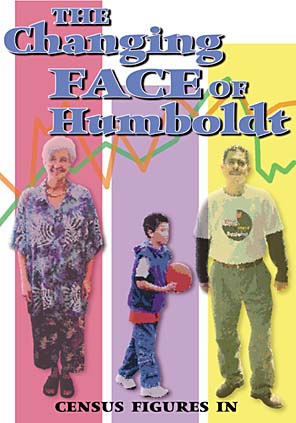
Humboldt County is changing,
in some ways slowly and in other ways very rapidly, and the 2000
census is the map to those changes. It delineates where we came
from, where we are going, who we are and who we are becoming.
The numbers that have started
to trickle out of the census look obvious on the surface. Humboldt
County's population in 2000: 126,518. We're 85 percent white,
almost 6 percent Native American and almost 2 percent of Asian
heritage -- none of which should surprise anyone who is in the
habit of looking at their human environment.
The data that have been released
so far are population, ethnicity and the number of residents
of voting age -- the detailed information about where people
work and how many toilets they have in their house won't be released
until later this year.
But take another look at this
initial data and you begin to see some trends. Just underneath
the surface of those numbers are stories, threads and social
phenomena.
This week the Journal takes
a look at three of these stories. We selected 11 communities
in Humboldt County, compared their census numbers from 1990 and
2000, and tried to figure out what's changed.![[chart of Percentage of change in under 18 population from 1990 to 2000]](cover0517-under18chart.jpg)
These are just three of the
stories. There are certainly many more, but these broad changes
are affecting the county as a whole, presenting new challenges
and changing our identity. More than anything else, that's what
the census is trying to tell us: who we are.
We aren't children
anymore...
In times of budget crisis, schools
have to look at all their optional programs and decide what might
be nonessential, said Trinidad Union School Principal Eric Grantz.
(in photo below) In Trinidad, Grantz said, optional programs
being "evaluated" include "music, art, library
personnel and new technology acquisition. Plus luxuries like
a vice principal and coaches." And Grantz's budget is definitely
in crisis.
Trinidad's population of children
shrank 44 percent between 1990 and 2000. In the last three years
alone, Trinidad Union's enrollment has dropped by 35 percent.
Why does that matter? State funding for schools is apportioned
on a per-child basis; the more children, the more money. A child
in California is currently worth about $4,200 in income; Trinidad
has 28 fewer children now than 10 years ago, so the pool of possible
funding open to Grantz has shrunk by more than $117,000.![[photo of Grantz]](cover0517-eric.jpg)
And it's not just in Trinidad.
While the overall population in Humboldt County grew by 7,400
over the last decade, there are 1,194 fewer children under the
age of 18. The annual loss to the Humboldt County's educational
system is as much as $5 million.
It takes the wind out of a school's
sails, said Janet Frost, administrative assistant with the Humboldt
County Office of Education. "It can cause major problems
in districts that still have to maintain the same number of teachers,
the same school site and the associated utilities, but they have
fewer dollars to do it," she said.
"We don't lose pupils in
groups that equal one class," Frost said. "For instance,
if you lose 20 students in your school, they will not all be
in the third grade," which would allow you to cut a third-grade
class out of the budget. Because the decline in enrollment tends
to be spread out across all ages and abilities, "a school
cannot dramatically cut back its expenditures without significantly
changing its instructional program."
The dollar drain doesn't affect
all schools in the same way. Rural school districts are particularly
hard-hit because they have less flexibility. Larger urban school
districts may be able to shift students to best utilize their
resources. Eureka City Schools dealt with declining enrollment
in elementary grades by closing Marshall Elementary and using
Marshall facilities for Eureka High School classes.
Rural districts "have school
sites that are spread out around an area so that children in
distant areas can attend school fairly close to where they live,"
Frost said. If you close one small rural school, "it may
mean they will have to take buses for a long time." When
the Southern Humboldt Unified School District decided May 3 to
close Miranda Junior High, one of the consequences was that some
students from Whitethorn Elementary School will probably have
to commute to Redway, almost an hour away.
And then there are school districts
like Trinidad with only one facility. "Closing isn't an
option," Frost said, because that one school "is who
they are. They're small; any loss of even a few students is proportionally
a big reduction in the kinds of services they can provide."
The cause of Humboldt's declining
childhood population may be as bad as its immediate effect, said
Gregg Foster, executive director of the Redwood Region Economic
Development Commission.
"Is this a symptom of something?
That's what we need to ask ourselves," he said. "If
we have fewer young people because the number of families aged
34 to 45 are decreasing, then we might be concerned because people
are not moving here or staying here because of jobs."![[chart of Percentage of change in population from 1990 to 2000]](cover0517-popchart.jpg)
Where is the growth?
The number of people under 18
declined in most of the communities studied for this report,
but a few towns managed to buck the trend: McKinleyville's youth
increased by almost 19 percent between 1990 and 2000 and Fortuna's
jumped 23.3 percent.
Those two towns managed to add
so many children by growing overall -- and fast. Fortuna, McKinleyville
and the Eureka suburbs are Humboldt County's expanding communities,
growing at rates of 19 percent, 27 and 29 percent respectively.
Why?
"The simple answer is,
that's where all the new houses are," said Foster. "Both
of them have a lot of developable land," something that
the city of Eureka does not. "Arcata -- both as a practical
matter because of lack of space and as a matter of policy --
limiting its growth. McKinleyville and Fortuna are not."
But double-digit growth does
not necessarily mean parallel increases in new jobs, Foster added.
He said there were probably some new jobs in both communities
but that the majority of the growth had come because "there
are a lot more commuters" sleeping in the two towns and
travelling to Arcata or Eureka to work.
McKinleyville, in fact, has
become a bedroom community, said Jill Geist, (in photo below)
a member of the board of directors of the McKinleyville Community
Services District. "In the '60s and '70s, we had several
working ranches. We had a strong agricultural base with heavy
flower production. There's been a shift away from that base,"
she said.
![[photo of Jill Geist]](cover0517-jill.jpg) What McKinleyville has instead of
jobs is livable space, she said. What McKinleyville has instead of
jobs is livable space, she said.
"There's still affordable
housing. We have adequate schools. There's a perception that
because we are a bedroom community with a nice downtown center,
a beautiful viewshed and less congestion, we are more of a family
environment."
The influx of people those amenities
are attracting is presenting the community with some serious
challenges, Geist said.
Some are concrete, like trying
to increase the capacity of the wastewater treatment system.
The McKinleyville plant has yet to become illegal, said Geist,
whose day job is with Arcata's Environmental Services Department.
But, she warned, its capacity is limited. A treatment marsh like
that in Arcata has been suggested, but Geist said that it would
still not solve all of McKinleyville's problems.
"I don't know what the
solution is," she said.
Equally challenging is the question
of how to provide McKinleyville with adequate police protection.
As an unincorporated community, McKinleyville is not a city but
simply part of the county. That means its residents are the responsibility
of the understaffed Humboldt County Sheriff Department.
"We are given one and a
half deputies for all of the 5th District," Geist said,
an area which encompasses almost the entire northern half of
Humboldt County. Neighborhoods get hit by vandals and petty thieves
regularly. McKinleyville would have to incorporate as a city
in order to provide itself a police force, Geist said.
There are other reasons for
a community growing as fast as McKinleyville to incorporate,
she said.
"We don't have a vehicle
by which the community can express its concerns," she said,
and a city government would provide one. "It would go a
long, long way toward letting McKinleyville decide its future,"
she said.
But it's an expensive proposition.
Geist pointed out that Arcata's budget was more than 10 times
that of the community services district's for the last year.
The revenues that could be gathered from a community that serves
mostly as a residential neighborhood wouldn't support incorporation,
she said. The explosive growth in McKinleyville may have created
a policing problem, but it is not going to solve it any time
soon.
"If the community wants
to incorporate, they can't do it as a bedroom community; they
have to have more than retail," she said. "How do you
do that? I think that's part of the struggle for the county in
general."
Growth is certainly a question
for Fortuna. Fortuna is less purely a bedroom community for Arcata
and Eureka than McKinleyville. With strong roots and current
connections to the timber and agricultural industries, Fortuna
is mostly a working town, said Mayor Phil Nyberg.
The good news is that many of
the problems facing McKinleyville have been or are being dealt
with by city government in Fortuna. The police "have done
an excellent job with crime," Nyberg said. The city has
been sued over its sewage treatment plant by the organization
Riverwatch, but he said the situation is under control. "And
we have an excellent road system," Nyberg said.
But the economic basis that
pays for all the amenities of city government may become a lot
less stable in the near future. Eel River Sawmills, one of the
two biggest employers for Fortuna, has declared it will close
its doors soon. As of press time, the mill had managed to purchase
logs to keep it in operation for the time being, but its future
is far from certain [see this week's In the News section].
"We're aware there may
be a squeeze in those areas," Nyberg said. "That's
one of the reasons we are conservative in our city budgets. It
could reduce the growth rate."
At the opposite end of the spectrum
from Fortuna is Eureka. Humboldt County's largest city shrank
by 897 people. Leading the way out of the city were whites; 2,289
fewer people classified themselves as Caucasian in Eureka's 2000
census as had a decade before.
But they may not have moved
very far. The unincorporated suburban communities surrounding
Eureka -- Cutten, Humboldt Hill, Myrtletown and Bayview -- grew
29 percent.
"A certain class of people
likes to live in Cutten," said Eureka City Councilman Jack
McKellar. He said upper-middle class people were leaving for
the suburbs because "they don't have any homeless shelters
or drug abuse shelters there."
"I think it's a choice
of a suburban rather than an urban lifestyle," said Eureka
Mayor Nancy Flemming. She said that drug treatment facilities
and halfway houses have actually helped to improve neighborhoods
in Eureka and were not the problem.
But the people leaving the city
for its suburbs were mostly young professionals with children,
she said, and it would be hard to attract them away from the
quiet and affordability of suburban life. "Young families
who can afford to live in a rural area will do that."
The key to keeping Eureka's
core alive is to embrace its city character and promote an "urban
lifestyle" as desirable, she said.
"You will see a different
group moving in" to replace the families, Flemming said.
Young professionals before they have their families and young
retirees will flock to an attractive urban environment precisely
because it is urban.
"We have really focused
on creating an arts and cultural district in Old Town that has
around the clock activities," she said. "It is our
responsibility to make this a livable city."
We're a growing
community![[chart of Percentage of change in Hispanic population from 1990 to 2000]](cover0517-hispanicchart.jpg)
Humboldt County's distinctly
rural character has brought people north for a century, fleeing
the populous cities to the south. For no group was this more
true over the last decade than Latinos.
Humboldt still lags far behind
the state in the percentage of people who identity themselves
as Latino -- just 6.5 percent vs. more than a third for the state
as a whole. But Humboldt far outstripped the state in the rate
of growth. The local Latino population grew at a rate of 65 percent
since 1990, compared to 42 percent across the state.
And this growth in the Latino
community -- also called Hispanic, or Chicano, or la Raza, depending
on who you talk to -- is real. Consider this: Over the last 10
years, Latinos became Humboldt County's largest minority group,
surpassing Native Americans. Small towns like Fortuna and Rio
Dell are now more than 10 percent Latino.
"A lot of people from Latin
America are farmers, so they like that kind of work, and they
come from places rich in natural resources, so the forest is
attractive to them," said Santiago Cruz (in photo below),
publisher of the Spanish language El Heraldo newspaper.
![[photo of Cruz]](cover0517-santiago.jpg) Cruz moved here from Mexico with his wife,
a native Eurekan, in the late '80s [See "Building a Bridge," Journal cover
story, Dec. 16, 1999]. His home
in central Mexico, San Luis Potosi, was rural in character, so
it made sense for him to come to a rural part of California,
he said. The small town life agrees with many aspects of Latin
American culture: It is family centered, friendly, simple and
connected to the land. Cruz moved here from Mexico with his wife,
a native Eurekan, in the late '80s [See "Building a Bridge," Journal cover
story, Dec. 16, 1999]. His home
in central Mexico, San Luis Potosi, was rural in character, so
it made sense for him to come to a rural part of California,
he said. The small town life agrees with many aspects of Latin
American culture: It is family centered, friendly, simple and
connected to the land.
"A lot of people are coming
up here from the big cities because they want a place to raise
their families," Cruz added.
And the Humboldt County vision
for the economic future meshes with Latino culture. "I think
the `Prosperity' plan [the county's economic development document]
is appealing to us because it promotes the well-being of the
community without changing some of the small-town atmosphere
and friendliness of people. Without staying apart from technology,
we still prefer a slower pace of life," he said.
The increased Latino presence
has for the most part been accepted by Humboldt County residents.
Cruz said Humboldters were by and large "very educated and
business-minded people who understand the value of the presence
of immigrants. ... Most of us are willing to sacrifice to succeed
in business. Some of the main industries -- agriculture, dairies,
manufacturing, fisheries, timber -- they hire a lot of Hispanics.
Due to that, we are welcome."
Cruz said Latinos now need to
integrate themselves into management and business ownership.
"We have been part of the work force and the next step will
be to be integrated into the Humboldt County economy. We have
had restaurants for years but we want to diversify.
"And businesses are beginning
to perceive a market in the Latino population," Cruz said.
The Bayshore Mall has a specific policy to demonstrate Latinos
are welcome, including allowing them to hold a cultural festival
there every year.
To help further Latinos' economic
integration, Cruz has set up a program where a certified public
accountant of Mexican descent will help business owners with
bookkeeping and taxpayers with tax returns. He said the Humboldt
County economy loses every year when immigrants who do not understand
the system fail to file tax returns. Their refunds never get
sent and therefore never get spent at local merchants. "The
local economy will grow if immigrants get their refunds,"
he said.
![[photo of Rosalinda Larios]](cover0517-rosa.jpg) There are some growing pains
associated with the burgeoning Latino population, said Rosalinda
Larios (in photo at right), a Humboldt State University student
and Chicano activist. Larios said that while she's never been
confronted by direct, explicit racism, there have been subtle
instances. There are some growing pains
associated with the burgeoning Latino population, said Rosalinda
Larios (in photo at right), a Humboldt State University student
and Chicano activist. Larios said that while she's never been
confronted by direct, explicit racism, there have been subtle
instances.
"When my boyfriend and
I go to the supermarket at night to buy beer we're followed down
the aisle by a security guard," she said. "I've been
told to speak English because we're in America."
Larios said the most important
thing is that people in Humboldt County change their mentality
about her ethnic group. She said Latinos aren't just visitors
or outsiders; they are in Humboldt County to stay.
"We are a growing community
and we deserve respect. If anything, what's going on now should
serve as an eye-opener to the white people that there are other
people," she said. "This place isn't only for white
people. It's beautiful out here and should be open for all."
IN
THE NEWS | IN THE GARDEN | CALENDAR
Comments? E-mail the Journal: ncjour@northcoast.com
© Copyright 2001, North Coast Journal,
Inc.
|