 
COVER STORY | IN
THE NEWS | ARTBEAT
TALK OF THE
TABLE | THE HUM | CALENDAR
May 4, 2006
11 Questions for Casey Crabill
story and photo by HELEN SANDERSON
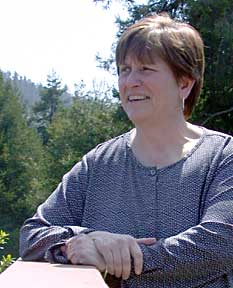 Casey
Crabill, right, College of the Redwoods' popular president,
announced last week that she is leaving to take over as president
of Raritan Valley Community College in North Branch, N.J., this
summer. During her tenure, CR obtained a $40 million, 30-year
bond to update facilities, opened campuses in downtown Eureka,
Arcata and Klamath, started early college programs for high-schoolers,
opened the Tourism and Hospitality Institute and created a community-based
strategic planning process. On Thursday, Crabill talked with
the Journal about CR's uniqueness, what it takes to be
a leader and why community colleges are a vital part of democracy. Casey
Crabill, right, College of the Redwoods' popular president,
announced last week that she is leaving to take over as president
of Raritan Valley Community College in North Branch, N.J., this
summer. During her tenure, CR obtained a $40 million, 30-year
bond to update facilities, opened campuses in downtown Eureka,
Arcata and Klamath, started early college programs for high-schoolers,
opened the Tourism and Hospitality Institute and created a community-based
strategic planning process. On Thursday, Crabill talked with
the Journal about CR's uniqueness, what it takes to be
a leader and why community colleges are a vital part of democracy.
1. Let's start with the obvious: Why are you
leaving?
I have been here doing this for seven years and
that's almost double the average tenure for a community college
president. It tends to be a job people move around from. I think
that there are some benefits both to the individual and the institution
when people move. I think fresh eyes are good. I think somebody
could come in and say, `Oh, why aren't you doing this?'
and I wouldn't see it anymore because I'm so close to it. So,
from a professional standpoint that kind of change is challenging
and energizing.
2. When you came in, what were you able to see
with fresh eyes?
I came in and it wasn't so much as "saw"
as "felt" that we were fairly isolated from our community,
and that's not healthy, in my judgment, for a community college.
There is really a very special mission for community colleges
to be locally rooted. That's why I'm in it. I like that we impact
people who live here. So that disconnect was a big deal to me.
3. How did you reconnect?
We did listening sessions and got out and met people.
Like, I met with the sixth graders at Winship [Middle School]
a few weeks ago and I said to them, "How do you like your
college? It's a community college; you kind of own the place."
So it was exciting getting to know the communities and helping
them own the place. That resulted in some things like the Hospitality
Institute, like the Eureka downtown center, like the compressed
calendar that made more opportunities available at different
times for people, like the online stuff. We got pretty good direction
from our communities.
4. Is it hard to balance the college prep and
vocational aspects of the school?
It is the key critical challenge facing community
colleges. We're what we call in higher education a comprehensive
institution. So we have a very complex mission that says, you
have to prepare students to transfer so they can be full-fledged
juniors. You're also charged with preparing people with the right
jobs for your region so they can make a living and support their
families. And you're open-entry, so you have to have enough
of the basic skills so that the access is real, so if a student
comes in and has challenges with reading or math or English you
have the prep classes so there's real access to transfer. You
don't just let somebody come in and flop around and fail. That's
not access.
5. You've been president of other community
colleges in Connecticut. What's unique about College of the Redwoods?
We have some programs that don't exist anywhere
else — the fine woodworking program [in Mendocino], the historic
preservation program, our manufacturing program. Those are really
outstanding, very, very different kinds of programs that aren't
replicated any other place. And there's no campus in the country,
I think, that's more beautiful than this one.
I think the level of effort the students exert
to be part of the college, in terms of working and managing childcare
and figuring out their transportation, all in a very difficult
economic environment, is different. I think that in general this
is a more challenging place to make a living for people who don't
have an education, and I see a pretty serious struggle on the
part of students to fight really hard to get their education.
So when they get it, it's really remarkable.
6. In April you were on a panel with Cherie
Arkley and Julie Fulkerson as part of the Cascadia Leadership
Conference. What did the three of you have in common as leaders?
The strongest thing we had in common is a real
sense that you have to get in touch with your own personal courage.
You have to be willing and able to take a risk. I think we were
all very focused on being personally OK and taking care of family
as a foundation. You've got to be comfortable and happy and positive,
because if you don't have that it's hard to find the energy to
care about the other stuff.
7. A lot has been made of the fact that you
will be the first woman president of Raritan Valley ...
Yes. Again, the first woman president! It's
2006, for God's sakes! [Laughs.]
8. But it is a big deal. You are the first,
so that's important.
I'm probably also the first person in my 40s to
have that presidency, because typically people are older. But
that doesn't draw that much interest. For me it's just that constant
reminder that the more things change the less they actually change.
I know what it means for me to do this work. Do I do it differently
than a guy? I don't know.
It's also hard for me to interpret because I've
worked for a number of presidents, but they've all been women.
I worked for a chancellor who was a man, but when I was a vice-president
and when I was a dean the president of both of those schools
was a woman, so my models were always women.
9. What kind of person would you like to see
as president of CR? What qualities should the new president have?
For me, if I were giving advice to somebody, I
would say that this is a college that functions on relationships,
and so it needs to be somebody who is happy to engage with everybody,
both internally and externally. You have to enjoy conversation,
you have to value other people's opinions, you have to go seek
opinions from the people who don't necessarily come to you. I've
always valued even showing up at a basketball game or an art
show. I'm not doing anything other than being there and respecting
the work of the students, but that's really important to the
college.
10. Are you excited to move? Or does anyone
actually say they're really stoked about moving to New Jersey?
Well, it's 45 minutes from Manhattan, and I do
miss some urban culture. But this part of New Jersey does have
trees. It's an area that still has quite a bit of farmland and
some small towns. I'm excited for a number of reasons. I'm going
to be closer to people that I care a lot about. Some of my family
is on the East Coast. I have lifelong friendships that have been
3,000 miles away for a long time. It will be nice to be closer
to those people.
11. You only applied for positions at community
colleges. Why work for community colleges rather than universities?
Is there a difference?
Community colleges change the lives of the people
who go there. They are the great democratizing force in this
country. They are truly engines of social change and social justice.
I learned that at an early age. My mom got her
education when I was in high school at a community college. She'd
been accepted to college when she graduated from high school
and she couldn't afford it. So she got married and had kids,
but always had that sense that she wanted to do something —
and I think, hey, you raised three kids! But what she meant was
she wanted access to a different economic opportunity and a different
intellectual opportunity. Universities do that for some people,
but I think by and large community colleges are that engine.
So I have a longstanding, very deep, political, personal belief
in community colleges.
People ask me all the time, why don't you move
up to the university? It's not "up" to me. I've been
in this realm for most of my career in education, and that's
on purpose.
COVER STORY | IN
THE NEWS | ARTBEAT
TALK OF THE
TABLE | THE HUM | CALENDAR
Comments? Write
a letter!
© Copyright 2006, North Coast Journal,
Inc.
|