|
 
IN
THE NEWS | CALENDAR

The rancherias at Trinidad
and Blue Lake
are quietly battling for the region's growing gambling market.
Above: an
airbrush artist works on a Blue Lake Casino mural
Below right: Workmen complete rock work at Cher-Ae Heights Casino
in Trinidad.
story & photos by BOB DORAN
 WORK IS ALMOST
DONE ON A MAJOR upgrade of Trinidad Rancheria's Cher-Ae WORK IS ALMOST
DONE ON A MAJOR upgrade of Trinidad Rancheria's Cher-Ae
Heights Casino, set on a bluff
overlooking Trinidad Bay. Meanwhile, over at Blue Lake Rancheria,
work is proceeding full-steam ahead on a new gaming facility
located off Highway 299. The Blue Lake Casino will employ 300
people and could provide a much-needed shot in the arm to the
local economy. It won't be able to compete with the scenic setting
of Cher-Ae Heights. But, as it is significantly closer to Arcata
and Eureka, it will have the important advantage of convenience.
It's a high stakes gamble for
both tribes: Trinidad's upscale expansion has set them back almost
$7 million, while Blue Lake's new casino is costing about $30
million.
How big is the gaming pie the
two casinos will be fighting over? No one knows exactly, but
according to a 2001 report by the New Orleans-based research
firm Urban Systems Inc., the potential market for casinos in
the northern Humboldt area could be as much $100 million a year.
No one is calling it a war, but a battle is clearly brewing.
Cher-Ae
Heights
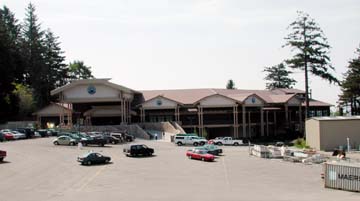 What started
in 1988 as "a 20,000 square-foot tilt-up, a tin building"
-- as one tribal official put it -- will soon be a 50,000 square-foot
facility with a new look, more slots, an expanded bingo room,
a bar dubbed the Firewater Lounge and the 200-seat Sunset Restaurant
overlooking Trinidad Head. What started
in 1988 as "a 20,000 square-foot tilt-up, a tin building"
-- as one tribal official put it -- will soon be a 50,000 square-foot
facility with a new look, more slots, an expanded bingo room,
a bar dubbed the Firewater Lounge and the 200-seat Sunset Restaurant
overlooking Trinidad Head.
"We've been in operation
for over 14 years and I'm proud to say that we've never closed
our doors one time," said Carol Ervin, tribal chairwoman
for what is officially known as the Cher-Ae Heights Indian Community
of the Trinidad Rancheria.
The same cannot be said for
a number of California Indian casinos. Many have closed -- some
permanently -- due to changes in management or troubles with
investment arrangements.
Cher-Ae Heights itself has gone
through several management teams over the years, although currently
the tribal council manages the casino.
"We don't have anyone from
the outside who comes in to run our business," said Ervin.
"If you get outside management and money in, they're the
ones who handle everything and the tribe doesn't have a lot to
say about what's going on."
According to Ervin, the original
bingo hall was financed by a small group of investors, who put
up $25,000 to $40,000 each for a total of $400,000.
Over the course of 14 years
that initial investment has generated millions of dollars, particularly
since California's Indian gaming rules began allowing coin-fed
slot machines.
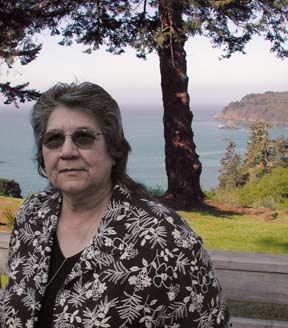 Carol Ervin,
tribal chairwoman for the Trinidad Rancheria Carol Ervin,
tribal chairwoman for the Trinidad Rancheria
sure and they're not saying.
But the report by Urban Systems makes an educated guess; it says
Cher-Ae Heights grossed as much as $50 million last year.
Where does all that money go?
"A lot of it goes back
to the winners," said Ervin. "It goes to pay wages,
to pay the vendors for the food and supplies, it goes into advertising.
It goes back to the community in donations.
"And it goes to assist
our members. We have a housing fund, an education fund, we pay
health insurance, fire insurance. We're developing a social welfare
base for our members so that no one will be on public assistance.
"I think the bottom line
is this: the money does not leave here, it stays in this community."
The idea of the remodel was
to maintain a natural look on the exterior so the building blends
in with the environment. "It's kind of a modernized replication
of an Indian house. Then as you get into the interior you'll
see more touches of Indian-ness. We didn't want it to be all
neon and bubbles shooting in the air.
![[photo of Jack Caza and Eric Bentler]](cover0502-cheraefoodguys.jpg) Cher-Ae Height's Chef
Jack Caza on left and
Cher-Ae Height's Chef
Jack Caza on left and
Food and Beverage Manager Eric N. Bentler.
"I see it as a melding
of the old and new. I wanted the Indian people to have pride
in it and feel some connection with it; on the other hand I wanted
non-Indian people to feel they were welcome too.
While there is still work to
be done on the building's interior, the restaurant is complete
and the exterior upgrade requires only minor finishing touches.
"This is it for the expansion,"
said Ervin. "We don't have a grandiose dream. We're not
going to build a 100,000 square-foot building. We're comfortable
with what we have. We're going to make it nicer and add more
machines. Before we're done I think we'll end up adding about
a hundred more machines."
It is possible, though, that
the tribe may one day build a "destination resort"
with accommodations for out-of-town gamblers, Ervin said.
"We have a beautiful setting
here and we have an empty building here, (since the United Indian
Health Service moved to Arcata) and do we want to tear it down?"
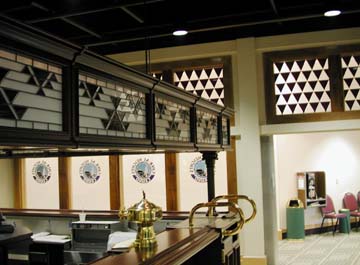 The Firewater Lounge, The Firewater Lounge,
named by tribal elder Joy Sundberg.
A
history of competition
On the wall behind Ervin's desk
are framed art pieces by her cousin, Brian Tripp. Talking about
his work, she mentions a piece that hangs in the hallway, a painting
with a poem about the brush dance. As talk turns to the importance
of the dances, she mentions their competitive nature.
"There was always a lot
of rivalry. The tribes competed against each other to see who
had the best singer, the best dancers and who's going to come
out with the strongest regalia. (And even today) they start in
the morning and as the day goes on they get more dressed up,
more feathers, more color. They get out of the Levis and sweatshirts
look. It's a competition."
And the competition between
the casinos? "I think it will be healthy. It will give people
a choice.
"Will it have an effect
on us?," she continued. "I don't think so. I think
they are two different businesses. We have 14 years experience.
We're here. We've been here for a long time. We're stable."
While Ervin says she feels secure,
the report by Urban Systems Inc. suggests she should be concerned.
It predicts that once the Blue Lake Casino is up and running,
it could draw around 10 percent more revenue than Cher-Ae Heights.
![[inside expanded bingo hall]](cover0502-insideconstruct.jpg) An
inside look at the expanded bingo hall under construction. An
inside look at the expanded bingo hall under construction.
How much money? Only the tribe
knows for
The Big Lagoon Rancheria commissioned
the report, which concludes that there's room for a third casino
on the Humboldt coast. Big Lagoon, a 16-member tribe that owns
and operates Hotel Arcata, still holds hopes of entering the
gaming business although so far their plans have stalled. Urban
Systems suggests that if they did build a casino, they could
pull in as much as 18 percent of the region's gaming revenue.
While Ervin admits that she
does not know all the details of Blue Lake's plans, the big difference
she sees between the two casinos is in financing.
"We have used local financing
with our banks, with Humboldt Bank, Six Rivers Bank, Wells Fargo.
We try to keep all of our business right here.
"I think Blue Lake has
outside investors coming in and I don't know how much say they
have about what goes on inside. All you know is what you hear,
and we heard there's a big investment group from Las Vegas or
someplace that's putting up something like $17 million."
Blue
Lake Casino
[architectural sketch
for entrance to the Blue Lake Casino]
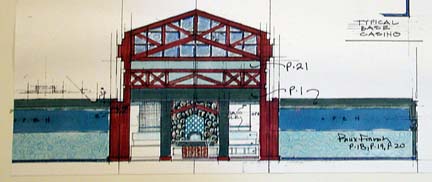 There's
only a seed of truth in the rumors Ervin has heard about the
casino her neighbors are building 20 miles away on the Blue Lake
Rancheria. There's
only a seed of truth in the rumors Ervin has heard about the
casino her neighbors are building 20 miles away on the Blue Lake
Rancheria.
Just as Cher-Ae Heights is managed
by the Trinidad Rancheria -- rather than an outside management
group -- the casino in Blue Lake will also be managed by the
tribe that owns it, the Blue Lake Rancheria.
But while Cher-Ae heights was
originally built with money provided by a small group of individual
investors, the Blue Lake facility is being financed through bank
loans guaranteed in part by an Indian casino in Louisiana.
In an interview, Blue Lake Casino's
chief financial officer Eric Ramos nonetheless emphasized the
project's independence. "Many tribes think that the only
way they can put together a large deal is to go out and make
deals with some Vegas guys or other money guys. That's not the
truth."
Ramos, who was born and raised
in Blue Lake, has a background in finance. He has a business
degree from Humboldt State University. After graduation he went
into the world of business.
"I spent a number of years
in Silicon Valley before coming back here. I worked for a `big
five' accounting firm, KP&G, for a while, then worked for
a couple of start-up companies. When this project came online
I ended up coming back."
Essentially he returned to help
run the family business. "The rancheria is sort of a big
family and it's a pretty exciting time for us," he said.
In fact, the casino operation's chief executive officer, Arla
Ramsey, is Ramos' mother. Jason Ramos, chairman of the tribal
gaming commission, is his twin brother.
Planning for the casino project
started in mid-1999 and construction was begun two years later.
An opening date is set for Aug. 1.
"With some luck we'll meet
it, maybe, maybe not, but that's the date we're aiming at,"
Ramos said.
How big will it be?
"The casino is 44,504 square
feet (almost as big as the expanded Cher-Ae Heights facility).
It has 349 machines and 12 tables with Blackjack, Hi Gal, Let
It Ride, Caribbean Stud, those types of card games. Some are
poker-based."
It's no coincidence that the
Blue Lake Casino and Cher-Ae Heights will both end up with 349
slot machines. Why 349?
"Under the state gaming
compact, tribes that have 349 gaming devices or less are considered
non-gaming tribes. Everyone pays a license fee for each machine,
but when you go over 349, you also pay a percentage of net win
on the machines, and that money goes into a revenue-sharing pool
for all of the non-gaming tribes.
"Once you go over 349 you
are no longer considered a `small tribe' and you don't get to
share in the revenue distribution pool. I believe the money also
goes to pay for all of the behind-the-scenes work that goes to
administer and regulate gaming."
Typically tribes that enter
the gaming business in a big way will have more than 350 machines.
The Hopland Sho-Ka-Wah Casino in Mendocino County, operated by
the Hopland Band of Pomo Indians, has more than 700 machines;
that's small compared with some Indian casinos in southern California.
"In a place like Palm Springs
you might find 2,000 machines or more," said Ramos.
Of necessity, Blue Lake is starting
small.
"We have to be kind of
conservative because we don't really know what this market is.
Our hope and our goal when we came out to build this is that
we would have the nicest casino from the Bay Area north."
The firm handling construction
for Blue Lake Casino is Kitchell Corp., an Arizona-based outfit
with a full division dedicated to Native American projects, primarily
casinos.
"Kitchell only builds top-quality
stuff," Ramos claimed. "Not to stereotype them, but
there are a lot of Indian casinos out there, especially in California,
that are basically metal buildings.
"I'm not knocking anyone
who built a tin building," he went on in an apparent reference
to Cher-Ae Heights' original structure. "We just took a
different approach. Instead of putting up the tin structure and
building it into an elegant place later on, we're going to come
out on the market with something that's really nice right out
of the gate."
Like Cher-Ae Heights, the Blue
Lake Casino will feature a bar -- the Steelhead Lounge -- and
an upscale restaurant, the Trillium (prominent Humboldt chef
Jean-Louise Hamiche will be running the kitchen). Alice's Restaurant,
named for a founding member of the tribe, will offer a buffet,
and there will be a fast-food area near the bingo hall. "The
bingo hall will be used as a multipurpose room so we can have
concerts, boxing, poker events, pool tournaments," Ramos
said.
![[photo of Ramos and Frank]](cover0502-alices.jpg) Chief
financial officer Eric Ramos and general manager Tom Frank in
the Blue Lake Casino's Alice's Restaurant Chief
financial officer Eric Ramos and general manager Tom Frank in
the Blue Lake Casino's Alice's Restaurant
The tribe raised capital for
the casino through a financing arrangement called a "loan
syndication" in which a lead bank recruits other banks to
put up money for a loan. "The lead bank administers the
loan, they collect the interest and principle payments and find
a way to perfect their interest in cash," Ramos said.
A complicating factor is that
the Blue Lake Casino is located on an Indian reservation, which
is essentially land held in trust by the federal government.
Because it is not legally possible to put a lien on government
property, the lead bank would not be able to foreclose on the
casino should it fail. That, in part, is why Blue Lake needed
another entity -- the Coushatta tribe of Louisiana -- to guarantee
the loan.
Many tribes avoid the complexities
of arranging financing by signing a management agreement with
an outside company. For example, the Big Lagoon Rancheria worked
on plans with at least two investor groups, including Gaming
World, a division of Bally's, the company that operates four
Caesar's casinos around the county. In many cases, tribes will
turn over operation of the casino to a management firm and just
take a percentage of the profits.
"You know what?" Ramos
said. "Debt service, the cost of money when you go to bank
syndication, is not cheap. But the flipside is, when you go with
a management group, they want a lot of money, either a percentage
or some other fee basis."
Ramos said no one from Las Vegas
or Atlantic City is involved in the project. Still, the tribe
will not run the casino alone. It has hired Tom Frank, a 15-year
gaming industry veteran, to be the casino's general manager.
As for the Coushatta tribe,
they run the Grand Casino near the border with Texas. Ramos said
"the Grand" is about 10 times bigger than the Blue
Lake Casino. Besides acting as a loan guarantor, the Coushatta
will also train Blue Lake's blackjack dealers. Ramos said the
Blue Lake tribe is paying a fee (he didn't specify how much)
to the Coushatta for the loan guarantee. Blue Lake will also
pay a fee for the blackjack training. "You pay for everything
in this world now," Ramos said.
"It's not easy when you
don't have any operating experience and you're trying to shop
for $30 million. Fortunately for us, (the Coushatta) stepped
up and offered help.
"What happens is Indian
tribes build their casino and it's profitable, then they look
at other businesses. Because they're in the gaming business,
it's easy for them to find a strategic partner in another tribe
that's building a casino. That's where our partnership came from."
Ramos believes the Blue Lake
Casino will provide an economic boon -- not only to the tribe
but to the surrounding community.
"From an economic standpoint
the North Coast needs business. People have to work to eat. We're
going to hire 300 folks locally.
"I don't know if you've
noticed, but timber isn't doing real well; there's not a lot
of local manufacturing that is doing well. Blue Lake Forest
Products, right down the road from us, just went out of business."
About the competition from their
neighbors?
"I think in the end any
sort of competition, even if it's between tribes, only helps
the customer. Cher-Ae Heights is going to run specials so that
the customer can play some other game or do something, and Blue
Lake will have to turn around and offer the same special or something
better. In the end the spirit of competition will foster a better
environment and provide more value to the customer. That sounds
clichéd, but it's the truth."
|
CASINO
STATS |
|
TRINIDAD
Cost: $6.5-7 million for upgrade
Size: 50,000 sq. ft. (bigger than a
football field)
Number of slots: 240
Bingo room: seats 800
Restaurants: Sunset Restaurant and a "snack
bar"
Employees: 200 in casino, 390 on tribal payroll
w/ Seascape and North Coast Inn
Opening date: scheduled for June 1
Members in tribe: 99
|
BLUE
LAKE
Cost: about $30 million for new facility
Size: 44,504 sq. ft. (bigger than a
football field)
Number of slots: 349
Bingo room: seats 456
Restaurants: The Trillium, Alice's Restaurant
and a "fast food operation"
Employees: 350+
Opening date: Aug. 1
Members in tribe: 51
|
IN
THE NEWS | CALENDAR
Comments? E-mail the Journal: ncjour@northcoast.com
© Copyright 2002, North Coast Journal,
Inc.
|