|
 
COVER
STORY | CALENDAR
April 18, 2002
UPDATE: A new Freshwater
flap
by KEITH
EASTHOUSE
A new source of disagreement has emerged in the long-running
controversy over logging in the Freshwater basin east of Eureka.
The latest tiff concerns a recent
report that raises questions about whether the state agency charged
with regulating logging in Freshwater has underestimated the
extent to which timber harvesting by the Pacific Lumber Co. is
increasing the frequency and extent of flooding in the watershed.
The report has been quickly
dismissed by scientists with Pacific Lumber and the California
Department of Forestry and Fire Protection.
In a nine-page report prepared
last month, Leslie Reid -- a leading expert on the environmental
impacts of logging -- said that when CDF calculated the likelihood
of flooding in Freshwater in a study last year, it failed to
consider the most important factor: the reduction in the ability
of streams to carry water due to channel shrinkage caused by
sediment build-up from harvested areas and logging roads.
Instead, CDF looked only at
the extent to which logging activity can increase peak streamflows
from run-off from logged areas and logging roads. Reid noted
in her report that Pacific Lumber's own analysis of flooding
in Freshwater suggests that "75 percent of the flooding
problem is due to sediment accumulation and 25 percent to increased
runoff."
Reid's report threatens to undermine
CDF's determination that 500 "clearcut equivalent acres"
can be harvested annually in Freshwater without further damaging
the basin is scientifically justifiable. It also puts at risk
a similar limit in the watershed immediately to the south --
the Elk River basin -- where CDF has imposed an annual ceiling
of 600 "clearcut equivalent acres." (The restrictions
apply only to the amount of land that is clearcut; the company
can log more acreage if it uses lighter logging methods, such
as selective harvesting.)
Even if CDF is right that the
current level of cutting won't make things worse, Reid's report
questions whether such an approach is wise in watersheds that
are already in tough shape.
Reid, a U.S. Forest Service
scientist with the Redwood Sciences Laboratory in Arcata, wrote
the report at the request of Humboldt County Supervisor John
Woolley, whose district includes the Freshwater and Elk River
basins. Woolley said last week that he hopes that "the important
critical statements (in Reid's report) are responded to by the
company."
John Munn, the CDF hydrologist
who made the flooding calculation, did not deny that he didn't
factor in decreased channel size due to sedimentation. But he
said the purpose of his calculation was simply to determine how
much logging could take place and not increase peak flows beyond
what they already are.
"Our conclusions haven't
changed," Munn said. "The (annual acreage) limit was
based on not making peak flows worse."
Jeff Barrett, director of fish
and wildlife programs for Pacific Lumber, echoed Munn's remarks.
"My overall response is that yes, Munn didn't consider (channel
constriction). His analysis was an analysis of peak flows. He's
being criticized for not doing something that he wasn't trying
to do."
Both Barrett and Munn said that
the restrictions the company is operating under as part of its
Habitat Conservation Plan -- such as limiting the amount of logging
that can take place in landslide-prone areas -- have substantially
reduced the amount of sediment the company's timber activities
are releasing into waterways.
Additionally, Barrett said that
an ongoing effort to rehabilitate logging roads -- the main source
of sediment discharge connected to logging -- is more than offsetting
whatever sediment discharges are taking place in Freshwater from
current logging.
Ken Miller of the Humboldt Watershed
Council, a strong Pacific Lumber critic, said that the difference
between Reid and Munn is "not just one more disagreement
between experts."
"Reid has shown that Munn
has made fundamental errors in his assumptions, his math and
in his conclusions ... and that those flaws result in a gross
overcalculation of how much logging is allowable without causing
further damage."
Miller castigated CDF for allowing
a level of cut that will perpetuate "the current degraded
conditions."
"Prolonging an impact is
itself an impact" and could prove lethal to hard-pressed
salmon and steelhead species in the two watersheds, Miller said.
Reid's report comes at a time
when the North Coast Regional Water Quality Control Board is
weighing whether to impose restrictions on the amount of sediment
that can be legally discharged from Pacific Lumber timber harvests
in Freshwater, Elk River and three other basins that have been
intensively logged by the company over the past decade (the board
is holding a two-day hearing in Eureka beginning Thursday to
discuss the matter).
Reid's report also comes as
the board has hired Concur Inc., a Bay Area-based mediating group,
to help resolve the longstanding and bitter dispute between Pacific
Lumber and residents who live along Freshwater Creek. Susan Warner,
executive officer of the board, said Tuesday that any mediation
that occurs will not include residents of the North Fork Elk
River, because they are in the midst of suing the company for
property damage. (Some residents there believe that Pacific Lumber
logging has fouled their drinking water with excess sedimentation.)
Whether mediation will actually
take place is not clear. Miller of the watershed council said
Tuesday his group -- which represents some Freshwater residents
-- might be willing to enter into talks provided they are limited
in time to perhaps 30 days; and provided that during that time
Pacific Lumber halt or reduce ongoing logging and not go forward
with planned logging in the two basins.
Jim Branham, Pacific Lumber's
director of government relations, said Tuesday that he couldn't
comment about whether the company would be open to such a proposal.
He reiterated, however, the company's position in favor of mediation.
Layoffs
at Blue Lake mill
Bruce Taylor Sr. knows the number
exactly: 93.
"That's the number of families
affected, including mine," he said Monday.
As president, CEO and founder
of Blue Lake Forest Products, Taylor ordered layoff notices for
84 employees Friday. He said the layoffs are permanent unless
new capital is found.
"The mill is shut down.
We have laid off everyone at the sawmill." About nine employees
remain to finish planing and shipping lumber still on hand, which
should take about a month.
"Basically, we're out of
logs," said Taylor, blaming the severe curtailment of logging
in national forests and low lumber prices that encourage private
landowners to hold on to their stock.
"Plus, we have logs rotting
in the woods, like those [downed] in the Megram fire" that
remain unavailable for salvage logging.
"The people who want to
get all sawmills out of business are winning," he said.
It was well known that the mill
has been struggling, but the layoffs still came as a surprise
to some employees.
"We've had problems before,
but I've always been able to come up with a plan. This time I
couldn't," Taylor said.
The mill was founded by Taylor
in 1986 when he purchased the old McNamara and Peepe facility
in a bankruptcy sale. Taylor filed his own bankruptcy Chapter
11 in 1991, settled with creditors and emerged from bankruptcy
in May 1992.
Taylor said Blue Lake is a modern
mill serving 150 to 200 customers in California and Oregon, that
specializes in odd-sized boards and planks and other specialty
lumber.
"We can cut up to 26 feet
in length," Taylor said. "It's the best mill of its
type in the Pacific Northwest. It's too good a mill to remain
closed."
Sterns may
get probation
Although John Sterns changed
his plea to guilty on all counts last week and was taken into
custody, he may not actually serve much time in prison.
"The court may very well
give him probation," said Rob Wade, deputy district attorney,
following the hearing.
Sterns, the chief fundraiser
for Humboldt State University until his arrest in March 2001,
pleaded guilty to all nine felony counts of embezzlement, falsifying
records and forgery. He admitted pocketing nearly $50,000 in
reimbursement for false travel and business expense claims. He
also inflated university donation reports by $15 million in a
scandal that rocked the university and resulted in a special
investigation by the Chancellor's Office.
"The district attorney's
office got everything we wanted" -- an unconditional guilty
plea on all counts, Wade said. "The investigation conducted
by the university, by Sgt. Tom Dewey, was excellent. With that
quality of work, we were able to file and get a conviction on
all charges," he said.
Sterns faces a maximum of eight
years and four months in prison and will likely pay restitution
of about $100,000 for direct losses suffered by the university.
He is also liable for fines of up to $10,000 for each of the
nine counts. Whether he actually serves time in prison or is
placed on parole as a felon is undetermined.
Judge John Feeney ordered a
psychiatric evaluation of Sterns, which is expected to take 90
days. Sterns apparently suffers from mental illness. Those conditions,
detailed in a pre-plea probation report not yet released by the
court, are now being treated and may influence his sentence by
the court.
"Let's face it. He's got
a lot of mental problems," Wade said. Plus, the court will
consider other facts in the case.
"This was not a typical
embezzlement. There were peculiarities to the crimes. He was
doing things that [he knew] would ultimately be detected,"
Wade said.
Sterns is scheduled to be back
in court May 28. His attorney could not be reached for comment
on this report.
A
spate of cancelled surgeries
Like most seniors, Vernon Rossig
II was looking forward to enjoying his last weeks as a high school
student. That's why he and his family decided months ago to have
a troublesome knee operated on no later than the end of March.
That would give the 18-year-old Arcata student plenty of time
to recover before important events like his senior prom.
Who, after all, wants to go
to the prom on crutches?
Rossig won't be there on crutches.
But, as it has been for months, his knee will be sore. The reason
is that it has yet to be operated on.
That's not because Rossig got
nervous at the last minute and didn't show up for the operation.
He was there all right, at St. Joseph Hospital in Eureka on March
29. He even arrived early, with his family, at 11: 15 a.m. --
two hours ahead of time.
He was checked into the hospital,
spent a bit of time in a waiting room and was then given a surgical
gown to wear and a bed to lay down in.
Then with less than an hour
before the surgery, a nurse walked in and announced that the
surgery had been cancelled. "She said they didn't have the
bed space," recalled Diane Rossig, Vernon's mother. "We
couldn't believe it."
The family tried to reschedule
the surgery, but the earliest date they could get was April 12
-- too late to ensure that Vernon would be off crutches come
prom time. So they've postponed surgery until after graduation
-- which means no crutches but also an aching knee (Rossig has
a bone chip in his knee that needs to be removed).
It also means -- probably --
that Rossig, a standout Arcata high linebacker, won't be recovered
in time to tryout for football this fall at College of the Redwoods.
"He had the potential opportunity to play football, but
now won't be able to because he probably won't be recovered.
This has messed up six months to a year of my son's life,"
his mother said.
It's probably not much comfort,
but Vernon is not the only one in the area who's had a surgery
cancelled. According to St. Joseph Chief Executive Officer Mike
Purvis, about a dozen surgeries have been cancelled in the past
three weeks. He said, however, that "accommodations have
been made to reschedule" and that no one's had to wait more
than two or three days to get operated on. (That, of course,
was not the case with Vernon.)
Dr. Raymond Koch, the orthopedist
who was set to operate on Vernon, said that he has never seen
so many cancelled surgeries in his 21 years as a physician in
the area. He said at least 10 and perhaps as many as 16 surgeries
have been cancelled in the past two to three weeks. While Koch
described the surgeries as "elective," he said that
some were "quite urgent."
"Some people were sick
and it was the kind of thing where if they had to wait a month
for surgery it could be a problem," Koch said.
He said one patient had a surgery
cancelled twice.
What's going on? According to
Purvis, two things: a spike in needed surgeries in the area of
the sort that occurs from time to time combined with what is
a nationwide problem -- a shortage of nurses.
Several nurses confirmed that
there is a nursing shortage in Humboldt County but blamed St.
Joseph administration for failing to adequately retain and recruit
nurses. "It's just poor management and poor planning,"
said one nurse who asked not to be identified.
Koch is skeptical that a shortage
of nurses is causing the problem.
Instead, he sees the cancelled
surgeries as a symptom of what is still a relatively new reality:
the monopoly of the hospital business in Eureka by St. Joseph,
which took over General Hospital two years ago.
In the past, the two institutions
competed for patients and quality of care was a higher priority.
With St. Joseph dominating the Eureka medical scene, the emphasis
has switched to the bottom line. That, at least, is Koch's fear.
"It seems ironic to me
that we didn't have this nurse problem until (St. Joseph) became
a monopoly," Koch commented.
He said that in the past, when
St. Joseph and General Hospital were separate institutions, close
to 200 patients could be hospitalized at the same time. Even
at those busy times, he said, surgeries were not being cancelled
at the rate they have been lately. He said that on one day almost
two weeks ago, a total of 86 patients were hospitalized in Eureka
-- 78 at St. Joseph and eight at General Hospital.
"I know of three surgeries
that were cancelled that day," Koch said.
Part of the problem may be due
to what Purvis called a "consolidation" of operations
at St. Joseph and General. This effort has led, for example,
to the closing of an entire medical surgery floor at General
as well as General's intensive care unit, according to sources.
Purvis said the consolidation effort has been in the works for
some time and has "begun to be communicated" to medical
staff.
Koch said that doctors have
been frustrated with St. Joseph management for some time over
a variety of issues and have been exploring the possibility of
starting their own elective surgery hospital.
-- reported by Keith Easthouse
League
honorees
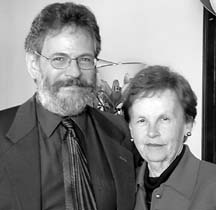 The Humboldt County League of Women Voters handed
out a pair of Civic Contribution awards at its annual luncheon
last Friday. The recipients were Muriel Dinsmore, right, and
Peter Pennekamp, who accepted the award on behalf of the Humboldt
Area Foundation. The Humboldt County League of Women Voters handed
out a pair of Civic Contribution awards at its annual luncheon
last Friday. The recipients were Muriel Dinsmore, right, and
Peter Pennekamp, who accepted the award on behalf of the Humboldt
Area Foundation.
Dinsmore, a former staff writer
for the Times-Standard and later director of public affairs for
College of the Redwoods until she retired, was honored for her
decades of volunteer work. In 1966, along with the late Homer
Balabanis of Humboldt State University, Dinsmore helped found
what is now the Humboldt Arts Council. She was an early advocate
for historic preservation and has been a member of the Eureka
Heritage Society for nearly 30 years. She continues to raise
funds for those and other community organizations, including
the College of the Redwoods Foundation.
The Humboldt Area Foundation,
which began in 1972 with a donation of $2.4 million from Vera
Perrott Vietor, was honored by the league for facilitating community
philanthropy. HAF manages the Vietor Trust and dozens of other
trusts worth $50 million. More than $22 million in grants to
charitable organizations have been made through HAF. Pennekamp
is the foundation's executive director.
Shakeup
in Fortuna
Fortuna city politics was turned
on its head last Tuesday as two long-time incumbents were voted
out of office and the city manager quit.
Mayor Phil Nyberg and Councilman
Odell Shelton lost out to challengers Debi August and Dean Glaser.
City Manager Dale Neiman resigned in response, saying he no longer
felt he had the support of the council.
"Two of the councilmembers
are out to get my job," Neiman said. His administrative
style had become an issue in the election, with critics saying
he was not open to community concerns. Glaser even characterized
him as a "vicious dog."
"Under those circumstances,
it's best to resign," Neiman said. "The city manager
becomes the issue and the city won't move forward on issues it
needs to deal with."
Neiman takes with him institutional
knowledge that will be hard to replace. He has worked in Fortuna
government for 16 years, eight of those as city manager.
"I know why decisions were
made going back to the 1970s," he said. "No one else
here has that overall picture."
August, who led the election
pack with 21.1 percent, said she was upset at Neiman's decision.
"I wish he would have stayed, at least for a while,"
she said. "Now we need a manager and a clerk. Dale was all
of that."
"The more I think about
him leaving this way, the madder I get," she said.
The new council met for the
first time April 15 and appointed Fortuna Police Chief Kit Bradshaw
interim city manager. Bradshaw will occupy the position for six
weeks while a new manager is found, August said.
The council also elected Mel
Berti -- whose seat was not up for election -- mayor. August
was elected mayor pro tem.
Coffee
and the soul of the west
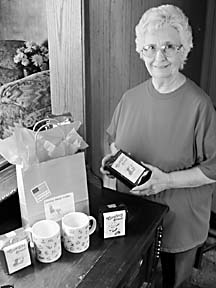 After
Betty Fulton's husband Roy died two years ago, she wanted to
find a way to pay tribute to the man with whom she had spent
her life. He had been a lifelong cowboy and a lifelong coffee
drinker, so what better way to honor him than to share his favorite
coffee? Fulton had no idea how well it would work: She will be
sharing Roy's coffee with a lot of people at a gala celebration
of cowboy culture in Washington, D.C., April 24. After
Betty Fulton's husband Roy died two years ago, she wanted to
find a way to pay tribute to the man with whom she had spent
her life. He had been a lifelong cowboy and a lifelong coffee
drinker, so what better way to honor him than to share his favorite
coffee? Fulton had no idea how well it would work: She will be
sharing Roy's coffee with a lot of people at a gala celebration
of cowboy culture in Washington, D.C., April 24.
"It's a blend I made myself
for my husband," said Fulton, who just moved from their
home ranch near Loleta to a house in Eureka. She designed the
blend and had it custom roasted at Humboldt Bay Coffee Co. It
quickly became Roy's favorite, so Fulton thought others might
be interested.
She drew a picture of her husband
for the label and sold it as Cowboy Blend Coffee at a few stores.
While Roy was alive, she never put much effort into giving the
coffee a high profile.
That changed earlier this year
when she was invited to bring her coffee to Washington as part
of a gala performance of a play called The Soul of The West.
A theatrical celebration of the American West, the performance
made for the perfect match with her coffee.
Cowboy Blend will be served
during the performance and sent home in gift baskets to VIPs
-- including President Bush. And Fulton gets to be there, something
she's excited about.
"I've never been to Washington,"
she said.
Fulton said she was also happy
to be involved carrying on her husband's cowboy heritage.
"The idea is to present
our values to urban America," she said. "I just thought
that would be a nice thing for him."
Arcata
Theater sold?
The Arcata Theater is expected
to have a new owner this week. According to David Phillips, CEO
of the Minor Theater Corp., the new owner of the Arcata landmark
will be music promoter Robert White.
Phillips described the sale
as, "a win, win, win situation -- a win for the community,
a win for the Arcata, a win for the Minor Theater."
According to Phillips, whose
company has owned the Arcata since 1974, the economics of the
film business have evolved to a point where single-screen theaters
like the Arcata are "archaic" and no longer viable.
The result is that big movie houses all over the country are
either chopped into multiplexes or, worse, closed altogether.
"We were faced with deciding
between selling or subdividing the theater into a triplex, and
essentially by doing so, removing the opportunity for anyone
to use it for concerts since the room size would have been reduced."
The building's new owner, White,
has been involved in music promotion for a few years, primarily
working with a Slovenian/Croatian partner putting on concerts
in Yugoslavia and Croatia. He has been formulating a plan for
the Arcata Theater with former Café Tomo manager Lincoln
Wachtel since September.
White said his primary interest
in the space is as a "legitimate entertainment complex"
that will offer "performing artists in any genre."
White and Wachtel are working on plans for renovation to make
the theater more music friendly.
"I'm looking forward to
having an avenue that I can help structure," said White.
Immediate plans include removing some seats in front to make
room for a dance floor and increase the room's capacity. Then
they will build a "legitimate stage."
Future changes include renovation
of the facade, installation of a permanent sound system and lighting
grid, creating a backstage area with dressing rooms and building
a balcony at the back of the room for a lighting/sound booth.
"Realistically it may be
six months before major changes happen," said White. "In
the meantime we will make some minor adjustments and put on some
shows." Initial plans call for concerts two or three nights
a week on weekends with a mix of local and touring bands.
Wachtel, who handled music bookings
for Café Tomo, said he is ready to roll since he has kept
in contact with a number of bands and agents. If all goes as
planned, he estimates there should be concerts by the end of
the month.
White is looking into offering
food and drink in the facility and said he would like to set
things up so that patrons would be able to "relax, have
a beer and watch a movie."
As negotiations for the sale
progressed, a sticking point was whether or not the new owners
would still be able to show films, and if so, would they be first-run
movies.
As it stands, Phillips has a
virtual monopoly, at least in the Arcata/Eureka area, and if
possible he wants to avoid setting up a situation where he will
have to go head-to-head with a competitor for an audience and
for film rentals.
At one point a clause in the
sale contract said the new management would not be able to show
films until five years after their release. That has been toned
down considerably. The contract in the works still does not allow
first-run films at the Arcata, but movies older than six months
can be shown.
White has no experience with
running a movie theater. He said he is planning on showing films
at the theater eventually "but probably not right away."
He is "looking for input" as to what sort of films
to book.
According to Phillips, selling
the Arcata will allow him to focus his attention and his capital
on the McKinleyville Cinema. In fact his deal with White is indirectly
tied to one with Murrish and Associates to purchase the land
for the new multiplex, "an enhanced first-run theater with
THX and all that."
Phillips said opening the McKinleyville
Cinema should help with a problem he has faced in booking films
for the Minor, particularly when the major studios' holiday movie
onslaught rolls around.
"The studios come to us
and say, `We want you to run Sorority Boys,' or some crap
like that, `and in return we'll let you run Lord of the Rings
and Amelie.' By building the McKinleyville complex and
having a number of screens there, we can be more selective in
picking films for the Minor that are appropriate for Arcata."
Murrish has a permit to subdivide
the parcel adjacent to the Mill Creek Shopping Center into six
lots. One will be sold to the Minor Theater Corp. "as soon
as the Arcata deal is done" and, according to Phillips,
groundbreaking for the multiplex should happen by the end of
this month.
According to Michael Wheeler,
the county planner dealing with the subdivision, one of the new
McKinleyville theater's neighbors could be a church.
"There has been talk about
putting a church on the southernmost parcel," said Wheeler.
"Murrish has been in contact with a church that's interested
in relocating."
Montessori
for Eureka?
Eureka City Schools is giving
parents the opportunity to choose an alternative curriculum within
the public school system. The system is floating the idea of
opening a Montessori program at Worthington Elementary.
Eureka City Schools spokesman
Sheldon Reber said the school system needed to hear from parents
interested in a K-2 Montessori program by June 1. The program
would start this fall.
"This is a child-focused,
time-tested program that is still innovative for our area,"
said Terri Vroman, a teacher at Eureka Adult School and the prospective
teacher of the Worthington Montessori. The Montessori curriculum
allows children greater autonomomy to determine what they would
like to learn.
"It offers a lot of choice
to children," Vroman said.
Some questions about the school
remain open. Eureka already has a Montessori school, Mistwood
Montessori, which offers a program for preschoolers and kindergartners.
Parents trying to give their children a Montessori education
would have to choose between the two schools for kindergarten.
Parents interested in the Eureka
City Schools Montessori program can call 442-6136 or 441-2567
for more information.
Tax hike
for hospital
Southern Humboldt property owners
will have to decide soon which they value more -- a low property
tax bill or hospital health care.
In a special election set for
June 25, residents of the Southern Humboldt Community Healthcare
District will have the chance to vote for a tax increase that
would provide extra funding to Jarold Phelps Hospital in Garberville.
Property owners already pay $25 a year for the hospital. The
new tax would raise that rate to $100.
The hospital is losing between
$20,000 and $30,000 a month, said George Koortbojian, interim
administrator. The hospital filed bankruptcy protection last
year and continues to operate -- barely.
"We continue to struggle,
like most rural hospitals," he said. Much of the problem
stems from insufficient payments from MediCal. Rural hospitals
have a higher percentage of MediCal consumers than do urban areas
and are harder hit by the low rates the government insurance
program pays.
Koortbojian said the decision
to seek an extra tax was made when it became clear that no help
could be expected from the state or federal governments.
"Twenty percent of California's
rural hospitals are in bankruptcy or are being closed, and the
other 80 percent are struggling like us. Everyone is swimming
in red ink," Koortbojian said.
"The community, in the
true rural spirit, must make the decision to support this service
in the community. It can only be solved on the community level,"
he said.
Seabiscuit
film in Ferndale?
A movie about horse racing's
most unlikely and iconic champion may be coming to the Victorian
Village of Ferndale.
Location scouts for a filmed
adaptation of a book about Seabiscuit, the undersized and crooked-legged
horse that won the 1938 national championship, have been looking
at Ferndale's racetrack. While racetrack manager Stuart Titus
said the interest is still "very, very preliminary,"
the track has one thing that a Seabiscuit movie would probably
need: wooden facilities.
"Unlike most other tracks
which have gone to steel and concrete, ours is still made of
wood," Titus said. "It was built in the '30s and '40s
and has maintained much of that character over time."
Universal Studios would film
in October or November and would not interfere with the annual
horse races at the track.
Seabiscuit rose from total obscurity
to a national championship with a failed prizefighter for a jockey
and a wild-horse breaker as a trainer. He caught the attention
of the country in 1938 and again last year with the publication
of Laura Hillenbrand's best-selling book, "Seabiscuit: An
American Legend."
Blue Lake
Casino moving forward
With environmental review and
construction almost done, the new Blue Lake Casino is ready to
hire some dealers.
Not just dealers, actually.
The casino will also need guards, waiters, slot machine technicians
and managers and will be holding a job fair April 27.
Training is provided for most
positions, said Jack Norton, human resources manager for the
casino. "It'll be everything from how to properly deal cards
to recognizing someone trying to cheat the game," he said.
All positions come with benefits including health coverage, he
said.
The job fair will take place
from 10 a.m. to 8 p.m. at the Blue Lake Rancheria Office, 428
Chartin Road, Blue Lake.
The sewage and water hookup
for the new casino is in its last stage of environmental review.
People can still comment on
the document at an April 23 public meeting at Blue Lake City
Hall. Call 668-5655 for more information.
Hosed at
the gas pump
If you listen to KHUM radio
regularly, you may have heard John Berning's song, "Hosed
at the Gaspump." The title pretty much says it all -- a
musical complaint about the high cost of gasoline, one that fits
right in with KHUM's ongoing battle against high gas prices.
Berning, who has a day job as
a lab technician at Mad River Hospital, wrote and recorded the
song at his home studio. Seeking a wider audience, he sent the
song to the Boston headquarters of Car Talk, the nationally syndicated
National Public Radio show featuring Tom and Ray Magliozzi, aka
Click and Clack, the Tappet brothers.
The Magliozzi brothers offer
irreverent yet serious advice to listeners who call in from around
the country with automotive problems. Heard throughout the U.S.,
the show is among the most popular on NPR and always ranks high
at NPR affiliate, KHSU. (It's on from 9-10 a.m. Saturdays and
on Wednesday from 7-8 p.m.)
On April 4 Berning got an e-mail
from Car Talk saying that his song would be played between segments
as a "bumper" on Saturday, April 6.
Since the Car Talk web site
(http://cartalk.cars.com/) includes information about the songs
played each week, Berning has heard from listeners all over the
country. The result: He is making plans for an entire album of
gas price protest songs.
By the way KHSU's biannual fund
drive starts Saturday, April 20, at 7 a.m. with Weekend Edition,
immediately followed by Car Talk. The drive ends on April 27,
with Car Talk. You can also find the show's web site by starting
at KHSU's web site (www.KHSU.org). The station's schedule has
a link to Car Talk.
COVER
STORY | CALENDAR
Comments? E-mail the Journal: ncjour@northcoast.com
© Copyright 2002, North Coast Journal,
Inc.
|