|
 
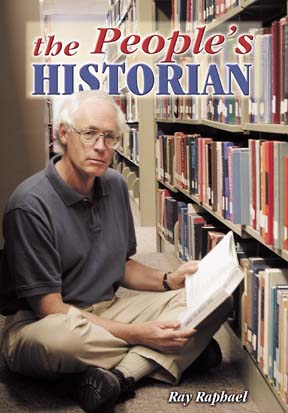
by BOB DORAN
SINCE HE MOVED TO HUMBOLDT County
30 years ago, Ray Raphael (in
photo above) has been studying and
writing about history. He was never trained as a historian, perhaps
that's why his approach to the past has always been a bit different.
His first book, An Everyday
History of Somewhere, published in 1974, set the tone. It
is an examination of the people and events that shaped southern
Humboldt County -- a history "from the bottom up,"
told by everyday people instead of by the political and other
leaders who typically dominate our history books.
This weekend Raphael celebrates
the release of his ninth book, A People's History of the American
Revolution. While it is quite different from his first book,
the approach is the same. He offers a history from the point
of view of common people; in fact the book's subtitle is, "How
Common People Shaped the Fight for Independence."
![[A People's History of the American Revolution book cover]](cover0412-revolution.jpg) Raphael's
own everyday history begins in New York City. He lived there
until he was 18. Raphael's
own everyday history begins in New York City. He lived there
until he was 18.
"The day after I graduated
high school I headed west, pack on my back. I headed for the
wide open spaces," he said while relaxing in a comfortable
chair on his front porch in Redway last week.
After spending a summer backpacking,
he made his way to Reed College in Portland, Ore. His official
major was philosophy, but he said, "My real focus was on
being an activist.
"The first summer after
I started school I got involved in the Civil Rights movement.
I spent two summers in the South. First it was a project doing
voter registration and tutoring, going into integrated schools
in North Carolina. Then we integrated several public facilities
-- the swimming pool, the baseball park and the wrestling match.
Integrating wrestling was tough."
In 1962 he went south with the
National Student Association and in 1964 worked with the Student
Nonviolent Coordinating Committee, SNCC.
"It was Freedom Summer
down in Mississippi. I met Fanny Lou Hamer and was involved in
that process. That was the year three activists were killed,
two of them I knew."
His experience with SNCC led
to his first exposure to the writer, Howard Zinn.
"I read his book, SNCC,
the New Abolitionists. What was remarkable was the fact that
he got it right. This was a time when people could easily get
it wrong. There was usually a focus on leaders, Martin Luther
King this, and Martin Luther King that. His book was about who
the people in SNCC really were -- the field secretaries and the
daily work going to the plantations.
"Zinn captured the whole
spirit of the movement from the bottom up. I was impressed because
here was this academic who got it. Then he wrote this other book,
Why We Should Get Out of Viet Nam, and I was very involved
in the peace movement."
After he finished at Reed, Raphael
became a full-time activist working with "the Movement"
on civil rights issues and protesting the war in Viet Nam. He
got a master's degree at UC Berkeley, once again a philosophy
major -- at least on paper.
"I didn't take a single
philosophy course, but there was a guy in the department who
was an expert in Karl Marx, so I studied under him. I took all
of my courses in political science, but my master's was in philosophy.
Really what I was doing was getting the theoretical underpinnings
of radicalism and what it meant for political action."
Feeling trapped in academia,
Raphael followed the lead of his friend Rondal Snodgrass who
was teaching in an inner city school in Portland. (Snodgrass
is now living in Southern Humboldt. Until recently he was executive
director of Sanctuary Forest.) Ray went back to Reed long enough
to get a teaching credential.
Raphael returned to California
to teach high school and to resume his work as a radical. After
a few years he began to get frustrated.
"It was hard being part
of the Movement in the '60s. You had all of these ideas, yet
the war kept going on and the civil rights movement was getting
splintered, becoming hyper-radicalized and dysfunctional. There
wasn't much change happening."
Then along came "flower
power."
"A lot of us started thinking
about creating an alternative. Instead of trying to stop this
huge machine, let's try to create a better life. You remember
I had a pack on my back when I came from New York; I was looking
for wide-open spaces. The combination of a search for a better
life and wide open spaces led me to southern Humboldt."
Raphael moved to Whale Gulch
in 1970. He and two partners bought 20 acres and got back to
the land.
"We collected wild foods
and grew some vegetables, raised chickens and rabbits. It was
pretty basic. Our land payments were $105 a month, but I had
put up the down payment to get a road in there, so my part was
$25 a month.
"I lived in a 12 by 16-foot
cabin for five years, totally off the grid, no electricity or
anything. This was presolar power so we had those smelly kerosene
lamps. It felt romantic until we did it for a year or two. Then
it was just suffocating."
All those years in college were
not completely forgotten. Raphael began a research project of
sorts, an exploration of the history of his own neighborhood.
"Being a curious guy I
wanted to know more about this place I'd moved to," he recalled.
"I looked in the library and found nothing. That was kind
of frustrating. So I started talking to old-timers and learned
a lot more. I met a guy named Harry Roberts, who had been raised
by Yuroks. He was kind of an heir to the Yurok high men's medicine."
Raphael and a group of friends
would visit Roberts on weekends to learn about the ways of the
past.
"We would take plants down
to him and ask, `What's this?' How did the Indians use it? We
learned how to grind acorns and all sorts of skills. We learned
the Native American traditions in an oral fashion, and then I
would go back and compare it with Kroeber. (Alfred Kroeber wrote
Handbook of the Indians of California.) It was so much
more alive the way we learned it orally."
This was around the time that
a group in the hills of Georgia put out The Foxfire Book,
an oral history with lessons on log cabin building, snake lore,
mountain crafts and food, and "other affairs of plain living."
"I was into doing some
sort of local Foxfire thing," said Rafael. "That's
how An Everyday History of Somewhere was born. I wanted
to explore the historical meaning of this place. As I started
looking, I found there was nothing written down. All the history
focused on Eureka and there was nothing about the backwoods.
![[Everyday History of Somewhere book cover]](cover0412-everyday.jpg) "So I decided
I should write a book, to do that I had to learn how to write.
All I knew how to write was college papers. I had to get the
therefores and howevers and convoluted sentence structures out
of my writing rhythm and learn how to write simply. "So I decided
I should write a book, to do that I had to learn how to write.
All I knew how to write was college papers. I had to get the
therefores and howevers and convoluted sentence structures out
of my writing rhythm and learn how to write simply.
"The key is I had a book
to write and I learned by doing it. I had this vision of everyday
history. And half the book was oral history, so I was transcribing
the spoken word. Listening to the words and transcribing affected
my writing. Ever after that people would say I have an accessible
style. I think it's because my writing is like what I hear."
Manuscript in hand, Raphael
went off in search of a publisher.
"I carried a couple of
copies down to San Francisco following leads. One was Rolling
Stone's Straight Arrow Press. They wanted to do it. But then
I took it to this paper called Clear Creek, a small journal
that only lasted a couple of years. Someone had told me they
were getting into book publishing.
"The guy who ran it --
Bill Barish, he's now a very well known writer -- said, `This
is great.' He sat up all night reading it and he wanted to publish
it. I was stoked. Then two weeks later he calls and tells me,
`I have bad news: Clear Creek's folding. But I happen to be a
literary agent, too. And I have a friend at Knopf in New York
and I'm going to send it to him.' That's how Everyday History
ended up with Knopf, which is probably the most respected publisher
in the country. What a stroke of luck."
Having established himself as
a writer, Raphael began contributing pieces to a number of publications,
in particular to the San Francisco Chronicle. His second
book, Edges: Human Ecology of the Backcountry, was a collection
of those articles.
"Then for my next two books
I took that oral history approach and applied it to the two most
controversial issues we have up here -- timber and marijuana."
Timber Talk: The People and
Politics of Timber was a collection
of interviews.
"My idea was to stop the
rhetoric and preconceived notions and get down to the people
level. Let's see what people really think. So instead of talking
to someone and quoting a little paragraph, I let them tell their
whole story. Whether you have an environmentalist or a timber
company executive, they tell their story and have their place
in the complete narrative."
Raphael faced some resistance
when he began work on his next book, Cash Crop: An American
Dream?, a look at the southern Humboldt marijuana trade.
![[Cash Crop book cover]](cover0412-cashcrop.jpg) Sensationalized stories in newspapers
and magazines had made the pot growers leery of any scrutiny.
The media invariably got some part of the story wrong. Sensationalized stories in newspapers
and magazines had made the pot growers leery of any scrutiny.
The media invariably got some part of the story wrong.
"That's one of the reasons
I wrote the book," said Raphael. "I had written these
other books and people kept asking when I was going to write
a book about marijuana. I'd say, `I'm not going to touch it.
I live here. What am I crazy?'
"What happened was every
year come September the Chronicle came out with their
headline story, the Sacramento Bee would do the same.
The New York Times wrote, "The streets of Garberville
are lined with Mercedes," -- that's a direct quote. This
was happening year after year in the early '80s. Finally this
guy came out with this outrageous novel, Outlaws in Babylon,
with tales of naked women cleaning pot. And on the cover of Newsweek
there was a picture of a guy with a mask and a gun; 60 Minutes
came out. The idea of keeping anything secret was ridiculous
and the picture that was emerging in the media was full of incredible
fantasies and lies.
"I said, `Let's just tell
the real story as it is, from the participants. I took a deliberately
flat approach, not advocating anything or opposing anything.
I just told the story and included all the actors. I have the
dope growers and the kids of dope growers, the head of CAMP (Campaign
Against Marijuana Plantings) and the high school principal, the
town businessmen.
"Most of the people really
appreciated the balanced approach, but there were probably 10-20
percent of the people who were inside the grower's community
who were outraged that I would say anything. They thought it
should all be a secret. They wouldn't even read it."
Raphael applied a similar approach
-- using first-person sources -- in The Teacher's Voice.
When his son was moving from boyhood to manhood, he wrote The
Men From the Boys: Rites of Passage in Male America. He revisited
timber issues in More Tree Talk, and wrote a detailed
biography of a southern Humboldt pioneer, Little White Father:
Redick McKee on the California Frontier.
Five years ago he began work
on a different sort of history, once again seeking out first-hand
stories of participants. The result was his new book, A People's
History of the American Revolution.
"It's goes all the way
back to the Everyday History -- all of my books are based
on the lives of individual people and how they experience reality.
It gives credit to their lives no matter what side of the political
issue they're on."
Of course there is a major difference
between collecting first-person oral history from living people
and investigating something that happened over 200 years ago.
How do you go about digging out the everyday history of the American
Revolution?
"It was a major challenge,"
said Raphael. "That's why this book took five years to write.
You basically have to comb all the written sources. There are
different levels of what you come up with."
What he searched for were the
stories of "common people."
"Common people are those
without the special privileges that accompany wealth, prestige
or political power. That includes just about everybody except
the elite."
A major obstacle in finding
the stories of the non-elite is the fact that 230 years ago most
were illiterate.
"Or they were barely literate.
Some could write a little bit, but if they wrote letters they
were not always preserved by secure family structures and housed
in safe places in mansions. So we have precious little to go
on. I had to search far and wide to find what remains.
"There were two slaves
who escaped to the British and became preachers. Their stories
were told in these religious journals in 1790 or something. If
you can locate these journals, you can get them on an interlibrary
loan. Sometimes the material is on microfilm. Sometimes it's
in an old book.
"Some of the stories have
been reproduced in book form; like, there's a marvelous one written
by an Iroquois warrior called Black Snake. He gives the inside
story about how the Revolutionary War affected the Iroquois.
"He talks about negotiations
that took place when both the Americans and the British were
courting the Iroquois trying to get them to join their side.
He tells us about the deliberations among the warriors, how they
reacted. Some wanted to join the British, others didn't. They
preached caution. But then those who wanted to join called the
others cowards and no warrior could be called a coward. So for
that reason they joined the war. We learn about this from the
inside."
Raphael made several trips back
East but for the most part he relied on the wonders of the interlibrary
loan system.
"The Humboldt State University
library deserves a lot of credit for this book," said Raphael.
His challenge was to figure out what source material to ask for.
"One footnote would lead to another and, as often as not,
authors only use a small portion of original source material.
The trick is to trace the material all the way back."
The picture he paints in A
People's History of the American Revolution is a far cry
from what we learned in high school history class. We find that
the American Revolution was much more than George Washington
leading a band of patriots in three-cornered hats against red-coated
Tories. Poor farmers did not necessarily side with rich landowners,
slaves did not necessarily fight alongside their masters. The
Native American population had hard choices to make. No one had
the option of remaining neutral.
"This is history from the
bottom up. Just as I do in all my books, my starting point is
to treat individual common people respectfully. How do they see
history? How do they try to participate in it? How do they do
what's best for themselves, for their group and their family?
We see things through their eyes.
"The key thing you see
through it all is that every single person during those time
had to become a political actor. They had to figure out how their
actions would be perceived, what the consequences would be, what
actions would best help them survive, what actions would best
help them promote their ideals or in many cases their own liberty
or economic well-being.
"There are so many myths
that are immediately shattered. Take for example the beginning
of the war, `The shot heard 'round the world.' In fact, in 1774
the common farmers of Massachusetts engaged in a total revolution
where they threw out every British official. The British had
to resign their positions or retreat behind British lines in
Boston. You never hear about this revolution of the common people."
After writing the book on speculation,
Raphael found a publisher, The New Press. All the pieces were
in place except for a title.
"I had all kinds of titles
that didn't quite work," he said. "Whenever anybody
would ask, `What are you working on?' I'd say, `Oh, it's a people's
history of the American Revolution, or it's a history of common
people in the American Revolution.' We couldn't call it `The
People's History of the American Revolution' because that sounded
too much like Zinn's People's History of the United States.
It would be like pirating his title."
While it wasn't in the original
plan, Raphael ended up using the exact title -- with Zinn's blessing.
"New Press published a
school book version of Zinn's People's History. They sent
the bound galleys of my book to Howard for a cover quote.
"At that point we still
hadn't settled on a title. I think we were down to something
generic like `Voices of American Revolution.' He read the book
and said he thought it was the best book he's read on the revolution.
On a deep level he understands my approach, that I don't take
a doctrinaire standard leftist approach.
"Howard talked to one of
the editors at New Press and they come up with this idea to do
a whole `People's History' series, where a number of writers
will explore issues in depth from the standpoint of common people.
This is volume one of the series. The other volumes are yet to
be done. This one will serve as a prototype. Howard is the series
editor. He's working with my editor at New Press, Marc Favreau,
to come up with some new authors for the series."
New Press has not determined
what the next in the series will be. A "People's History"
of California has been suggested along with several other ideas.
Whatever the choice, Raphael will not be the author. He already
has commitments for several other projects. He's finishing up
a book that focuses on the 1774 overthrow of the government by
the farmers of Massachusetts.
"After that I'm trying
to get a local history going with the Humboldt Historical Society.
Jerry Rohde and I are working on a two-volume history of Humboldt
County. If you know his work, you know Jerry likes to write about
things place by place. We realize that our approaches are different
enough so that we'll need to do two different books. The subtitle
of mine will be `People and Time' his will be "People and
Place.' Jerry likes to describe it in weaving terms, as the `warp
and woof' of local history."
![[Photo of Howard Zinn]](cover0412-zinn.jpg) Thursday, April 12, 6-9 p.m.,
Ray Raphael will sign copies of his book at Orange
Cat Goes to Market in Garberville. Friday, April 13, Thursday, April 12, 6-9 p.m.,
Ray Raphael will sign copies of his book at Orange
Cat Goes to Market in Garberville. Friday, April 13,
6-9 p.m., he will
be at Northtown Books, 957 H St., Arcata. Thursday, April
19, at 8 p.m., Howard Zinn (photo
at left) speaks at HSU's East Gym
as part of the Associated Students Lecture Series. Free admission.
For more information contact the University ticket office, 826-3928.
IN
THE NEWS | GARDEN | ARTS! ARCATA | CALENDAR
Comments? E-mail the Journal: ncjour@northcoast.com
© Copyright 2001, North Coast Journal,
Inc.
|