|
 
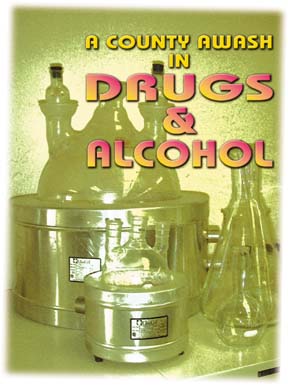
By GEORGE RINGWALD
I WAS KIND OF STUNNED WHEN I
CAME UP HERE -- about three years ago from the Bay Area,"
Tom Antoon recalls. " I thought this was going to be a sleepy
little backwater town. I was just blown out of my socks when
I came up here and saw the extent and intensity of the problems
around drugs and alcohol in this county. I kind of expected marijuana
to be an issue, of course. Alcohol is much more of an issue than
I anticipated, and methamphetamine is an incredible problem up
here.
![[photo of Tom Antoon]](cover0322-antoon.jpg) "When I was in the Bay Area,"
he adds, "I think one of the primary drugs of choice was
crack, crack cocaine. But up here I'd have to say that methamphetamine
and alcohol really are taking their toll." "When I was in the Bay Area,"
he adds, "I think one of the primary drugs of choice was
crack, crack cocaine. But up here I'd have to say that methamphetamine
and alcohol really are taking their toll."
Antoon, a youthful-looking 52,
compact and stocky, with a small, neat mustache, is senior program
manager of Humboldt County's Mental Health, Alcohol and Other
Drug Programs.
"We outstrip other like-size
counties in drug and alcohol problems," noting of course
that "outstripping" in this case is "kind of a
sad commentary."
In 1997, for instance (latest
figures available), there were 472 drug felony arrests, plus
463 drug misdemeanor arrests. Alcohol felony arrests came to
39, but alcohol misdemeanor arrests soared to 2,734. Those figures,
noted the county's Public Health Department, were "very
substantially higher than other rural counties."
And from that same report, consider
the annual costs: For each adult or child in the county, $738;
cost per user, $3,251; and total cost each year, $93 million.
Superior Court Judge Bruce Watson,
whose court handles 180-200 cases a month, estimates that "at
least 80-85 percent of all criminal cases involve drugs and alcohol
to some degree."
![[photo of Judge Watson]](cover0322-watson.jpg) Tracing the evolvement of drugs
over the decades, Watson says that in the '50s marijuana and
heroin "were available in a small circle"; in the '60s,
marijuana "became more prevalent"; in the '70s it was
"marijuana and cocaine, along with alcohol"; and "all
through this tobacco"; in the '80s, methamphetamine, heroin
and alcohol along with a continuation of marijuana became the
drugs of choice; and in the '90s, "what seems to have happened,
cocaine has been replaced by methamphetamine." Judge Watson
adds, "The glamor of coke has diminished. Methamphetamine
picked up the slack, so to speak." (Obviously, a big part
of that switch is the price differential.) Tracing the evolvement of drugs
over the decades, Watson says that in the '50s marijuana and
heroin "were available in a small circle"; in the '60s,
marijuana "became more prevalent"; in the '70s it was
"marijuana and cocaine, along with alcohol"; and "all
through this tobacco"; in the '80s, methamphetamine, heroin
and alcohol along with a continuation of marijuana became the
drugs of choice; and in the '90s, "what seems to have happened,
cocaine has been replaced by methamphetamine." Judge Watson
adds, "The glamor of coke has diminished. Methamphetamine
picked up the slack, so to speak." (Obviously, a big part
of that switch is the price differential.)
In Humboldt County the number
of annual drug treatment admissions for methamphetamine users
escalated from 61 in 1991 to 412 in 1997.
"That's a real big problem
here," said Antoon, "partly because we're a rural county
and labs can be built in areas that are not as accessible and
discoverable by law enforcement. So we have a lot of difficulty
with clandestine meth labs. There's a lot of manufacturing going
on in this county, and of course a lot of sales and abuse as
well."
Indeed, as Antoon notes, "Roughly
400 of the 800 drug program admissions in the county are for
methamphetamine abuse or dependence."
Actually, trying to break out
the numbers on types of drugs here is practically impossible,
as District Attorney Terry Farmer concedes.
![[photo of Terry Farmer]](cover0322-farmer.jpg) "The statistical mechanism
of both the courts and our office are notoriously unreliable,"
he told the Journal, "because we have a bad system
-- garbage in, garbage out. A lack of resources really puts this
county, I think, statistically behind the eight ball and in the
dark ages. That's because the court system is old, decrepit and
unreliable. ... In an age where we have this belief that we can
answer virtually any question by pressing a button, we think
the technology is there to do that, (but) it's a whole lot less
sophisticated than we would like it to be." "The statistical mechanism
of both the courts and our office are notoriously unreliable,"
he told the Journal, "because we have a bad system
-- garbage in, garbage out. A lack of resources really puts this
county, I think, statistically behind the eight ball and in the
dark ages. That's because the court system is old, decrepit and
unreliable. ... In an age where we have this belief that we can
answer virtually any question by pressing a button, we think
the technology is there to do that, (but) it's a whole lot less
sophisticated than we would like it to be."
A couple of things he can tell
you, though. Alcohol, for one, has always been a problem in the
26 years he's been in Humboldt County.
He relates, "A guy in the
liquor business told me one time: `In good times, business was
good, and in bad times business was better.'"
His "big kick today,"
as he puts it, is methamphetamine. "It's highly addictive,
it's associated with violent, paranoid kinds of behaviors.
"This is not just a law
enforcement-related phenomenon," he goes on. "People
in the educational community, the business community, the health
services -- they're having problems retaining qualified employees,
keeping kids in school, because their parents are involved in
methamphetamine, problems keeping families healthy and together.
"It's really kind of been
an explosion in the last 10-15 years. We throw these phrases
around like `the war on drugs,' and I think at least law enforcement
was of the opinion for a while that we could solve this problem.
Well, we can't solve it all by ourselves. Law enforcement is
an important component in the battle, but only one part, and
the parts that really need to be beefed up, I think, in this
county are treatment and education."
Business people, too, are aware
of the problem. Dave Edmonds, president of the Eureka Chamber
of Commerce, for example, says there's no question that drug
and alcohol abuse is hurting the county's economy -- with employees
showing up late for work, or not at all, and goofing-off on the
job when they do.
Greg Foster, executive director
of Redwood Region Economic Development Commission, says: "We're
bombarded with it (the drug problem) constantly. Absenteeism
and drug and alcohol abuse are closely related. Methamphetamine
is particularly bad, because people will stay up for five-six
days, and then they'll crash."
The commission, he says, has
found "an incredible dropoff" between people being
"interested" in a job and actually doing the work.
A number of major businesses have gone to drug testing, primarily
for safety reasons -- companies in construction, trucking or
mill work, for example -- but they are finding, as Foster relates,
that "60 percent (of job applicants) are dropping out because
of the drug and alcohol issue; they either don't want to take
the test, or they took it and didn't pass."
He adds, "We have companies
who are saying their growth is restricted because of work force
issues, and one of the big issues is drugs."
There are at least a dozen drug
and alcohol recovery programs in the county today, and District
Attorney Farmer pushes for even more.
"I think we don't have
enough," he said, "and I would like to see more resources
into increasing the capacity of our rehab programs. I think rehab
works at least as well as any other effort that you're going
to put into stopping people from using drugs. Not that it's an
overwhelming success, but putting people in jail is not an overwhelming
success either."
There is no easy quantifying
of success rates of the assorted drug recovery services, detox
centers or rehabilitation facilities.
As Tom Antoon likes to say:
"Recovery is not about the old Nancy Reagan thing of `Just
Say No.' It's not about drinking or using. It's about changing
lifestyles, about making healthier choices of `How I'm going
to live.' And like anything else, you need to be taught."
The drug and alcohol recovery
program at Antoon's facility (at 2922 I Street in Eureka) presently
has 75-100 people in treatment. They come in during the day for
educational programs and group talks. They learn about nutrition,
about relapse prevention, and how to socialize without using
drugs. Their average age is from late 20s to mid-40s.
"They're not kids,"
said Antoon, "but almost all of them started during early
childhood or early adolescence in their use or abuse of chemicals.
"You'd be amazed,"
he adds. "In the years that I've been doing this work (Antoon
is a licensed attorney and psychotherapist, but finds little
time for private practice on the side), it's not uncommon to
hear about kids starting to drink and to use marijuana at the
age of 6-7 years old."
And does he find that here?
"Oh, you bet, you bet! Kids, they learn from their parents.
... They don't develop interpersonal skills, some don't develop
much of a work ethic, they drop out of school ... and a lot of
the folks we're dealing with wind up in the criminal justice
system. So there's an awful lot of learning that goes into the
treatment -- helping people to learn new life skills, change
behaviors, change patterns of who you hang around with."
Then, too, they face "a
lot of community-based resistance," as Antoon puts it, touching
on a pet peeve of his.
"There's a lot of stigma
around drug and alcohol addiction," he observes. "I
think an awful lot of people look at it as some sign of moral
weakness or a flaw in somebody's constitution, when in fact it's
a medical disorder, a medical disease, just like diabetes or
a heart condition. Really, it is a disorder, a biochemical disorder.
For those who have chemical dependency, that indeed is a medical
disorder. So many people are really afraid to have `those people'
in their neighborhoods, as though it's a different class of people,
and the fact is that it's not. It is regrettably a disorder that
doesn't favor any socio-economic class over another; it's not
gender-biased, it's not race-biased, it strikes anybody. It's
a tragedy."
For Antoon, the big uplift comes
when people graduate from the seven-month program.
"There's usually some sort
of ritual," he explains, "and these folks bring their
families with them. It's neat to see the kids or the wives, their
husbands or partners, and they're just beaming! They got their
daddy back or they got their wife back, and you can see how people's
lives are repaired. It's gotta be the most moving experience
that I have."
Michael Goldsby, program director
of St. Joseph Family Recovery Services, runs a smaller group
-- about eight to 12 people -- and his philosophy, not surprisingly,
is quite similar to the county program.
![[photo of Mike Goldsby]](cover0322-goldsby.jpg) "Society has erroneously the
idea that treatment is an easy out, that it is coddling people,"
he said. "Every program I'm familiar with requires a strong
work ethic. "Society has erroneously the
idea that treatment is an easy out, that it is coddling people,"
he said. "Every program I'm familiar with requires a strong
work ethic.
"Western people want to
separate body, mind and spirit, like they don't have anything
to do with each other, and a disease like alcoholism certainly
shows how these things are connected. People's craving is a physiological
craving. It's not like a bad habit or a poor choice. It is a
true craving that people without an addiction cannot understand."
Goldsby, who also teaches a
chemical dependency studies class at College of the Redwoods,
manages a staff of about eight at the St. Joseph facility, including
a medical doctor, a masters-level therapist, and a certified
drug and alcohol counselor. Most of the costs are covered by
private patient payment and insurance coverage of outpatients.
The program is also subsidized by the St. Joseph Health System.
The California Department of
Alcohol and Drug Programs disburses funds to the county alcohol/drug
treatment program, amounting to about $2,250,000, and Tom Antoon
says: "It's not enough, I can tell you that right out of
the chute."
Some of that funding goes to
other residential treatment programs, such as Crossroads, the
Detox Center, and the Humboldt Recovery Center.
"Money is a problem,"
Antoon admits. "Attracting qualified, skillful substance
abuse treatment professionals to the area is difficult. It's
a fertile field (for them), but if you want to eat, it's not
a very lucrative field, that's for sure. I admire not only the
people who are in recovery and doing something to change their
lives, but people who dedicate themselves to helping those folks.
"Treatment does work,"
he concludes. "You know, you throw enough mud at the walls,
some of it's going to stick."
The people at Crossroads, a
non-profit, therapeutic recovery community, are also busy throwing
mud at the walls, so to speak. Besides their main treatment house
at 1205 Myrtle Ave. in Eureka, where they have 28 beds, all presently
occupied -- and with a long waiting list -- they also have four
houses across the street (all paid for mainly with county funding)
that are for people who are graduating from the 18-month program.
Gordon Costello, administrative
director at Crossroads, which has been in existence since 1975,
explains the "therapeutic community" by saying: "We're
dealing with long-term issues -- of childhood physical or sexual
abuse, abandonment, or maybe they grew up in a family of addicts,
grief, loss of a child ... What we find is that people with substance
abuse problems tend to take those issues to kind of hurt themselves,
and they self-medicate and keep the addiction. If you can do
something about helping them to come to at least a truce with
the issues, the chance of recovery is greatly increased."
![[photo of Abbe Hess and Gordon Costello of Crossroads]](cover0322-crossroads.jpg) Crossroads
also supports a group called CHOW -- for Community Health Outreach
Workers -- who go into the county jail and pick out people who
might have a chance of recovery outside, and put them in clean
and sober living programs. They claim a 60 percent success rate
for that effort. Crossroads
also supports a group called CHOW -- for Community Health Outreach
Workers -- who go into the county jail and pick out people who
might have a chance of recovery outside, and put them in clean
and sober living programs. They claim a 60 percent success rate
for that effort.
Still, the addicts keep showing
up at their door. Costello comments: "In this business,
success is very relative. I remember hearing statistics years
ago that if you had one out of 10 people who could successfully
stay clean, even a year out, that you were doing well."
Or as Dr. Lawrence Badgley puts
it: "Per capita, there seems to be greater illicit substance
abuse (in the greater Eureka area) than in many places in California.
The problem is rampant. It's out of control; something has to
be done."
Badgley, a veteran practitioner
in the drug wars, says that he has treated hundreds of addicts
for methamphetamine and heroin. "For example," he says,
"I have three-four people in hospital now with problems
related to opiates (heroin). Not to say that the same people
don't use methamphetamine...I think it's called the poor man's
cocaine. You have to understand there's not a strict differential
between these two groups. There's a large crossover."
A doctor who is already well
noted in the Eureka medical community for a practice especially
dedicated to the indigent -- a statement that is likely to make
him snap, "Don't make me out a Mother Theresa!" --
Badgley is now getting ready to embark on a new approach to the
drug and alcohol problem.
"Over time," he relates,
"I've been interested in the use of herbs and nutrition
and acupuncture for various medical problems, including the problem
of addiction. So I'm currently organizing a group (of four or
five alternative medicine practitioners besides himself), and
we're going to put together a medical protocol that uses nutrition,
vitamins, minerals, acupuncture and various herbs that might
be effective for this problem. Counseling will also be a part
of it.
"I've used acupuncture
in past years to withdraw people from heroin. I've also used
it for smoking, treated hundreds of people for smoking. And there
are studies from treatment centers that use electro-acupuncture.
"The goal is to turn that
system on when the person is withdrawing. And then you supply
the body with the raw materials of a nutritional nature, which
are needed to establish the correct balance of chemicals in the
nervous system."
He hopes to be operational in
the next couple of months.
"I'm not aware of anybody
who has tried this," he says. "It's worth a shot. Nothing
ventured, nothing gained."
Any shot would seem worth it,
because the problem continues to escalate.
Abbe Hess, program director
at Crossroads, where she has worked for the past 14 years, certainly
knows that as well as anyone.
"We always have a waiting
list," she says. "That's the big problem in Humboldt
County. There's a bigger need than any of us can take care of.
The problem's been around a long time. And treatment's where
it's at."
|
War on some
drugs
They
don't usually come under much critical public scrutiny in America's
war on drugs, but the use -- and especially the abuse -- of some
medications you pick up at your local pharmacy can also be dangerous
to your health.
Andrew Sullivan, senior editor of the New
Republic, in an article recently published by Santa Rosa's Press
Democrat, notes, for example, that "a growing number
of `medicinal' drugs also have a high `recreational' street value:
painkillers such as Vicodin, downers such as Valium, uppers such
as Ritalin and anesthetics such as ketamine."
Pointing up the contradictions, Sullivan
writes that "you can get a dose of Xanax from your doctor
and feel extremely mellow within half an hour, or you can take
two puffs of pot and be a felon."
Or, again: "permitting addictive,
destructive booze while banning nonaddictive, benign pot made
no real sense."
In Sullivan's view, it is not, strictly
speaking, a war on drugs, but a war on some drugs.
"And as the sophistication of pharmaceuticals
develops exponentially each year," he predicts, "the
lines we draw between legal and illegal, between stigmatized,
will become more and more arbitrary."
|
IN
THE NEWS | CALENDAR
Comments? E-mail the Journal: ncjour@northcoast.com
© Copyright 2001, North Coast Journal,
Inc.
|