|
 
IN
THE NEWS | GARDEN
| GOOD NEWS | CALENDAR
Story & photos by BOB DORAN
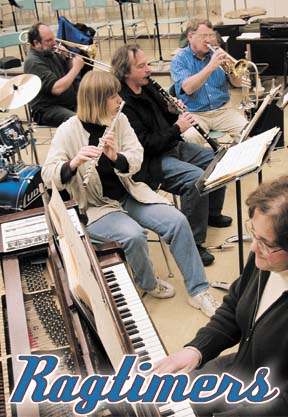
 THE MUSICIANS STRAGGLED IN ON A RAINY THURSDAY
night. Cornet player Michael McClimon was the first to arrive.
He had the key to Fortuna High's music room, practice space for
the Humboldt Ragtime Band. THE MUSICIANS STRAGGLED IN ON A RAINY THURSDAY
night. Cornet player Michael McClimon was the first to arrive.
He had the key to Fortuna High's music room, practice space for
the Humboldt Ragtime Band.
Drummer Michael LaBolle showed
up next. His drum kit wasn't elaborate, but it took a while to
set up. There was small talk as the rest of the septet arrived.
While David Demant unpacked his tuba, he spoke with LaBolle about
that day's big news: the elimination of 40 teaching positions
at Eureka City Schools. (Both teach music in Eureka, and both
were relieved that music programs have so far escaped the ax.)
Once all seven musicians were in their seats, McClimon gave the
word, "All right ragtimers, let's get to work."
The band worked its way through
a series of compositions in ragtime, a music form that was popular
100 years ago. While an untrained ear might confuse ragtime with
Dixieland jazz, McClimon had explained earlier that there's a
"very clear" difference between the forms. "Ragtime
is not jazz -- it's ragtime. When you go to a Dixieland festival
you're constantly reminded of turns of phrase that come from
the vocabulary of ragtime; the same tunes are used in a lot of
cases. It's interesting how much jazz owes to ragtime, yet most
people don't know much about it."
Those interested in learning
more have some golden opportunities in the next couple of weeks.
This Saturday, McClimon's band is giving a concert at the Morris
Graves Museum entitled, Ragtime: The Roots of Jazz. The
following weekend the band will make its ninth appearance the
Redwood Coast Dixieland Festival, playing at 7 p.m. on Friday,
March 28 at the Red Lion and at noon Sunday, March 30 at the
Eureka Inn.
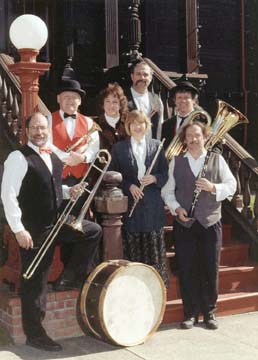
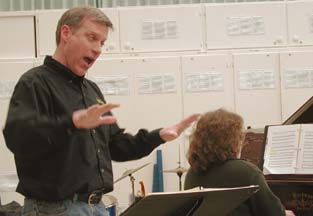
Above right: The
Humboldt Ragtime Band.
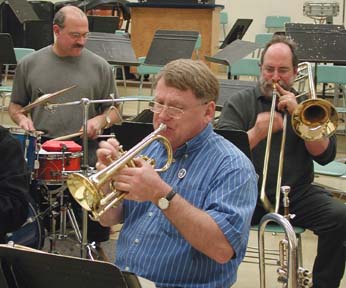
Below left: drummer Michael LaBolle, cornet player Michael McClimon
and trombonist Jimmy Durchslag
 Spawned along the Mississippi Spawned along the Mississippi
Okay, so what, exactly, is ragtime?
The Journal sat down with McClimon last week to find out.
Soft-spoken and far from tall,
McClimon doesn't seem the bandleader type, but when it comes
to ragtime he speaks with passion and authority. Leaning forward
in his chair, he began with some history.
"Ragtime was dance music
played around the turn of the century in bars and for dances,"
McClimon related. "And [of course] you had the `professors'
who played [piano] in the parlors of brothels. That's where ragtime
got its bad name because of its association with prostitution."
Precisely where ragtime first
developed is hard to say. It came from a time when the recording
process was in its infancy, when popular music was primarily
spread through sheet music sales. The new form first surfaced
in the Mississippi River Valley, up the river from New Orleans,
among itinerant musicians, most of them black, who blended march
tempos and minstrel-show songs using a "ragged" syncopated
beat, maintaining the rhythm in the bass line, but playing the
melody just off the beat.
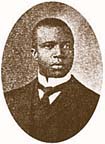 "The
very first ragtime piece published was 1898," said McClimon.
"Scott Joplin's `Maple Leaf Rag' was published the next
year. Joplin was from Sedalia, Mo., that's kind of a Mecca for
ragtimers; they have the Scott Joplin Festival there every year.
He solidified the form -- he was the most articulate in the way
he wrote it down." [Scott
Joplin, photo at right] "The
very first ragtime piece published was 1898," said McClimon.
"Scott Joplin's `Maple Leaf Rag' was published the next
year. Joplin was from Sedalia, Mo., that's kind of a Mecca for
ragtimers; they have the Scott Joplin Festival there every year.
He solidified the form -- he was the most articulate in the way
he wrote it down." [Scott
Joplin, photo at right]
At first the music was played
solo on piano. "But it was natural for a bass player or
a tuba player to come in and start plunking along, then maybe
a trumpet would say `I want to play along too.' By 1905, they
were already publishing stock dance band arrangements. [In addition
to solo piano music], you could get [sheet music] for a mandolin
quartet, for piano and violin, for piano and cornet, all the
way up to dance band orchestrations."
Joplin,
the peak, revival
By 1910 the ragtime craze was
going full tilt. The sheet music for "Maple Leaf Rag"
had become a best seller, Joplin has moved to New York, and rags,
some well-written, some not, turned up on pianos in parlors across
the country. Ragtime orchestras formed to play in dance halls.
Tin Pan Alley songwriters like Irving Berlin drew on the form.
(Berlin published "Alexander's Ragtime Band" in 1911;
some ragtime historians suggest that he "borrowed"
the melody from Joplin.)
According to McClimon, the craze
ended when World War I began. Jazz was taking hold, using some
of the same concepts, particularly the syncopated rhythms, but
loosened up. "Ragtime died off kind of suddenly when Dixieland
jazz took hold, and then the swing bands came in."
How is ragtime different from
jazz? "No. 1, there's no improvisation in ragtime. Everything's
written down, just like Mozart. They used the same tunes in the
Dixieland era, but they jazzed them up, they swung them more.
"Another thing is the style
of playing ragtime is more square: You play clean, clear, even
eighth notes instead of swung eighth notes. We always have to
make sure we don't let loose when we play our ragtime, because
we try to play it authentically."
When Scott Joplin died in 1917,
his rags faded into the background, but they weren't totally
forgotten. In 1950 two authors, Rudi Blesh and Harriet Janis,
published They All Played Ragtime, a book based on interviews
with figures from ragtime's past, including Joplin's widow. "That
book really started the ragtime revival," said McClimon.
It began slowly as part of what
was imprecisely called Gay '90s music. Across the United
States people heard rags in Shakey's Pizza Parlors, a chain that
used silent movies and ragtime piano players to draw customers.
Interest picked up at the end
of the '60s when classical pianist/musicologist Joshua Rifkin
rediscovered Joplin's rags while looking into 20th-century American
composers. He made a recording of rags for the Nonesuch label
that became a modest hit, perhaps because, unlike the "honky-tonk"
style favored in pizza parlors, Rifkin took Joplin's music seriously,
playing it with a wistful elegance.
Meanwhile, a New York librarian,
Vera Brodsky Lawrence, began a project collecting sheet music
for all of Joplin's known piano works. "She came across
this little band book the musicians at the turn of the century
called The Red Back Book," explained McClimon. "It
was published by John Stark, one of Joplin's main publishers.
He published what he called `15 high class rags' in this book;
eight of them were Scott Joplin pieces, including `The Entertainer'
and `Sunflower Slow Drag.'"
Gunther Schuller, who headed
the New England Conservatory of Music, cleaned up some of the
Red Back Book band arrangements, recorded them and published
them. Again the project was a bestseller. With more pianists
jumping on the bandwagon, Joplin suddenly dominated the classical
charts.
The ragtime revival reached
its zenith in 1973 when Marvin Hamlisch used Schuller's arrangements
of Joplin's music in the soundtrack of The Sting. Hamlisch
took home an Academy Award for "Best Musical Score"
when the movie swept the 1973 Oscars.
"The story wasn't set in
the ragtime era, more like the '20s, but it got even more people
interested in ragtime," McClimon pointed out, going on to
explain that those same Red Back Book arrangements were
crucial to the foundation of the Humboldt Ragtime Band.
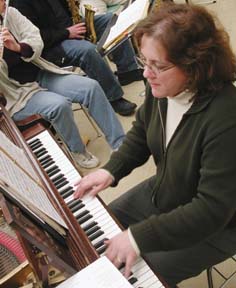 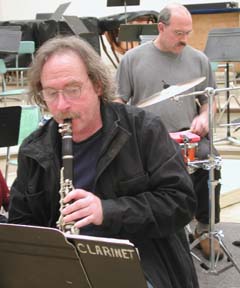
Left: Pianist Dana Christen.
Right: Clarinet/saxophone player and composer/arranger
Frank Stover.
Evolution
of a musician and a band
Born and raised on a farm in
Iowa, Michael McClimon learned to play the cornet in school bands,
and then played trumpet in jazz bands in college and in a swing
band when he was in the Navy.
Based in San Diego, the Navy
swing band took a couple of trips up the coast that included
stops in Humboldt County, and when he finished his naval career
in 1974, he and his wife decided to move here. After earning
a teaching credential at Humboldt State University, he taught
music at a number of schools in the region while his trumpet
remained mostly in its case. "I taught music for close to
15 years without playing much," he recalled. "Then
about 10 years ago I decided to start gigging."
Among the bands he played with:
Titanic Swing Band (now known as Big Band Swing) and the Evelyn
Johnson Orchestra, a dance band that has been around "for
something like 50 years." He did a stint with the local
Dixieland outfit, the Hall Street Honkers; and assembled a German
band, Hans' Oom-pah Band, for Octoberfest.
For the past 27 years he's directed
the Scotia Band, "a little community band that's been
going since 1935." He got up from his desk to take a photo
of the large band from the wall. The band plays traditional Souza
marches, medleys from musical theater and popular tunes. "We've
been rehearsing every Monday at Fortuna High for years,"
he said. The Humboldt Ragtime Band grew out of the Scotia Band.
In 1985, the Scotia Band marked
its 50th anniversary with a celebration that included -- in addition
to dinner, cake and punch -- some ragtime.
"I bought several of [Schuller's]
Red Back Book arrangements for the occasion and we played
some of them for the party, played maybe a 30-minute set at the
cake cutting. Ten years later the arrangements were out of print.
Today you have to rent them if you want them."
Except for that brief foray
into ragtime, the arrangements McClimon had collected gathered
dust for a few years (they are now out of print). Then in 1992
a group in Fortuna started up a concert series at a place called
the Monday Club.
The first band drew on McClimon's
friends and associates in the Fortuna area, his flautist daughter,
Sarah, among them. Another original member was tuba player/vocalist
David Demant, who's still with the group. Of course, piano was
central; a drummer, a trombonist and a clarinet/sax player completed
the lineup.
"My concept was always
to be a little ragtime dance band," said McClimon. "So
we don't use a string bass, we have a tuba. A lot of the stock
arrangements have full string parts which we don't use."
Over the years players have
left the area or dropped out. In 1994 Frank Stover came onboard
as clarinet/saxophone player and composer/arranger, Scotia native
Dana Christen signed on as pianist, and trombonist Jimmy Durchslag
joined.
Christen has been teaching music
at Scotia School for 21 years. Those who follow the local music
scene will recognize Durchslag as a founder of the salsa/Cuban
music label Bembé Records, a former member of Kachimbo,
current member of Ponche! and of Humboldt Time, a southern Humboldt
bebop combo that gathers once a month for a gig at the Redwood
Pub.
A couple of years later Jill
Petricca took over the flute/piccolo chair; she is well-known
in Humboldt's classical scene and as a jazz player. Another music
teacher, Michael LaBolle, joined around the same time on drums.
LaBolle teaches at Lincoln School in Eureka and has been active
in Humboldt's Latin, samba and world music scene for years.
McClimon seemed genuinely surprised
that some of these high caliber musicians have joined in an exploration
of what some might see as an obscure musical form.
"It takes some chops to
play ragtime; it's a challenge to play it right. I feel like
the Humboldt Ragtime Band has gotten to a point where we're doing
more than just playing what's on the page. We have some really
good players who have been together for years."
 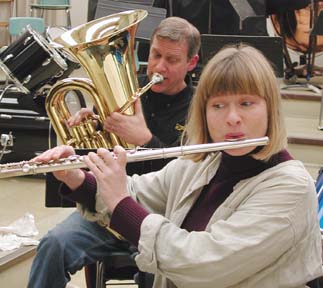
Left: Tuba player and vocalist
David Demant. Right: flautist Jill Petricca.
Attention
to detail
"I'm amazed at some of
the nitpicky things we talk about at our rehearsals," McClimon
continued, "things we never dreamed of discussing five years
ago. We were just getting through it before, now we know it."
Listening to the band practice
at Fortuna High last Thursday, the "nitpicky" attention
to detail was evident. It was also clear that, while McClimon
is ostensibly the leader, the whole group participates in decisions
about how any given piece is played. Most of the players are
teachers, everyone takes the music very seriously and no one
is afraid to express an opinion.
Durchslag initiated a spirited
discussion on how to handle the dynamics on "Scott Joplin's
New Rag." A new approach to the fourth strain shifted the
nuance, and after a couple of practice runs everyone agreed that
it sounded better.
While Joplin was central in
the history of ragtime, and was dominant in the revival, he was
just one of many composers who used the form. The next tune rehearsed
was "Alaskan Rag" by Joseph Lamb, another major ragtime
figure.
The piece is an example of how
the Humboldt Ragtime Band works. McClimon and Stover found it
in the appendix to They All Played Ragtime while looking
for material for a score they assembled for the Charlie Chaplin
film, The Gold Rush, performed at the Broadway Cinema
for the Dixieland festival a few years back.
All they had was the piano part,
so Stover, who also works as a classical composer, wrote parts
for the rest of the band. He has also written a number of original
rags; the band will play two of them at the Graves concert.
Stover, who typically writes
much more complex works, described composing in the ragtime form
as "a pleasant distraction."
"It's not exactly my style,
I usually write orchestral stuff," he said, explaining that
writing rags is relatively easy. "For one thing, ragtime
is rarely very adventuresome in the harmonic, tonal sense. The
melodies aren't very complex."
McClimon concurred. He said
simplicity was part of the music's charm. "We're not talking
about some real stuffy kind of music that people will politely
sit through," he said with a laugh.
"This is fun music, and
we have fun with it," he went on. "We've pulled
out an arrangement called `In My Harem' that's kind of topical
right now. It's a hilarious piece of Tin Pan Alley schlock written
by Irving Berlin. We got it from the Barkdull Library (see accompanying
story). David Demant has a ball singing it.
"Ragtime is really happy,
very positive, upbeat kind of music. It reflects a beautiful
time in American history; there was all this optimism at the
beginning of the 1900s. [That optimism] basically ended when
we entered World War I. Scott Joplin died [in 1917], we entered
the war that same year."
Rekindling that optimism is
part of what has kept McClimon interested in ragtime. He had
this to say about the most recent turn of the century: "I
was thinking this is going to be a great time for America to
feel optimistic again. We were going into a new century and had
all these new things to look forward to. Unfortunately it didn't
work out that way. The economy looks terrible, and I can't believe
we're on the verge of war, maybe two wars. I try to stay positive
-- it's not easy -- but playing this music helps me feel optimistic."
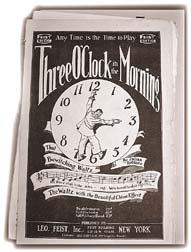 The Barkdull Orchestra lives again The Barkdull Orchestra lives again
THE HUMBOLDT RAGTIME BAND plays
more than ragtime.
When bandleader Michael McClimon
and other band members began looking for additional music to
play, they learned about the Barkdull Library, a local collection
of popular tunes from the Roaring `20s, right after the ragtime
era.
"It's sheet music that
came from Charlotte and Calvin Barkdull; they were brother and
sister," said McClimon. "They had a small group, about
six people that played all around the Eureka area."
About 20 years ago Humboldt
State's music department got a call from Charlotte Barkdull Niskey.
(Some time after the band broke up she married Frank Niskey,
a Humboldt County judge.) She said she had some sheet music she
wanted to donate to the university.
The college sent out Gil Cline,
a music professor who specializes in jazz. He met Niskey at her
Eureka home; at the time she was over 80.
"From 1919 until 1923,
when she was still a teenager, Charlotte and her brother had
a working band," said Cline. "It was sort of a jazz
band, although they may not have called what they played jazz.
They called it the Barkdull Orchestra.
"Charlotte played piano
and violin, I think her brother [Calvin] played saxophone. They
played the dance circuit, played everywhere: Eureka, Trinidad,
Clam Beach, Loleta, they played in Falk, the logging town, all
over."
After chatting with Niskey in
her living room, Cline was led downstairs. "The music was
sitting in her basement, laid out on tables, about 400 pieces.
They were published arrangements of the pop tunes of the day
mostly from Tin Pan Alley in New York. You bought them in stores
or on a subscription basis through the mail.
"[The arrangements] were
intended for dance bands and for bands that played in vaudeville
houses; there was a plethora of this kind of music. The collection
is representative of that era."
Cline gathered up the music
and took it back to his HSU office. With help from students it
was catalogued. "Now it's tucked away in a closet [in the
music building]. We make it available for research purposes,
but that's infrequent because not many people actually want to
play this music."
-- reported by Bob Doran
IN
THE NEWS | GARDEN | GOOD
NEWS | CALENDAR
Comments? E-mail
the Journal
© Copyright 2003, North Coast Journal,
Inc.
|