 
COVER
STORY | IN THE NEWS | FROM THE PUBLISHER
ARTBEAT
| DIRT |
STAGE MATTERS | THE HUM | CALENDAR
February 23, 2006
9 Questions for Cheryl Seidner
by HELEN SANDERSON
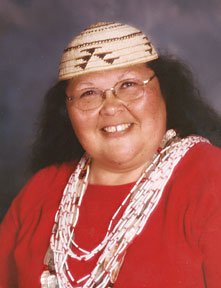 Tribal
Chairwoman Cheryl Seidner [right] spoke with the Journal
in advance of this weekend's Indian Island Candelight Vigil,
an annual event to honor the Wiyot people who were murdered by
white settlers in what is known as the Massacre of 1860. Somewhere
between 60 and 200 people, mainly women and children, were killed
on Indian Island on the last Saturday in February that year.
The Wiyot men were away from the island, gathering supplies at
the end of their weeklong dance to bring balance to the world.
Seidner, 55, and other tribal and religious leaders established
the vigil to promote healing in the community. The annual event
takes place at the west end of Woodley Island on Saturday, Feb.
25, from 6-8 p.m. Tribal
Chairwoman Cheryl Seidner [right] spoke with the Journal
in advance of this weekend's Indian Island Candelight Vigil,
an annual event to honor the Wiyot people who were murdered by
white settlers in what is known as the Massacre of 1860. Somewhere
between 60 and 200 people, mainly women and children, were killed
on Indian Island on the last Saturday in February that year.
The Wiyot men were away from the island, gathering supplies at
the end of their weeklong dance to bring balance to the world.
Seidner, 55, and other tribal and religious leaders established
the vigil to promote healing in the community. The annual event
takes place at the west end of Woodley Island on Saturday, Feb.
25, from 6-8 p.m.
1. How did the vigil start? When did it start?
It was 1992. I can remember that because Columbus
sailed the ocean blue in 1492. And in 1992 they were going to
bring in two, or one, of the replicas of his three ships to Humboldt
Bay, around Columbus Day, and it just did not bode well with
me. We are celebrating the "founder" of America. Well,
we weren't lost. We were always here. Even when I was a little
kid, in 1960 I was in fourth grade and my teacher, a wonderful
lady, she was teaching on that unit and she said, "Who discovered
America?" And all these little hands flew up in the air
and they said, "Christopher Columbus." And my little
brown arm goes up in the air -- "The Wiyots were already
here!" [Laughs.] So I became a little outspoken advocate;
I was outspoken ever since I can remember.
So we had been talking about what we were going
to do and somebody called a meeting. The Maritime Museum was
involved, a professor on campus was involved, I was involved,
someone from the tribe was involved, the Historical Society was
involved. We came together and we started talking about putting
up a kiosk, talking about the island and doing all these different
things, but we couldn't raise the money to do it. Then we got
to the stalemate of: Someone was going to write the history [of
Indian Island and the Wiyot] and they weren't going to allow
anyone to edit it.
2. Who are they? Who was going to write the
history?
That's not important. Someone was going to write
the history and they weren't going to let anyone edit it. We
felt very uncomfortable about not being able to look at it before
you plop [a plaque] on there. So it just stopped in the water
and we couldn't raise the money for the kiosk. But we said we've
got to do something. Then a pastor from the First Congregational
Church in Eureka, the president of the Historical Society, myself
and another tribal member got together. We said, "We need
a healing." Since this Massacre of 1860 there has been a
tremendous chasm between two worlds and it's not getting any
closer, the chasm is not narrowing enough. The other thing we
realized is that no one had probably given a thought to all the
people that died there that day. And so we wanted to remember
them, though we may never know their names. So with those two
premises we decided to put a candlelight vigil together.
Each year it grows, sometimes it has subsided.
Last year we had well over 200 people show up. We started out
at about 75 people the first time. We've had people come and
share poems, share feelings, share songs, share prayers and we
even had a Jewish person come in her shawl and do a prayer in
Hebrew. It's not exclusive. Even in the 1860s dance, it was for
all people. White people were here, the tikwo', and
they were included if they wanted to come. You can't come as
a spectator -- you must come as a participant. And I put that
same thing into it today; even though it may not be a dance,
you have to come with a good heart. If you are angry with someone,
don't come. But come if you're hurting and you need healing.
3. You are the descendent of a baby who survived
the massacre. What do you know about him?
His father was the one who put on the dances on
the island. His father was named Captain Jim -- they [the white
settlers] didn't know how to pronounce his name, so they called
him Captain Jim since he was a leader. That's how my mother got
her last name, James.
When they put on the world renewal dance the men
never stayed on the island, they went back to the villages and
would bring back the next day of supplies. The women and children
and the elders stayed on the island with a couple of young men.
It wasn't really for protection but just a watchful eye. And
the reason why we know all of this information is because Captain
Jim was one of the men who came back with the supplies and saw
all the devastation. He lost his family except for his son. Jerry,
the baby, grew up and he passed away in the 1940s, I think, and
he was a pretty renowned individual, at least in my family he
is pretty doggone renowned.
4. Who told you about what happened on the island?
My mom and dad. They were exceptional people. They
have been gone almost 30 and 40 years of my life. My dad was
killed when I was 16 and my mother died when I was 26. But you
know, I go back to them at any decision I ever make. I go back
and say, what would mom and dad do? They were, as I say, exceptional
people. They told me. I knew about this before I even went to
elementary school. They said, "Now, that happened in 1860.
That's a long time ago and you need to remember it. Don't forget
it. But don't beat people up for it because it's not them that
did it." I never forgot it.
5. When you're at the vigil, what are you thinking
about? How are you feeling?
I do a lot of praying. I start out the day with
a prayer, as I do every day ... I try to do every day. Sorry,
God. Usually that whole day is blank so I don't have to worry
about anything. I get there about 4 p.m., walk the site, say
a prayer, try to get in the frame of mind that we are trying
to heal a society that may not want to heal.
6. The World Renewal Dance the Wiyot were doing
in 1860 was never completed, and even now it has not been completed.
Finishing the dance is a goal of the Wiyot. What has to happen
first?
The island has to be cleaned up. We need to put
a dance house on the island, because our dances are in the wintertime.
We have to take off the debris from the 1.5 acres that we bought
[from the city of Eureka] and we have to make it so it's safe
for people to walk around, we have to make it so people can't
come in and loot [gravesites]. We're slowly doing that but it
takes time and it takes money.
7. What do you think of development of the Eureka
waterfront, particularly the Balloon Track? Do the Wiyot have
a voice, or a say in the development there?
The state of California has given us the right
to be a part of the decisions, and for right now we're just looking
into it.
8. Any particular feelings?
No. What is it they say? No comment. [Laughs.]
I just noticed your jacket. I like it.
9. Thanks. It's really warm. Anything else about
the vigil that you'd like to mention?
Dress for rain or shine, dress warmly, bring a
candle. Be there willing to put your best foot forward.
COVER
STORY | IN THE NEWS | FROM THE PUBLISHER
ARTBEAT
| DIRT |
STAGE MATTERS | THE HUM | CALENDAR
Comments? Write
a letter!
© Copyright 2006, North Coast Journal,
Inc.
|