|
 
by BOB DORAN
ON A COLD, CLEAR, BEAUTIFUL MORNING IN EARLY January, the 1908
Zanone house at 16th and G streets in Eureka teeming with activity.
Inside the Queen Anne Colonial ![[photo of Zanone house]](cover0125-zanonehouse.jpg) Revival-style Victorian, a video
crew from the HGTV Channel 29 series, Old Homes Restored,
were setting up lights for an interview with homeowner Ron Kuhnel.
Just inside the entry way, Peter Santino was carefully stripping
the woodwork below the stairs, removing layers of varnish that
will be replaced by an authentic shellac treatment. In front
of the house masons put the finishing touches on an extension
of the sidewalk and curb. Once the cement is cured it will be
virtually impossible to tell the new work from the original.
Another truck pulled up and a crew of iron workers began setting
posts for an old-fashioned wrought-iron fence. Revival-style Victorian, a video
crew from the HGTV Channel 29 series, Old Homes Restored,
were setting up lights for an interview with homeowner Ron Kuhnel.
Just inside the entry way, Peter Santino was carefully stripping
the woodwork below the stairs, removing layers of varnish that
will be replaced by an authentic shellac treatment. In front
of the house masons put the finishing touches on an extension
of the sidewalk and curb. Once the cement is cured it will be
virtually impossible to tell the new work from the original.
Another truck pulled up and a crew of iron workers began setting
posts for an old-fashioned wrought-iron fence.
The three-man crew from Old
Homes Restored spent four days in Eureka. Besides the Zanone/Kuhnel
home, they filmed a segment at Blue Ox Millworks, which makes
authentic reproductions of woodwork, and another on the conversion
of a former Old Town bordello into a French-style apartment by
Mary Beth Wolford. The crew wrapped up its visit with a segment
on a historic fisherman's cottage on Gunther Island, also known
as Indian Island, home of Eureka Mayor Nancy Flemming and husband
Mark Staniland.
Retirees with a
mission
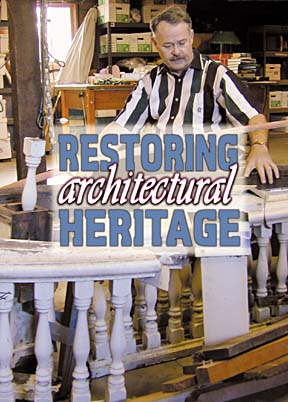
Ron
(in color photo at top) and Melanie
Kuhnel (photo below right) moved to Eureka from Sacramento two years ago
after they retired. The Kuhnels had often visited the city. Melanie's
daughter, Leslie Lollich, a familiar face on local television
news for the past 17 years, lives here with her husband and two
sons.
![[photo of Melanie Kuhnel]](cover0125-melanie.jpg) "Since the '70s I've walked
around town with Leslie looking at the houses," Melanie
said. "We were driving down the street one day and saw that
this house was for sale. I walked in the front door and said,
`I have to buy this house.'" "Since the '70s I've walked
around town with Leslie looking at the houses," Melanie
said. "We were driving down the street one day and saw that
this house was for sale. I walked in the front door and said,
`I have to buy this house.'"
Because she was interested in
historic architecture, Melanie joined the Eureka Heritage Society.
At one of its functions she learned about a program at College
of the Redwoods, called Historic Preservation and Restoration
Technology, and enrolled in an introductory course.
"I had been a data-processing
manager, so this was a completely different field for me,"
she said. "I found the whole subject incredibly interesting;
I was having a lot of fun doing research. I learned that this
house had not really been changed too much. The people who lived
here hadn't remodeled the place. It's amazing, almost everything
is original."
Melanie enlisted the help of
her husband, Ron, who found himself spending many hours digging
through old papers at the courthouse and the library.
"The house was constructed
by Magdalena Zanone," Ron explained. "She was the widow
of Domingo Zanone, a cattle baron who came here in 1866. He had
a 5,000-acre cattle ranch between Cape Town and Petrolia, right
along the ocean. He died in 1908 leaving six children and his
widow. She built this house and lived here until 1948 and raised
her children here. Her spirit is in this house."
To help with plans for the interior,
the Kuhnels hired Penny Eskra, an interior designer specializing
in restoration of historic buildings.
"I prefer doing accurate,
authentic restoration, not rehabbing or renovation," said
Eskra, whose past projects include work on the Carson Mansion.
"Restoration means putting back as closely and accurately
as you can by doing in-depth research of the physical surfaces,
of the chronological history of the family that owned the house
and determining what has happened with subsequent owners.
![[photo of video crew]](cover0125-filmcrew.jpg) A video crew from HGTV Old Homes Restored (cable channel 29)
A video crew from HGTV Old Homes Restored (cable channel 29)
sets up equipment in the Zanone house.
"When you put it all together
you come up with an idea of what you can and cannot restore depending
on how much of the original fabric remains -- the woodwork, the
configuration of rooms, wallpapers or fragments that can be replicated."
His interest piqued, Ron enrolled
in some of the other restoration courses at CR.
"I took [a class in] historic
preservation fieldwork. There's a home in Rohnerville that we
use as a project house. We went in there and learned all the
techniques -- how to find old wallpaper, how to do historic research
before you actually tear the place apart.
"Then I started the architectural
millwork class a year ago. I'm taking it again this spring since
I'm working on repairing the old balustrade. I'll work on it
at the woodshop at CR and use their tools."
Most of the house's redwood
gutters have been partially repaired and a curved wooden gutter,
replaced years ago with a metal gutter, is piled next to the
balustrade in the basement, waiting to be refurbished.
The College of the Redwoods
has been offering a two-semester certificate in historic preservation
and restoration technology as part of its Construction Technology
Program since fall 1996.
Bill Hole, a woodworking instructor
with a background in carpentry and remodeling, was instrumental
in establishing the program. Among other projects, his renovation
work includes rebuilding the historic motor vessel M.V. Madaket,
which has been on Humboldt Bay since 1910.
Hole joined forces with Jill
Macdonald, a sixth generation Humboldter who went to the University
of Oregon to earn a master's degree in historic preservation.
With support from the Eureka Heritage Society, they put together
an advisory committee that included preservation advocates like
Ted Loring Jr., a Eureka realtor, and former Arcata Mayor Alex
Stillman.
"I went around the country
and gleaned ideas from all the different programs," said
Hole. "There are only a handful of restoration programs
nationwide and there aren't any hands-on programs like this on
the West Coast at all.
"In our program you get
to work in a shop and learn how to duplicate molding and trim.
You go out and work on a building, get underneath it and study
the foundation and actually work on it. You get inside and learn
how to repair windows," Hole added.
Adaptive renovation
![[photo of Mary Beth Wolford]](cover0125-marybeth.jpg) Mary Beth Wolford, (photo at left)
who is completing two terms as president of the Eureka Heritage
Society, moved here four years ago from Southern California,
in part because of the historic architecture. The first house
she bought in Eureka was a Queen Anne. Mary Beth Wolford, (photo at left)
who is completing two terms as president of the Eureka Heritage
Society, moved here four years ago from Southern California,
in part because of the historic architecture. The first house
she bought in Eureka was a Queen Anne.
"I spent two years on the
project, then thought, `I'd like to do this again.' I happened
upon some commercial property downtown that was for sale and,
rather reluctantly, sold the house I had just completed.
"I enjoyed the prospect
of taking a space that wasn't designed for residential living
and redesigning it as my own residence. It was challenging because
it's only 28 feet wide and it's a block deep. It previously had
seven individual rooms and some common rooms. Mine is an adaptive
renovation. I've redesigned it as a French apartment, giving
it a cosmopolitan feel.
"I'm still working on it.
I'm adding another 2,400 square feet on the back right now, a
carriage house garage. Upstairs will be a rooftop garden with
a glassed-in Victorian conservatory."
Wolford is also involved in
the Heritage Society's most recent project -- an upgrade for
the display of Romano Gabriel's folk art, purchased by Dolores
Vellutini after Gabriel's death.
![[photo of film crew on rooftop]](cover0125-rooftop.jpg) The film crew is in Mary Beth The film crew is in Mary Beth
Wolford's rooftop garden.
Standing second from the right is
Tom Morrin of Celtic Construction.
"We, (the Eureka Heritage
Society), are the caretakers for this fabulous folk art exhibit,"
she said. "We're putting in new lighting and we just put
in some screening on the windows so the objects won't fade so
badly. We're adding new signage. Volunteers for this project
are EHS members Gerry and Carol Hale. We'll have a ribbon cutting
in May during Preservation Week."
Home tour sparks
purchase
The Heritage Society's annual
fund-raiser is a historic-homes tour in the fall, a tradition
that goes back many years. One particular tour 16 years ago was
particularly memorable for Eureka Mayor Nancy Flemming, who at
the time was a shop owner in Old Town, and her husband Mark Staniland
(both in photo below left)
.
![[photo of Mark Staniland and Nancy Flemming]](cover0125-mayorhouse.jpg) When Flemming
moved to Eureka in 1973, the Eureka Heritage Society was just
forming and had begun the monumental task of cataloging 10,000
buildings in the city. The structures were photographed and evaluated
for architectural and historical significance. Dolores Vellutini,
Sally Christensen, Ted Loring Jr. and Muriel Dinsmore were instrumental
in initiating the survey and directing the efforts of a staff
of professional architectural historians and more than 1,000
volunteers. When Flemming
moved to Eureka in 1973, the Eureka Heritage Society was just
forming and had begun the monumental task of cataloging 10,000
buildings in the city. The structures were photographed and evaluated
for architectural and historical significance. Dolores Vellutini,
Sally Christensen, Ted Loring Jr. and Muriel Dinsmore were instrumental
in initiating the survey and directing the efforts of a staff
of professional architectural historians and more than 1,000
volunteers.
Ultimately about 1,500 buildings
were deemed to be historically significant.
"I was a young mom helping
do the survey of all the buildings in the city," Flemming
recalled. "It was a huge project. I lived in a house at
Buhne and G that was on the historic registry, coincidentally
right across the street from Muriel Dinsmore. I'd throw the kids
in the car and drive all around.
"We also got to study the
architecture of Eureka through a docent program at College of
the Redwoods," she said. "That really helped me appreciate
the exquisite architecture here and to understand what an incredible
heritage we have. The Heritage Society helped create an awareness
of what a precious asset we have."
Besides working on the survey,
Flemming helped organize the home tours. Her home was included
on one of the tours.
"One year we were focusing
on Old Town and turn-of-the-century businesses. Muriel was very
interested in having this little island cabin and the boat-building
facilities on the tour. She asked me to go look at the place
to see if I could `dress it up' for a tour."
![[photo of house]](cover0125-before.jpg) The empty house on Gunther Island (The unrestored house is shown in photo
at right) had been the home of a fisherman,
Ernie Lampela, and his wife, Valene. (He was the model for the
fisherman's memorial sculpture on Woodley Island.) The empty house on Gunther Island (The unrestored house is shown in photo
at right) had been the home of a fisherman,
Ernie Lampela, and his wife, Valene. (He was the model for the
fisherman's memorial sculpture on Woodley Island.)
"As soon as Mark and I
set foot on the island we fell in love with it," said Flemming.
"We talked with Valene and arranged to move over to see
if we could endure the hardships. We ended up buying the property
and moved in before the tour.
"It was very small, dark
and cramped. What we've done since then is open things up and
let in more light. Fixing it up has been an ongoing, very slow
process. Everything has to be brought over in a skiff or with
our tugboat, the Nancy Stout.
"It was a big thing to
get a hot water heater so we could take a shower or a bath in
the morning. When we moved in you had to build a fire in the
fireplace which was plumbed to a hot water storage tank. We've
been through several generations of generators. We installed
a septic system. Mark added a wind generator while the House
and Garden television people were here."
![[photo of video crew]](cover0125-dock.jpg) The video crew follows mayor Nancy Flemming and
The video crew follows mayor Nancy Flemming and
husband Mark Staniland down the dock to their historic
fisherman's cottage on Gunther (Indian) island.
Their reworking of the rustic
cottage is more renovation than restoration. While Flemming says
most of the work they have put into the place is invisible, new
touches have added a bit of Victorian character. (See restored house with Mark and Nancy
in photo above)
Bay windows have been installed
on the front of the house. (Flemming says that bay windows are
common in seaports because the fog makes people want to let in
more light.) The patio in front is bordered by a fence made from
railings that once were part of the mezzanine in Capt. Buhne's
marine supply store -- built before the turn of the century --
which now houses the First Street Gallery.
![[photo of kitty]](cover0125-kitty.jpg) More of the railings, including some curved
sections, lean against the side and back walls. All were a gift
from Dolores Vellutini, who owns the First Street building. (The
mezzanine was removed during earthquake retrofit.) (In photo at right, the family cat sunbathes
under the railings.) More of the railings, including some curved
sections, lean against the side and back walls. All were a gift
from Dolores Vellutini, who owns the First Street building. (The
mezzanine was removed during earthquake retrofit.) (In photo at right, the family cat sunbathes
under the railings.)
Flemming said eventually the
wood will be part of a fence leading to a circular deck behind
the house. But that project and others will have to wait until
a more pressing one is taken care of -- repairing the decaying
docks where the Nancy Stout and Flemming's skiff share space
with another fixer-upper, an old sailing ship.
Destination an
asset
"A lot of builders don't
know how to deal with the old places," said Hole, who serves
as alternate on city of Eureka's Historic Preservation Commission.
"Appraisers don't know
how to appraise them, realtors don't know how to market them.
So people tend to steer away from them saying, `Oh that's just
an old house.' I look at them and say, `What a treasure.'
"If you go to other parts
of the world, it's easy to find buildings that are hundreds of
years old and people still use them. They still live in them.
In our country -- with our disposable society -- I think it's
important to preserve some of this heritage for generations ahead."
Some property owners do not
see the importance and many want no part of historical designation.
According to Loring, of the 1,500 buildings that met the Heritage
Society's criteria as historically significant, only half ended
up with an official listing.
"When they set up the historic
register they allowed individuals to opt out if they chose to
do so. About half of the people opted out."
The reason, Loring said, was
fear.
"What's this going to do
to my property rights?"
Loring said although the city's
ordinance puts some restrictions on remodeling and demolition,
there are advantages. The builder gets to use the state historic
building code which in some cases can allow for the use of less
expensive methods and materials.
Owner Ron Kuhnel feels that
more property owners would be willing to invest in restoration
if the city would pass a tax incentive available under the 1974
Mills Act.
"The Mills Act basically
provides about a 50 percent reduction on property taxes for a
house that qualifies. Major cities in California, including San
Francisco and Los Angeles, have passed it. In cities where it
has passed, it's had a positive effect. The city benefits in
two ways: Trades people get work and the homes go up in value,
which ultimately increases the property tax base."
According to Wolford, the Heritage
Society will soon make a presentation to the City Council urging
adoption of the act.
"We have a number of agencies
throughout the community writing letters and talking to City
Council members," she said. "The more we encourage
people to invest in improvements in the vintage homes we have
here, the more other people will start fixing their places up."
It shouldn't be hard to convince
the mayor, although she only votes in case of a tie on the council.
"It [The Mills Act] helps
create tax incentives for people who have historic structures
so that it's not perceived as punitive to be in an historic district,"
she said. "What they're trying to do is make [historic designation]
an asset something people will strive toward rather than avoid."
She feels that the city's architectural
heritage is what makes it stand out.
"It's important for a city
to understand and exhibit its own unique personality, just as
it is for people. One of the unique parts of Eureka's personality
is the very varied architecture we have because we were, and
are, a seaport. Celebrating our past can help define our future.
We are a city with its own flair, with a style and flavor --
an authentic place. And that is something we should preserve,"
Flemming concluded.
For Ron Kuhnel, taking care
of an old house is a matter of personal commitment.
"When we bought this house
we took on a responsibility. We bought a piece of history. It
sounds kind of high falutin', but this house doesn't belong to
us, it belongs to the ages."
The Old Homes Restored segments
will air 10 times throughout 2001 on HGTV (Channel 29), available
on cable television. The Eureka Heritage Society's survey, Eureka:
an Architectural View ("The Green Book"), includes
the inventory of historic buildings along with a history of the
city illustrated by existing architecture. The society's annual
meeting is scheduled for Saturday, Jan. 27, at 1:30 p.m. at the
Vance Hotel. It will include a discussion on the history of the
hotel by Kathleen Stanton, Kurt Kramer and Ted Loring Jr. The
annual meeting is open to current EHS members and new members
who may join at the door. June Beal is membership director. For
more information about the Eureka Heritage Society, visit its
website: www.eurekaheritage.org,
or call 445-8775 or 442-8937.
IN
THE NEWS | CALENDAR
Comments? E-mail the Journal: ncjour@northcoast.com
© Copyright 2001, North Coast Journal,
Inc.
|