|
 
![Crab Economics 101: From the bottom of the sea to your plate [photo of Sach Rotwein]](cover0117-photohed.jpg)
Story & photos by ARNO HOLSCHUH
![[photo of crab]](cover0117-bigcrab.jpg) WHEN ZACH ROTWEIN WAS GROWING UP IN MARYLAND
his mother would often lose him in the grocery store. They'd
go in together, but as soon as her back was turned, Rotwein would
wander off. She always knew where to find him, though -- at the
seafood case. WHEN ZACH ROTWEIN WAS GROWING UP IN MARYLAND
his mother would often lose him in the grocery store. They'd
go in together, but as soon as her back was turned, Rotwein would
wander off. She always knew where to find him, though -- at the
seafood case.
"I'd be
there asking the fishmonger where each kind of fish was caught,"
he said. "One day, it dawned on me that you could make a
living catching these things."
Making a living
off of the sea is just what Rotwein now does, both as the captain
of the 30-foot fishing boat Sundown and as the proprietor of
Cap'n Zach's Crab House in McKinleyville. Some years he makes
a very good living, once turning an $80,000 profit. Other years,
he's lucky to break even. The 2001-02 crab season is one of those
"other" years.
For crabbers
to survive in the long run, "You need a good price and decent
quantity" and this year has neither. In a good year Rotwein
will harvest thousands of pounds of crab and fill his boat in
a few hours. This year he can spend 12 hours on the water and
only bring 600 pounds into the dock. To top it off, the price
per pound that crab processors are paying has gone down over
last year.
It's just another
chapter in the history of North Coast crab fishing, where the
price and amount of crab harvested vary widely from year to year.
It puts Rotwein -- and other crabbers -- on a pendulum swinging
between caviar and humble pie.
But why? What
biological factors lead to feast one year and famine the next?
What determines the price a fisherman can get in the crab fishery?
One thing is for sure, said Rotwein: The only crabbers who will
survive in the business are those who can find ways to deal with
both biological and market fluctuations.
"The secret
used to be to go out and fill your boat. Now the secret is to
go out and get as many crab as you can -- and then get the most
money for them," he said.
![[photo of men on boat]](cover0117-onboat.jpg) Zach Rotwein and his deckhand Jim Simmons
pulling crab pots aboard the Sundown. Zach Rotwein and his deckhand Jim Simmons
pulling crab pots aboard the Sundown.
The importance
of being aggressive
It's dark, cold
and severely early -- 5:45 a.m. early. It doesn't bother Rotwein.
He's down at the dock in Trinidad, slapping on his rain gear
and clambering into the tiny boat he uses to row out to the Sundown.
Early starts are part of being an aggressive crab fisherman,
he said, and in this game only the aggressive survive.
"You gotta
get out there, fish long hours, fish in rough weather,"
he said. "Really, unless the weather is death, you have
to fish."
"There
have been times we stayed up 42 hours straight crabbing, went
home for four hours of sleep and went back out again. You get
into that competitive mindset; there are only so many crabs out
there, and while you're sleeping, someone else is pulling them
up."
The Dungeness
crab fishery operates on a different system from most others,
because there are no limits on how many crabs can be caught.
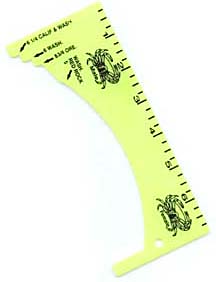
The crab fishery has two main regulations: No harvesting females
and no males under six inches. The idea is to give male crabs
a chance to reach sexual maturity and mate, and females a chance
to carry those eggs to term.
That leaves
a pool of legally sized male crabs -- and they belong to whoever
gets them first. He who tries hardest gets the most before the
supply is exhausted.
![[photo of two men with crab pot]](cover0117-emptypot.jpg) And you have to be ready
to invest in a lot of gear. Rotwein has 350 crab pots in the
water, each of them worth around $100. He also owns a crab fishing
license worth about $16,000. Together, they represent a $51,000
investment -- not including his boat, maintenance or crew. And you have to be ready
to invest in a lot of gear. Rotwein has 350 crab pots in the
water, each of them worth around $100. He also owns a crab fishing
license worth about $16,000. Together, they represent a $51,000
investment -- not including his boat, maintenance or crew.
Putting forth
a lot of effort and cash is vital, because it allows you to get
your share of the crab catch, he said. That's especially true
early in the season. When the season opens in December, boats
can bring back literally tons of crab a day. Those who dawdle
do not win: By the end of the season in early summer, boats might
be lucky to get 300 pounds per trip; there just aren't many legal
crabs left to catch.
The intensive
fishing effort doesn't seem to be hurting the crab's biological
condition, said Dave Hankin, fisheries biologist at Humboldt
State University. "The population has persisted in spite
of fishing. In that sense it is sustainable fishery."
 But while the crab population is
biologically sustainable, it could hardly be called stable. Dungeness
crab naturally experience wild fluctuation in population, zooming
from peaks to troughs -- like this year -- on a roughly decade-long
cycle. But while the crab population is
biologically sustainable, it could hardly be called stable. Dungeness
crab naturally experience wild fluctuation in population, zooming
from peaks to troughs -- like this year -- on a roughly decade-long
cycle.
"The last
good year we had around here was the 1995-96 season," Rotwein
said. He left Trinidad with his crew when the season opened at
midnight and by 4:30 a.m., the boat had begun to sink under the
weight of the crab they had collected. "We had 10,000 pounds
in four and a half hours," he said.
Now, five years
later, he finds himself in the bottom of the cycle. When he pulled
his pots on the first day of the 2001-2002 season, he got just
1,600 pounds in 10 hours of work.
"There
were some long faces," he said.
Tough years
in the crab fishery are harder now than they were in years past,
because the other commercial species on which fishermen relied
are no longer available.
Crab represents
the last man standing in terms of commercial fishing on the North
Coast. Salmon fishing has been heavily curtailed since the late
1980s because of concerns over their viability as a species.
Similar concerns have effectively brought the once-lucrative
rockfish industry to a grinding halt as well.
"It used
to be that the guys who owned the boats, in order to get crew
members, would say, `If you want to fish the salmon season, you
have to come out and fish crab as well.' Then the salmon fishing
wasn't as good, so it was: `If you want to do crab fishing, you
have to come salmon fishing, too.'
"Now, all
we have is crab."
This means that
crab fishing is getting more attention from fishermen now than
ever before. The incentive to set more and more pots in the water,
always present, is growing even more. It has the potential to
put the squeeze on crabbers, because the number of crabs isn't
increasing -- but the cost to try and get your share of the crabs
is.
The extremely
intense fishing methods may even be reducing the economic value
of the fishery, and some people are trying to find ways to fight
the push for more pots (see related
article below).
But for now,
guys like Rotwein are glad that they still have a fishery --
and they will continue to work the system that is available to
them.
![[photo of boat deck with crabs and pots]](cover0117-crabsnpots.jpg) Crab pots stacked on
the back of the Sundown. In the background is the Humboldt shoreline
since most small crab boats stay within a few miles of shore. Crab pots stacked on
the back of the Sundown. In the background is the Humboldt shoreline
since most small crab boats stay within a few miles of shore.
Now for the
hard part
Let's assume
you're a crab fisherman -- a very good one. You've just brought
in 1,000 pounds of crab on your boat and you're looking to turn
that crab into some cold hard cash. But who needs 1,000 pounds
of fresh crab all at once?
Processors.
Seafood processors buy the majority of crab during the most productive
part of the season. That crab is then either sold live or --
more likely -- frozen and sold later in the year.
Processors naturally
want to be paid for the trouble of taking care of all that extra
crab. Crab that they buy for around $2 a pound at the dock goes
in grocery stores for around $4.50, so there is a profit to be
made.
Crab fishermen
often see that profit and start crying foul, but the processors
aren't necessarily their enemy, Rotwein said.
"In those
years when we have a lot of crab, there's no other way we could
deal with the volume," he said. The processors are necessary
if crabbers want to continue to see years where a single boat
trip can gross over $10,000.
"If you
catch 7,000 pounds, you won't complain about the $1.65 price,"
he said.
![[photo of crab being measured]](cover0117-measuring.jpg) ![[photo of crab pot being emptied]](cover0117-pot.jpg) ![[photo of fisherman tossing crab pot into ocean]](cover0117-tossingpot.jpg)
Left, measuring
crabs to see if they are legal size.
Middle, emptying crab pots by artificial light. Pre-dawn starts
are just part of successful crab fishing.
Right, Tossing the pot, emptied of crabs and loaded with fresh
bait, back into the ocean.
But a recent
change in the marketplace for wholesale crab in Humboldt County
has some crabbers worried. Eureka Fisheries, once the largest
purchaser of crab from Eureka and Trinidad, was purchased and
closed in August. That left only one big buyer for crab: Pacific
Choice Seafood.
"It hurt
when Eureka Fisheries went under," said Dave Bitts of the
Humboldt Fisherman's Marketing Association. "Any time you
have one player dominating the market, the pricing is going to
get less competitive," he said. (Representatives of Pacific
Choice were not available for comment.)
But the crab
price isn't just a function of what Pacific Choice decides to
do. "The market for crabs is national, if not international.
The supply can come from anywhere between San Francisco and Alaska,"
Bitts said. Prices are a function of the crab supply along the
whole Pacific Coast.
That's one reason
this year has been so tough. While crabs are scarce here, prices
remain low because of the large hauls crabbers are making in
Oregon. "From Coos Bay north, we have the impression there
is a fair abundance of crab," Bitts said.
Crab fishermen
don't have to take low prices lying down. There are ways for
some of the fresh crab they catch to be sold directly to the
consumer. That's how Scott Creps is making ends meet this year.
The part-time crabber, part-time logger owns the Barbara J out
of the Woodley Island Marina. He's been selling live crabs directly
from his boat under a new Eureka city program that started this
year.
"We've
been selling most of our crab down here at the dock," he
said. "It's been real important."
![[photo of boat selling crab]](cover0117-crabboat.jpg) Scott Creps sells live crab off his boat,
the Barbara J, at the Woodley Island marina. Scott Creps sells live crab off his boat,
the Barbara J, at the Woodley Island marina.
By cutting out
the middleman, Creps is getting a lot more net cash out of the
few crabs he's catching. "We're doubling our money here.
Normally, we'd get about $1.75 a pound. Here, we get $3.50."
In a year when Creps is bringing in less than his normal load
of crabs, the price premium is vital. Consumers get a deal too
-- that's about $1 less per pound than grocery stores charge.
Of course, one
crabber has been selling directly to the consumer for years.
Rotwein, also known as "Cap'n Zach," sells most of
his crabs through his seafood restaurant and market in McKinleyville.
"I heard
all these people complaining about the quality of the seafood
around here," Rotwein said. He was pulling the stuff out
of the ocean every day anyway, so he knew there was a good supply.
The question was just getting that fresh fish to market and,
"I saw a niche," he said.
It has helped
cushion him from the swings of the crab industry. "Running
the crab house isn't as exciting as catching the stuff, but in
a bad year I have another job," he said.
A good financial
strategy for the bad years like this one is a necessity in the
crab game. Rotwein crabs because he loves it, saying it's "the
most relaxing thing I can do." But in order to crab you
have to possess more than love -- you need the tenacity and skill
to navigate treacherous seas and a tough marketplace.
"What we
have left are high-bred crabbers, the ones who are capable of
surviving a couple bad years," he said. "The ones that
will survive are the ones who are doing something right."
A new approach
WHEN FISHERMEN
HEAR THE WORD REGULATION, THEY GET MEAN.
so -- regulations
to protect species threatened by overfishing and habitat loss
have all but closed most of the lucrative fisheries off the coast
of Northern California. Salmon and rockfish are virtually off-limits
to the vessels out of Eureka and Trinidad. That's left Dungeness
crab as the only major commercial fishery, and fishermen don't
want the government to get any ideas about additional regulations.
"We're
real suspicious," said Zach Rotwein, a 20-year veteran of
the crab industry. "We've seen what's happened to salmon
and rockfish."
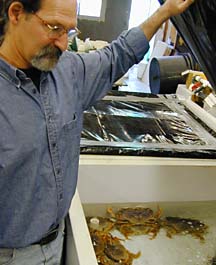 Humboldt
State University fisheries biology Professor Dave Hankin at the
crab lab. Hankin keeps dozens of crabs inside the HSU Telonicher
Marine Laboratory in Trinidad.
Humboldt
State University fisheries biology Professor Dave Hankin at the
crab lab. Hankin keeps dozens of crabs inside the HSU Telonicher
Marine Laboratory in Trinidad.
But two Humboldt
State University professors are trying to help crab fishermen
make friends with regulation. By changing the rules under which
crabbers operate, there is a chance they could make more money
-- a lot more.
"The way
that Dungeness crab are managed now in the regulatory scheme
results in a fishing derby," and that's bad for the fishermen,
said Steve Hackett, professor of economics at HSU.
Most of a season's
legal-size crab are landed in a month-long frenzy at the beginning,
leading to a glut on the marketplace. More crab is caught than
can be sold fresh, so processors buy the excess, freeze it, and
sell it through the year. Crab is much less expensive frozen
than fresh, so the fisherman gets less money per pound.
But what if
the crab catch was spread out across the entire season, which
lasts six and a half months? The crabbers could sell all their
crab on the fresh fish marketplace for an added price. "It
would probably improve the lot of fishermen," Hackett said.
The idea has
been tried before with remarkable success in other fisheries,
said Dave Hankin, HSU fisheries biology professor and Hackett's
research partner.
The fishery
for Pacific halibut used to be an absolute free-for-all, Hankin
said. "The fishery was regulated through quotas -- there
was only so much fishermen could catch in a given area."
That made fishing
for halibut a race. Once the quota had been reached, everyone
had to stop, but until that point, fishermen could try as hard
as they wanted. Those that set out lots and lots of fishing gear
would get a greater portion of the quota, so boats got caught
in a kind of arms race, always trying to outdo each other. The
end result? "The quota would be caught in a matter of days,"
Hankin said.
That sent most
of the halibut to the freezer, and fishermen got low prices for
their frenzied effort.
Until a new
regulatory system came along, that is. A new quota system was
established, where each boat was allowed a certain portion of
the total catch. They could go out to harvest that catch whenever
they wanted -- when the price was high. The result was "a
two- to three-fold increase in the income that fishery produces,
with no extra biological impact," Hankin said.
That's what
Hackett and Hankin want to talk to crab fishermen about: Could
it work here? While the crab fishery lacks the regulatory framework
of quotas that existed for halibut, Hackett and Hankin think
it is worth talking about. The most important thing for them
right now, Hankin said, is not to give the wrong impression.
"You have
to expect fishermen to be pretty reluctant to allow any more
regulation, because all the other regulations in other fisheries
have been pretty disastrous." And the seafood processors
have built up the capacity to handle large amounts of crab; Hackett
and Hankin both said they don't want to do anything to ruin that
investment.
"Any ideas
about regulation would have to come from the participants themselves,"
Hackett said.
Above all, Hankin
wants to make it clear to fishermen that no one is trying to
curtail the amount of crab they catch; they're just looking for
a more economically efficient way. He thinks crabbers will listen
because it would be in their best interest.
"I'm willing
to bet there are substantial numbers of fishermen out there right
now who realize that what's going on now is not a good thing."
But it may be
an uphill road. As Rotwein said, the crabbers "are managing
right now, even if it isn't a pretty picture." That's more
than you can say for the salmon fishery.
"If they're
asking me to trust the government, I would have to say I'd rather
stay with the status quo," he said.
Hackett and
Hankin invite all interested parties -- especially crabbers --
to discuss the idea at a meeting March 27 at the conference room
in the Woodley Island Marina complex.
IN
THE NEWS | CALENDAR
Comments? E-mail the Journal:
ncjour@northcoast.com
© Copyright 2002,
North Coast Journal, Inc.
|