|
 
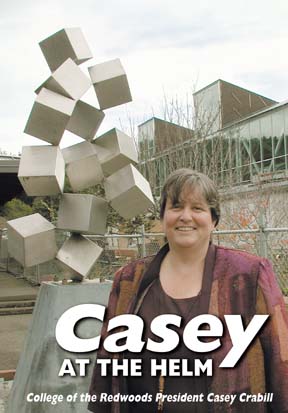
Story by GEORGE RINGWALD
Jeffrey L. Bobbitt, a transplanted Texan now in his fifth year
at College of the Redwoods (CR), has served as vice president
of Academic Affairs under both the previous administration of
Cedric Sampson and the present one of President Kathleen E. "Casey"
Crabill, and he has not the slightest hesitation in comparing
the two.
"You remember a couple
days ago [this in early December] when we had one of these days
that looks like late summer, a little warmer and there wasn't
a cloud in the sky?" he asks. "And it was bright and
clear." That would be the Crabill climate. "And you
think today" -- when it's pouring rain outside -- "that's
how much difference!"
 And "in large part," he adds, that
change can be attributed to the leadership style and vision of
the present chief executive officer. And "in large part," he adds, that
change can be attributed to the leadership style and vision of
the present chief executive officer.
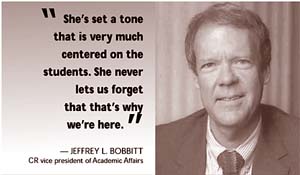
"I've never worked in
an organization where communication is as open and free as it
is here," Bobbitt says. "She's set a tone that is very
much centered on the students. She never lets us forget that
that's why we're here."
One student I encounter on
the campus tells me: "She's very tenacious. She's doing
a lot to reform the college, including putting up a new library."
The student adds that the "new" president (as some
still see her, although she's now in her third year) is "very
personable on a social level" but a no-nonsense administrator.
"You can tell she's tough, clawed her way up the professional
ladder." (Well, maybe, although I couldn't tell anything
like that in our recent interview. I found her open, engaging,
straightforward, with a good sense of humor.)
David F. Harris, with CR's
Computer Information Systems, notes another important difference
in the present and past administrations:
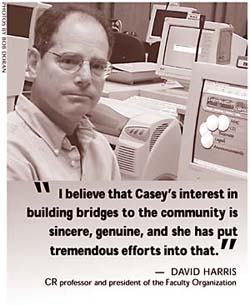
"I believe that Casey's
interest in building bridges to the community is sincere, genuine,
and she has put tremendous efforts into that. And she has made
it absolutely clear to everyone at this school that that is extremely
important."
Harris, who is president of
the CR Faculty Organization -- the college teacher's union --
recalls that there was some concern that the administration would
want to change or modify the three-year contract negotiated during
the past year. "And that didn't happen," he said. "It
was an incredible display of integrity, and it's had a very powerful
effect.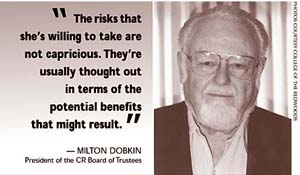
"Another area,"
Harris continues, "Casey is a little bit more of a risk
taker. She is adventurous in trying new things and trusting the
people she works with, the faculty and administration, to take
the initiative and try something. She wanted to encourage the
use of technology across the district, and she got behind the
program of creating a Center for Teaching Excellence at the college.
And that's risky, because it required funding, and there is no
guarantee. It's still in progress..."
Milton Dobkin, a retired Humboldt
State University vice president and current president of the
CR Board of Trustees, agrees on the risk-taking, but he qualifies
that. "The risks that she's willing to take are not capricious.
They're usually thought out in terms of the potential benefits
that might result."
Dobkin notes too that the
board "certainly supports" her building-bridges program,
which has, for instance, resulted in her own membership on the
boards of KEET-TV, the Humboldt Area Foundation, Redwood Community
Action Agency and the Greater Eureka Chamber of Commerce.
"She does not diminish
her attention to the college or the district in the process,"
Dobkin observes.
"One of the things I
shake my head at," he adds, "and wonder how she's able
to do it, she makes very frequent visits to the two most remote
operations in the district, one on the Mendocino Coast (at Fort
Bragg) and the one in Crescent City. Those are very difficult
drives, and there's no way to get there except by driving, and
yet she does that once or twice a month. She feels it's essential
that those operations be regarded as important functions of the
district."
It remains for an earthy journalist
of my acquaintance to add finis to the Crabill encomiums: "She
has lit a fire under everybody's butt -- but in a nice way."
By this time, along with David
Harris, I have come to the conclusion that the woman does everything
but walk on water.
Milt Dobkin laughs at the
suggestion, and says, "Well, I've never seen her attempt
that. She is a kayaker; doesn't need to walk, she rides."
One thing borne in on me going
around the campus is that just about everybody is on a first-name
basis with the president -- or a first nickname basis, rather.
 "She doesn't stand on ceremony,"
Dobkin notes. "I think one of her favorite lines is whenever
somebody calls her Dr. Crabill, she turns around to see if her
father's back there." (Her father, now retired, was a professor
of medicine at the University of Pittsburgh for more than 20
years and at Albany Medical College before that.) "She doesn't stand on ceremony,"
Dobkin notes. "I think one of her favorite lines is whenever
somebody calls her Dr. Crabill, she turns around to see if her
father's back there." (Her father, now retired, was a professor
of medicine at the University of Pittsburgh for more than 20
years and at Albany Medical College before that.)
"It's just my style,"
she says when we meet in her office just before the year-end
holidays. "I prefer informal levels of interaction, particularly
with faculty and staff. I keep my door open. People know if my
door's shut, I'm either on an incredible deadline or I'm talking
about something that's confidential."
(Indeed, David Harris says,
"I don't know of anybody who doesn't feel they can just
walk into her office to talk about something, if they really
felt compelled to.")
So, I wonder, how did she
come by that nickname?
"I've had it since I
was 9," she says. "It's a combination of things, really.
It relates both to Casey Stengel and to Dr. Ben Casey. So it
goes way back."
On the day I meet her, Casey
Crabill is dressed in a gray pants suit, with a colorful red
blouse. She is an imposing figure of a woman, with beringed fingers
and dangling earrings. She sits behind a desk, which is relatively
uncluttered, although there are two high stacks of paper at one
end that look like a lot of homework. On one wall I note a watercolor
that looks like a Viola McBride effort. It is, she says, and
I am moved to relate a comment the inimitable Ferndale artist
made to me one day some years back, when we were talking ages,
and I was then around 60. Quick as a whip, she snapped at me:
`You're just a kid!'"
And I throw out that line
when Casey Crabill, a native of Albany, NY, tells me she was
born June 16, 1956. She laughs and says, "I'll take that.
Thank you."
Originally a teacher of English
in Albany, she went on to become an acting or interim president
at two colleges in Connecticut before becoming one of three finalists
for the presidency at College of the Redwoods.
"All three women performed
very well," CR board President Dobkin relates, "but
the board was just convinced that Casey would be the best choice."
Dobkin goes on to say: "We
were fortunate that Connecticut, where she came from, has a very
misguided policy that if a person accepts a position as an interim
president, that disqualified the person from being a candidate
for regular appointment." That cleared the way for Crabill's
appointment here.
She'd been thinking "for
quite a while" about coming west.
"In Connecticut,"
she notes, "there were 12 community colleges, and in California
there are 108. And this area is compelling: it's beautiful. It's
very easy, I think, to picture moving to some place idyllic like
this. Particularly when the college I was working at is on the
I-95 corridor, which is basically one big city, from Washington,
D.C., to Boston."
One can't help wondering if,
as the first woman president in CR's 34-year history, Crabill
has encountered any misogyny since taking the job.
"No," she replies.
"You know, it's funny. When I first came here people said,
`Well, what's it like being the first woman president?' I said
I don't know what that means yet, because I have been president
of two other places. So the role is familiar. I find this a very
open community. The college particularly mirrors that; my board
is very engaged, and I haven't had a moment where I felt like
a woman being president."
What, I ask, is the biggest
problem in running this campus?
Turns out there are two.
"One of the challenges
that are endemic to the school," she says, "is that
we are now in a period where the original faculty and the faculty
that were hired shortly thereafter are retiring. We're having
to hire upwards of 10 new faculty each year.
"That's got its pluses
because we have the opportunity to re-energize the place. [But
there is] also the challenge of losing institutional memories
and really the heart of the curriculum.
"So one of the challenges
is to make sure that new folks are integrated very quickly, that
folks who are thinking about retiring have the opportunity to
put all of their stuff in perspective for the new folks. A community
college is so rooted in the community that the new people have
not only the structure of the school to learn but in many cases
the layout of the community. They have to learn who are the employers
in this area. In the case of the transfer programs [for instance,
to a four-year state university, such as HSU], they have to learn
who are the receiving institutions and what are their standards.
"So that transition is
a real challenge. It's a challenge to draw professionals to this
region. ... It's a challenge to help people see the area for
the wonderfully complex area that it is."
Crabill switches to Problem
No. 2.
"The other challenge,"
she says, "is obviously a fiscal challenge. We'll never
-- and I don't know that any college will -- have enough money
to do all of the things we know we could. We have a tremendous
amount of technology here. The money to keep that technology
is a huge challenge. The money to hire enough support people
to keep the technology running is a co-equal challenge."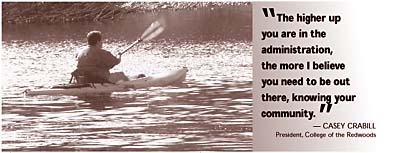
There are new buildings coming
on line this summer and next fall. But of course every new building
means the costs that come with it, the faculty to staff it, the
heating, et cetera, et cetera. "Boy," Casey exclaims,
"I'll tell you the energy challenge this year was something!"
I mention that Vice President
Bobbitt, who teaches two classes (chemistry and math) along with
his administrative duties, thinks that Casey, too, would like
to take on teaching a class.
She laughs, and says, "I
would. I don't know when I'll fit it in, but I'd love to get
my hands on an English class. I miss the classroom. I miss the
immediacy of interacting with students."
On the subject of CR students,
she says: "They're very diverse as a group. Our average
age here is about 27. Many of them are here for transfer preparation;
that's about 40 percent. We also have a lot of students in career
programs; that's about 25 percent."
She adds: "I will say
that the student body has a high level of need -- financial need.
A large proportion of our students receive financial aid. And
that was a surprise, coming from the East Coast, because it's
much cheaper to go to school here. We are $11 a unit. For comparison
purposes, Connecticut was $69 a unit. I didn't anticipate that
the same level of financial struggle would be present with so
much reduced cost. Here, in many cases, a book costs more than
the course. Yet students struggle, so their perseverance is against
pretty significant odds."
Certainly one of Casey's pet
projects is building bridges to the community.
"I'm a strong believer
that community colleges play a service role to the community
" she says, "and the basis for planning needs to take
into account what the needs are of the larger community. So when
I first got here, one of the challenges I faced was that the
college was in need of developing a strategic plan. I asked my
senior team to work with me on a community involvement project.
So we held listening sessions, 15 of them, throughout the district.
"The listening sessions
generated a tremendous amount of data, and one of the things
we learned was that we hadn't done a very good job of communicating
what was available [at the college]. At a lot of the sessions,
people were saying things like, `You need to develop an automotive
training program.'"
She pauses, grins, and says:
"We have one!"
"The listening sessions
were a good jump start," she goes on. "I asked all
my administrative team to serve on boards and to work through
the agencies and organizations in the community that mean something
to them.
"I'm not going to choose
for them. But it's not acceptable for the managers that work
with me to work here and go home and think they've done it all.
The higher up you are in the administration, the more I believe
you need to be out there, knowing your community."
She added that she would be
"professionally disappointed in someone who couldn't find
a way to do that."
(I was reminded of that tough-as-nails
characterization of the CR president I'd gleaned from that earlier
talk with my student source.)
Could she cite an example
of this extracurricular work? She offered that of Vice President
Bobbitt, who is "active in the Old Town Rotary Club and
is active in his church."
She added, "Actually,
I'm very pleased with the response I've had from the team."
Does anyone on the team object?
She laughs and says, "They
haven't told me."
Casey (this first-name basis
is catching) of course has heard some of the campus scuttlebutt
about the problems of her predecessor, Cedric Sampson, toward
the end of his 10-year term. As one source puts it, "There
was a lot of tension in the college, anxiety and turmoil, tension
between the faculty and administration."
Casey, however, has a happier
reason to remember Sampson.
"Cedric left the district
in very good, financial shape," she notes, "and that's
not always easy. I'm grateful for that. It's much easier to come
in to a ship that isn't sinking."
There are rumors, I've heard,
that HSU would be delighted to have Casey Crabill as its next
president. (HSU President Alistair McCrone is retiring in June.)
She is quick to dismiss the idea.
"I'm a community college
person," she says. "It inspires me."
Board President Dobkin told
me: "I don't know that that's even in the realm of possibility.
Not that she wouldn't make an excellent president of HSU, but
I know something about the process of selection of presidents,
and given the kinds of board of trustees and chancellor of the
California State University, I think the chances would be slim
or none. ... You know, I was vice president of academic affairs
over there for 14 years. I'm very familiar with the CSU system.
And the method of finding people and choosing them..." He
pauses every so slightly... "boggles the mind."
Anyhow, for now, Casey Crabill
has a full plate in keeping up with the agenda at College of
the Redwoods.
Dobkin observes: "People
think of the College of the Redwoods as the Eureka campus, but
they don't understand that the district is perhaps the largest
geographically in the state. It runs from the Mendocino border
to the south, over to the coast at Fort Bragg, up north to Crescent
City, and east to Willow Creek and Trinity County. So there are
about five different counties involved in the Redwoods Community
College District. It's also the largest board in the state of
any community college district -- expanded from seven to nine
board members, and most other boards tend to be five members."
Crabill makes a point of going
once a month to Crescent City, with its campus of 1,000, and
once a month to Fort Bragg, with 1,200.
"I need to be connected
with them as I am here," she states.
"And I'm on a first-name
basis with every full-time employee in the district. I don't
know how I could do otherwise."
Almost apologetically, she
adds, "I don't know all the part-timers, but I'm working
on it."
SAN FRANCISCO PRESIDIO
A new concept
in distance learning
The San Francisco Presidio hardly
falls into the bailiwick of the College of the Redwoods, but
rehabilitating those historic buildings is just the latest pursuit
of CR's risk-taking president, Casey Crabill.
It may seem "a high-profile,
risky endeavor," as one CR prof calls it, but in the eyes
of Crabill it's "an exciting risk."
"I'm so taken with that
program," she told the Journal. "Bill Hole developed
the historic preservation program (at CR), so when this opportunity
came up, I said, `Why are they calling on us?' Well, we're the
only accredited historic preservation program west of the Mississippi.
I was stunned to learn that. The National Park Service was very
interested. I said, `Well, you know it's almost 300 miles away
and in another college's district.'"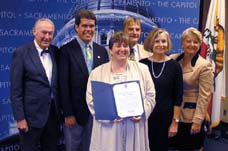
College of the Redwoods receives Governor's
Historic Preservation Award in October 2001. From left, Knox
Mellon, California State Preservation Officer; Bill Hole, CR
Historic Preservation and Restoration Technology program coordinator;
Casey Crabill, CR President; Frank Trocki, CR Dean of Professional
and Technical Programs; Alex Stillman, historic preservation
advocate and Cherilyn Widell, Presidio Trust Preservation and
Compliance Officer.
But City College
of San Francisco graciously bowed out, clearing the way for CR.
The upshot is that the Presidio is contracting out the work to
CR, and Bill Hole, professor of construction technology, along
with Dane Cowan and Jill Macdonald, fellow teachers of historic
preservation at CR, have been working down south since early
November.
Hole, who started teaching at
CR in 1991, calls the project "a new concept in distance
learning." He notes that the first approach came from Cherilyn
Widell, historic preservation compliance officer with the Presidio
Trust, who knew Hole through the CR preservation program. Hole
gave Crabill "an overview" of what the project involved,
"and without hesitation she said, `Let's do it!'"
About 110 employees of the Presidio
Trust are now students working with CR teachers. "We're
teaching them hands-on techniques, and theory of historic preservation,
rules and laws." The Presidio was always a military base,
from the time the Spaniards ran it in 1776, and the buildings
were soldiers' quarters. Now, they are being turned into housing
to be leased out.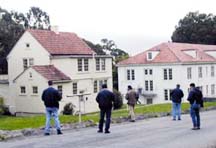
Hole speaks of historic preservation
as "a love, a passion." He said, "It's global,
something we pursue to help future generations. That's really
all it's about. We're stewards."
As Casey Crabill observes: "I
think he's in heaven with the Presidio project. It was hard to
get him down off the clouds after they approached us."
College of the Redwoods students record
the condition of the Pilots' Row buildings at the Presidio in
San Francisco.
IN
THE NEWS | ARTS! ARCATA | CALENDAR
Comments? E-mail the Journal: ncjour@northcoast.com
© Copyright 2002, North Coast Journal,
Inc.
|