|
 

story & photos by ARNO HOLSCHUH
St. Joe's hired
guns
A consulting group with
a record of keeping
unions out while pushing the limits of the law
A second wave of nurses in supervisory
positions took a pay cut and stepped down at St. Joseph Hospital
last week so that they could participate in an upcoming union
election. Nineteen charge nurses from the medical-surgical unit,
where patients recover from less acute illnesses and injuries,
will be giving up responsibilities like bed assignments and accepting
a 10 percent pay cut in return for the right to vote for union
representation. Sixteen charge nurses from critical care made
the same move for the same reasons Dec. 4.
The nurses say their action was prompted
by hospital administrators who changed the nurses' job description
to make them part of management, which would have prevented them
from voting.
Hospital administrators said the nurses
were always part of management and their job description was
changed as part of a broader reorganization underway at the hospital.
What's behind the nurses' push to unionize?
And what is the hospital doing to keep the union out?
When
registered nurse George Batiste [see
photo below] moved to Humboldt
County in 1982, it didn't take him long to find out where he
wanted to work: St. Joseph Hospital.
"They had a better compensation
package than anyone and issues of patient care were addressed
properly by administrators," he said. If a nurse had problems
or concerns, "you could go to the sisters" -- the Sisters
of Orange, owners of the hospital and its parent organization,
St. Joseph Health System-Humboldt.
"At that time, it was the pl ace to work," he said. ace to work," he said.
That was 1984. Last week, Batiste
sat in Ramone's Café, across the street from St. Joseph,
explaining why he is backing the effort to unionize the 350 registered
nurses at the organization's three Humboldt County hospital sites.
"In the early '90s, things
started going downhill," Batiste said. The hospital switched
to a corporate style of management and "the warm fuzzy feeling"
nurses had under the sisters began to dissipate. Pay increases
for nurses started to lag behind other areas and a shortage of
new nurses who wanted to work for St. Joseph Hospital developed.
To top it off, nurses' ability to act as advocates for patients
was diluted as management listened less and the patient load
grew, he said.
"St. Joe's has a long-standing
tradition of providing quality patient care to the community.
The values the sisters had at the start were service, excellency,
dignity and justice. Those values applied to employees as well
as patients," Batiste said. "Now those values are no
longer important as far as employees go. Now they treat us like
cattle."
That is why a group of nurses
from St. Joseph and Redwood Memorial Hospital announced Nov.
17 that they want to unionize with the help of the California
Nurses Association. Seeking better wages, more nurses and job
protections for whistleblowers, the nurses are collecting signatures
to file for an election to make CNA their representative.
The campaign has been greeted
with dismay by St. Joseph administrators who say the nurses will
only hurt themselves by unionizing.
"We believe our values
are about providing a just, respectable workplace," said
Mike Purvis [see photo
below] , chief executive officer
and president of St. Joseph Health System-Humboldt County. "And
we believe that can be done best in an environment that doesn't
have a third party buffering between administration and employees."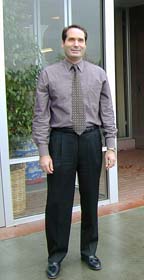
To drive that argument home,
St. Joseph's administration has begun distributing a bi-weekly
newsletter with an anti-union message. They have even hired a
third party of their own to help -- the Burke Group, a consulting
firm that specializes in winning elections for management (see
separate story).
Management, still dealing with
the aftermath of several years of operating losses, portrays
itself as reaching out at every opportunity, but many nurses
feel not respected and they are underpaid. Both sides are battling
for the hearts and minds of a majority of the nurses, because
in a matter of months, a decision will be made: Union yes or
union no.
W
hile it's true that money makes the world go round, when nurses
organize, they aren't just looking for more pay, said Liz Jacobs,
CNA spokesperson. The first demand of newly organized nurses
in contract negotiations is the ability to speak freely about
the problems they see on the job -- and to have someone listen.
"Having a voice is the core issue that all nurses everywhere
pick up on," Jacobs said.
Two trends are making the job
of a nurse progressively tougher, both the result of managed-care
cost-cutting. Because managed care discourages hospitalization
of a patient until it becomes absolutely necessary, the facilities
are dealing with sicker patients. Hospitals also have trouble
keeping a full roster of nurses on staff, meaning the remaining
nurses are being spread thinner. That makes their mission of
care harder to fulfill.
While a union contract won't
affect the flow of patients into the hospital, the CNA believes
that it can at least protect nurses who speak up about problems.
Without union support, their role as patient advocates could
be compromised by the fear that management may not listen --
or, worse, may punish nurses if it doesn't like what they're
saying.
Jacobs said when the CNA has
negotiated contracts at other hospitals, one request is always
to institute a professional practice committee. Such committees,
made up of nurses, communicate to management what problems nurses
face and make suggestions on how they can be solved.
In order to speak without fear
of reprisal, it is also important that nurses be classified as
"just cause" employees, not "at will." St.
Joseph is an at-will employer, meaning management can terminate
an employee without giving justification. A union contract could
change that.
"When you have a collective
bargaining agreement, you can only be disciplined for just cause,"
and blowing the whistle on problems in the hospital isn't just
cause, Jacobs said.
Another important way nurses
can have their voices heard is through the establishment of an
"assignment under objection" form. If a nurse in a
CNA-organized hospital is asked to do something that is not in
the patient's best interest, he or she can file an official document
that says so.
"Right now, if a nurse
is asked to work in a unit where he or she is not competent or
one with too many patients, the nurse can say so. And then the
manager can say, `OK, but you have to do it anyway,'" Jacobs
said.
That exposes the nurse to legal
liability. Under California law, nurses are required to act in
the best interest of patients. If something goes wrong, a manager
can claim ignorance of a nurse's complaint. An assignment under
objection form shows the nurse warned her superior about an unsafe
condition. That protects the nurse from financial liability for
someone else's poor decision, or from conditions such as critical
short staffing.
Jacobs said she has not heard
of a nurse at St. Joseph being forced to face the legal consequences
of someone else's mistake. But in her experience, the benefit
for nurses has been that managers are less likely to assign nurses
to jobs they are uncomfortable with if it involves a written
record.
M
ary Anne McCrea, vice president and chief operations officer
at St. Joseph, said she didn't believe "a piece of paper
really demonstrates there's a good process [for dealing with
nurse complaints] in place."
McCrea, who was hired this summer
for a newly created position, said she prefers a system of communications
that was not based on legally binding documents.
"I have worked places where
nurses filed that [form] every time they felt they were inadequately
staffed," she said, and the document did not help solve
problems.
What about a nurses oversight committee on patient care?
"That structure is already
in place," she said. A council for the largest unit in the
hospital, the med-surg department, was started in September.
Nurses from the unit, where non-emergency injuries and illness
are treated, meet every week with McCrea "to identify the
top issues in their environment and how they will address them
-- or they refer them to me."
None of the nurses interviewed
for this report had heard of the new council, but Purvis said
that was just timing.
"I just don't think the
employees have had an opportunity to see it work," he said.
A
unit council won't address one patient-care issue the nurses
say is most urgent: a nursing shortage.
"In today's hospital environment,
we can't do our job because we have too many patients who are
too sick to provide each of them with adequate patient care,"
Jacobs said. "We can't do the things that make us feel like
we're doing a good job -- comforting patients, expediting their
recovery, making sure they don't have complications."
St. Joseph administrators and
the CNA agree that the nursing pool is shrinking, but differ
on why and what can be done about it here.
Nurses say St. Joseph just doesn't
pay enough -- about 40 percent less for starting nurses than
in urban areas.
"We can't recruit and retain
nurses because we aren't competitive," said emergency room
nurse Roxanne Spencer, who has been in the profession for more
than 25 years. She said she can understand why young nurses would
choose to work elsewhere.
"I now make less than my
daughter, who has been working as a nurse in San Diego for two
years. We need to bring the wages up."
The two nursing schools at Humboldt
State University and the College of the Redwoods produce about
60 registered nurses a year. Last year St. Joseph convinced just
12 of those to become staff nurses.
Spencer said she comes into
contact with a lot of nurses rotating through the ER as part
of their training and while many want to stay in the area, few
do. The reason they leave is simple, she said.
"Money." Nurses in
Humboldt may have to pay less for rent, but they have the same
amount of tuition debt to pay off. "While they are offered
maybe $17 an hour here, they tell us they can get around $24
in other areas."
"I think it's dangerous to say that someone is going
someplace else because of higher pay," replied Purvis. "Keep
in mind that at Humboldt [State University], you have a student
base that is not predominately from Humboldt County. If a student
comes in from San Francisco or Los Angeles, that doesn't mean
they want to live their life here as a nurse."
And the nursing shortage isn't
confined to Humboldt County. McCrea said it is a national problem
that will only get worse. The nursing workforce is "a baby
boom workforce," she said, and about to retire. To make
matters worse, fewer young people want to become nurses.
"There have been reductions
in applications to nursing schools," McCrea said, which
will only compound the shortage problem. It's even hard to find
faculty to teach in nursing schools, she said.
While it would seem the obvious
answer is to offer higher wages, McCrea said she believes "relationships"
are more important than dollar signs. St. Joseph plans to expand
the training offered to new nurses and, "We're building
partnerships with the faculty and the students."
Purvis also believes local pay
scales match the local economic situation.
"St. Joseph provides very
competitive wages for the area," Purvis told the Journal.
"The cost of living index shows a substantially lower cost
in this area. We just don't believe it's realistic for us to
match the compensation in the [San Francisco] Bay Area."
Spencer said she isn't convinced
that the lower wages for Humboldt County are being shared equally
by management. "Is Mike Purvis making less? Is Mary Anne
McCrea?"
All Purvis would say about his salary is that it is "competitive."
According to the most recent non-profit corporate tax returns
available, Purvis made $147,965 in fiscal year 1999/2000. That
number is not an accurate reflection of his annual salary, however,
as he began at St. Joseph during that period and did not work
a full year. His predecessor Neil Martin made $384,000, according
to 1998 returns.
The backdrop to the salary debate
is a very real question about where extra money should come from.
St. Joseph, like most of the hospitals in California, faces a
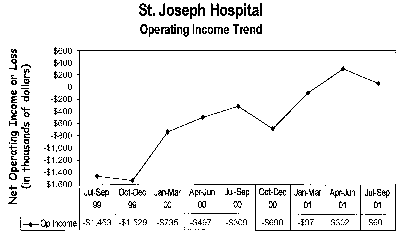
tough financial situation. As recently as 1999, the hospital
was losing millions a year in operating costs (see chart). By
last spring, the hospital put its head above water -- barely.
"Our financial health is
improving, but we still have a lot of challenges," Purvis
said. "There are no extra dollars."
But Jacobs argued the hospital's
tenuous financial situation could be helped by reducing the reliance
on temporary nurses.
St. Joseph has been relying
more and more on "travelers," temporary nurses who
travel to hospitals on demand to make up for staff shortages.
Travelers are flexible, qualified and currently keeping St. Joseph
at safe staffing levels -- but they are also much more expensive
per hour than staff nurses.
"You pay for their flexibility,"
McCrea said.
Just how much more expensive
they are is unclear. Purvis said the cost to the hospital is
around $50 an hour -- about 50 percent more per hour than an
experienced staff nurse with benefits. The CNA estimates they
cost as much as $90 an hour.
"Our goal is that traveler
use is minimal," Purvis said. But the reality is the use
of travelers continues to rise. Travelers' compensation doubled
from 6 percent of the total nursing budget last year to 12 percent
this year.
It's a widespread trend, Purvis
said. And although St. Joseph is using more travelers, it still
uses fewer than other California hospitals, where travelers make
up 25 percent of the nursing budget.
Batiste thinks that extra money
should be going to better compensation to attract staff nurses.
"Nothing against travelers," he said, "but with
two nursing schools in the area, we should be able to hire nurses."
Purvis
is convinced that the problems nurses are identifying will be
fixed with or without the union.
"We feel like this organization
has 90 years experience in successfully listening and responding
to employees," he said. He concedes that "communication
can occur with employee representation as well," although
it would be "harder and less effective."
"I think [nurses' demands]
are reasonable, although it might be an issue of timing. We would
like less travelers, we want competitive wages, but we also want
positive operating income."
In Purvis' view, many of the
problems he is hearing about from nurses can be traced to management
turmoil over the past two years. The hospital underwent a lot
of stress as it tried to get back into the black while completing
the purchase of General Hospital, its primary competitor, in
October 2000.
"We have gone through a
huge change in our organization. Some very important leadership
positions were vacant during that transition," Purvis said.
"While I don't hear many people complain about that lack
of leadership, in my view it comes back to that." Now that
the new management team is taking over, those problems should
sort themselves out without unionization, he said.
"It's just entire new layers
of managers," Spencer said. Once a department manager herself,
Spencer said the new management structure "is not a good
idea for a hospital our size. With those extra layers of management,
I don't think they're going to hear our voice."
It's just one more reason for
Spencer to vote union yes. Even if St. Joseph were to offer better
pay, cut down on traveler usage and institute better safeguards
for nurses critical of the hospital, she said she would support
the CNA.
"I think we need a solid
voice -- and now is the time."
St.
Joe's hired guns
A consulting group with a record of keeping
unions out while pushing the limits of the law
W hen it comes to quashing a union campaign, there's no tool
more effective than the Burke Group.
On its website, the world's
largest labor relations consulting firm boasts of a 96 percent
success rate in union elections, compared with 52 percent success
for hospital management without consultants.
"So far, we've found them
to be very helpful," Purvis said of the hospital's new consultants.
In addition to teaching management how to talk to employees about
unionizing, they also keep St. Joseph inside the legal boundaries
of the National Labor Relations Act, he added.
But the Burke Group has been
known to stray outside the boundaries of that law. The firm has
been involved in several unionizing campaigns where the election's
final result was invalidated because of violations of the act,
forcing a new election.
During a Burke Group campaign
at Long Beach Memorial Hospital in early 2000, management illegally
implied that working conditions would deteriorate and compensation
would decrease with CNA representation. Nurses were asked by
their superiors about how they planned to vote, and union literature
was confiscated. The CNA lost that election but won the subsequent
legal battle; the National Labor Relations Board identified 26
violations of the act and ordered a new election.
Purvis declined to identify
what tactics St. Joseph will be using in the upcoming campaign.
He said hiring the Burke Group was necessary because the CNA
has trained professionals on its staff, and St. Joseph needed
help. "We lack the time and experience of a group like the
CNA."
The Burke Group won't directly
speak to nurses, but will help keep St. Joseph's message "on
target," Purvis said. "I think having the Burke Group
will help us channel our communication."
The group hasn't made itself
visible yet to the nurses at St. Joseph.
"Their activities have
not been overt," said nurse George Batiste. "We feel
we'll probably see stronger action once we file for an election.
"We know this group has
been found guilty of violating labor relations at other hospitals.
We'll be monitoring their activities."
IN
THE NEWS | CALENDAR
Comments? E-mail the Journal: ncjour@northcoast.com
© Copyright 2001, North Coast Journal,
Inc.
|