 
COVER
STORY | IN THE NEWS | READERS
REQUEST
ARTBEAT
| THE HUM | CALENDAR
November 17, 2005
22 Questions for P. Scott Brown
by HEIDI
WALTERS
[Due to space considerations,
this interviewas originally published in the printed edition
as "15 Questions for P. Scott Brown"]
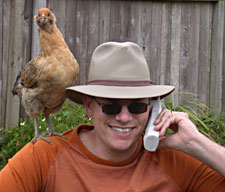 On
Nov. 1, Eureka resident P. (for Phillip) Scott Brown's 4-year-old
magazine, Fine Books & Collections, won an Eddie award
in the enthusiast magazines category. (Disclosure: Brown is married
to our Dirt columnist, Amy Stewart). The Eddie is a coveted
award that the likes of National Geographic and Sports
Illustrated vie for in other categories. It's a big deal. On
Nov. 1, Eureka resident P. (for Phillip) Scott Brown's 4-year-old
magazine, Fine Books & Collections, won an Eddie award
in the enthusiast magazines category. (Disclosure: Brown is married
to our Dirt columnist, Amy Stewart). The Eddie is a coveted
award that the likes of National Geographic and Sports
Illustrated vie for in other categories. It's a big deal.
Brown started the magazine with
his mother-in-law, a former journalist, later hooking up with
a publishing company based in North Carolina. Brown and his contributors
write about everything "from hand-written manuscripts that
pre-date the invention of printing all the way to the latest
trends in popular fiction," says Brown. The latest issue
has a piece about Captain Cook's maps. An earlier issue had famous
author Larry McMurtry writing about why he no longer signs books.
The magazine sucks a reader in. Tell us more, P. Scott Brown.
1. So, your magazine is not
necessarily just about old books?
No. But the history of the book
is quite long. The first book as we know it was invented about
the 4th century, so there's a 1600-year history. We try to cover
different parts of that, and so the majority of what you'll see
is about older books, but that's because that's the majority
of the time that we cover.
2. There's a certain high
aesthetic to old books and maps. Have we lost that sense of elegance
with the digital age? Will people be, years from now, affectionately
ogling computer files?
Well, I think what sometimes
we lose sight of is, the books that have survived that people
are still interested in, from 100 years or 500 years ago, are
really the best of their era, and there were a lot of not-so-great
books that were just forgotten in time. And I think the same
thing is true in the current time, that there are books that
will stand out because they are well-made or well-designed.
3. But do you think we'll
keep making hard copies of books?
Yeah. And what we use as a modern
book is actually the end product of 2,000 years of continuous
innovation. And so it seems like it's a very simple product,
but it's actually been tinkered with and redesigned, and the
technology has improved literally over two millennia, so it's
a very, very good device.
Until somebody can figure out
a way to make a device that is as easy to use, that lasts more
than five or six hours without needing to be recharged, can be
dropped in the bathtub, can be read in bed, can be taken to the
beach -- you know, I think the book is going to be around for
awhile. But I also think that somebody will eventually invent
that device.
4. I read in one of your
pieces online that the audience for old books is growing.
Last year the market grew 38
percent, to, I want to say, $6 billion. So, the interest in these
books is growing rapidly, and that's mostly a function of [the
fact] that it's getting easier and easier to find them now. You're
no longer limited to the selection at your local used bookstore.
You can literally buy books from almost any used bookstore in
the world.
5. You have, I think I read,
4,000 subscribers?
Uh, yeah: 4,523 is our official
number.
6. Where are all these people?
Are they concentrated anywhere, or are they all over?
No, I don't think they're really
concentrated anywhere. We have people in all 50 states and most
of the Canadian provinces and about half the countries in Europe.
7. Are there many collectors
that you know of in Humboldt County?
There are several book collectors
in Humboldt County. And Eureka Books is a very widely known bookstore
in the antiquarian book world. Pretty much anywhere book collectors
gather, and hear you say you're from Eureka, they'll immediately
say, "Oh, how's Eureka Books doing?"
8. Speaking of Eureka, you
mentioned fleeing a six-figure job to come to Eureka. What was
that job that you left?
I ran the administrative services
for the department of transportation in the City of San Jose.
I was responsible for the budget, which was $125 million a year.
(Laughs). The department was much bigger than the entire city
of Eureka.
9. So why did you leave it?
Why did you move to Eureka?
Because my wife and I love Eureka.
We think it's a great town. We live eight blocks from the bay
in a Victorian house and we can walk to downtown. If you buy
a house in the San Francisco Bay area, you're basically chaining
yourself to a desk for 30 years to pay for it, and neither one
of us wanted to do that, and the market in Eureka was, and still
is, comparatively affordable. So we decided to move up here and
try our hand at some other things.
10. I was looking at your
new map column, and I love that. It seems like a great feature.
And I was wondering why you added it.
Most people who collect books
or are interested in books are also interested in most things
that are printed, and so maps are part of that. And many books
are sought because they contain maps, also. It's often one of
the primary features of early Americana books about the history
of the United States and how it was settled.
The most famous sort of maps
are maps showing the state of California as an island, and for
over a hundred years almost every mapmaker in Europe drew the
United States with California as a separate island because they
sailed up the Gulf of California, along Baja, and they kept sailing
and sailing, and they just never came to land, and it was completely
unknown territory, and there was desert, and so they would get
tired and they would turn around, and they would just assume,
"Well, it must just keep going."
11. In the latest issue,
writer Derek Hayes talks about witnessing a certain cavalier
treatment of old manuscripts at the British Hydrographic Office.
Do you ever get reactions after printing something like that?
The comments we've had on that
have been about improving access. That's a real big concern right
now. One of the biggest stories in the antiquarian world right
now is about a map dealer who worked out of his home on Martha's
Vineyard -- the very highest end of map dealers -- who was caught
cutting maps out of books in the Yale University library and
so, that has generated a lot of controversy, because some of
these maps were six-figure maps. They were the earliest depictions
of the United States in printed form. So there's some concern
that the map thefts are going to cause libraries to clamp down.
The more difficult you make it for somebody to use something,
the fewer the people that are going to use it. So, you gain something,
and you preserve it, but who are you really preserving it for?
It's a very difficult thing. If you go to a museum, you can look
at a painting on the wall. But a book you have to interact with.
You actually have to flip through a book to appreciate it.
12. What do you think of
people who throw away dust jackets?
The dust jacket came into common
use about 1900, but pretty much everyone threw them away because
they weren't seen as part of the book, they were seen as advertising.
And if the publisher had stuck a little leaflet inside the book,
you would throw that away because it was advertising other books.
And no one would think anything of it. If you look at pictures
from, say, the 1920s, of people in the library, you won't see
a single book with a dust jacket on it.
I'm not particularly exercised
about it. I think books are made to be used. (But) if you want
to understand how a book was marketed, what the publisher saw
in this book, and if all the covers are gone, then you've lost
that little bit of that book's story.
13. What about bent corners
and writing in the margins?
If you are interested in reselling
your book, at any point, I would not advise throwing away the
dust jacket, writing in it or dog-earing the pages, because the
next person that comes along will want something that's as close
to new as possible.... Unless, of course, you're famous, in which
case the more you write in your book the better.
14. What do you collect?
I collect Gary Soto, who's a
poet in Berkeley, and R.K. Narayan, who was the first professional
novelist in India starting in 1935.
15. Why those particular
writers?
My philosophy of collecting
is that you should pursue something that you like, and preferably
something that already isn't being done to death. In other words,
lots and lots of people collect Ernest Hemingway, and great collections
of Ernest Hemingway books have already been done.
16. Have you always been
a collector, of something or other, even as a kid?
As a kid I collected coins,
and then I collected matchbooks until they spontaneously combusted
in my closet, and then I started collecting books in college,
then I really started doing it in graduate school.
17. Where's your favorite
used book store in the world?
My favorite used book store
in the world is Serendipity Books in Berkeley, because it has
incredible depth and books in virtually any subject you can imagine.
They have more poetry than most university libraries have, and
you can spend a week in there and not see everything.
18. What's the most surprising
thing that you've come across since you started the magazine.
One of the things that has intrigued
me most is the Gutenberg Bible, which is famous for being the
first book ever printed. What I've discovered is, it wasn't just
that it was the first book that was ever printed, but that Gutenberg
had to invent type, metal that he could use to reproduce
letters. But no one had ever seen a printed book before, so he
had to create (in German) literally hundreds of letters to print
the Bible, because if you think of the way that you write, if
you're writing cursive, it changes depending on what letter's
next to it. And (people back then) would have had a hard time
reading a modern printed book, because we had to learn how to
read printed type as a culture. And because his was the first
one, he could not rely on that, so he had to make type that would
be different depending on what letter was next to it, which mean
it was immensely more complicated than printing a book today,
because we only have 26 lower case and 26 upper case letters.
He had to use several hundred different characters to print the
book. He also had to invent ink that had to stick to lead long
enough to be printed onto a piece of paper, and also dry fast
enough that the paper wouldn't smear, but not so fast that you
would ink the lead and not be able to get it onto the paper.
And in fact people still don't really know what he used for ink.
They've been doing tests on that for a number of years, and they
think it was actually closer to the oil paints that artists were
using at the time than it is to modern ink. And there's the actual
mechanics of printing the Bible, which is a very large book.
19. When was that?
(From) 1450 to 1455. Most people
consider the invention of printing the most significant invention
of the last thousand years. It literally changed the world, because
with the invention of the printing press, suddenly you could
have the Protestant Reformation because people could pass text
from one town to the next and from one country to the next, and
that had never really been possible before. And it just revolutionized
every form of life -- much like the Internet is doing now.
20. So what are the big plans
for the future of your magazine?
We're going to be available
in Borders and several other bookstore chains.
21. Where has the magazine
been available?
Mostly by subscription, and
through some used bookstores.
22. Is there anything you'd
like to say that I didn't ask you about?
Well, I guess maybe more about
why we moved here. Humboldt County's the sort of place that you
can do kind of whatever you want. If you can think of it, the
opportunity's there. With the Internet and the telephone, you
can make your own future.
COVER
STORY | IN THE NEWS | READERS
REQUEST
ARTBEAT
| THE HUM | CALENDAR
Comments? Write a
letter!
© Copyright 2005, North Coast Journal,
Inc.
|