
COVER STORY | IN THE NEWS | FROM THE PUBLISHER | STAGE MATTERS | DIRT
ARTBEAT | TALK OF THE TABLE | THE HUM | CALENDAR
November 16, 2006


SLOG TO THE SPOILS-TO-BE: Warm air smelling like sawdust blew from the
southeast up the Samoa Peninsula, and you could hear the loud
whine of machinery at the pulp mill. A breathy repetitive clank.
The wind brought a new load of wood chips from the Fairhaven
wood-fired power plant to scatter along the road sides.
Down on the beach, where bright green piles of
washed-up sea grass bunched like a temporary jungle alongside
the foamy surf, a few people and their dogs were already going
through their paces. Though the prediction was rain, sunlight
soaked through a thin film of clouds. It was morning, about half
an hour past low tide.
 I
walked north, following a path through the dunes between beach
and road. Past exotic, red-tipped green iceplant masses draped
like ponchos over dune tops, through exotic bush lupine, around
clumps of non-native European beach grass. Here and there an
empty soda bottle, a candy wrapper. Other than the trash, it
didn't make the walk less beautiful, the dunes' alien apparel.
I was alien, too, on my way to see the mouth of an alien, 15,000-foot
black pipe -- at the end of its complicated journey through a
portion of Humboldt Bay -- jutting out over the beach and dumping
a dark, fine, silty murk onto the pale sand. I
walked north, following a path through the dunes between beach
and road. Past exotic, red-tipped green iceplant masses draped
like ponchos over dune tops, through exotic bush lupine, around
clumps of non-native European beach grass. Here and there an
empty soda bottle, a candy wrapper. Other than the trash, it
didn't make the walk less beautiful, the dunes' alien apparel.
I was alien, too, on my way to see the mouth of an alien, 15,000-foot
black pipe -- at the end of its complicated journey through a
portion of Humboldt Bay -- jutting out over the beach and dumping
a dark, fine, silty murk onto the pale sand.
Finally I saw the sign, posted high on a grass-covered
dune that dropped cliff-like to the beach. Its text was small
and I had to scramble up the dune's crumbly edge to read it.
"Public harbor works in progress," it said in all caps.
"Marina maintenance dredging underway. Every 7-10 years
it is necessary to perform maintenance dredging on various marinas
and docks along Eureka's waterfront." Etc., etc. The gist:
From this November till next March, there'd be bay goo spilling
onto this beach. The water would temporarily lose its clarity,
tiny beach denizens would temporarily be choked, but the waves
of winter would handily scour the gunk away. Come springtime,
the beach would return to normal. The resurrection would begin.
Meantime, said the sign, there were other beaches along the spit
visitors might enjoy.
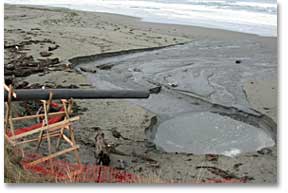
The plastic pipe was just beyond the sign (and
another sign stood beyond it), propped in the crook of a raw,
vulnerable-looking sawhorse of lumber planted in the sand at
the base of the cliff. Wouldn't a big wave or storm take it out?
Anyway, nothing was coming out of the pipe, although it looked
like something had at some point the night before. There was
a pool beneath the pipe, and liquid had spilled from it to the
ocean, forming a down-cut delta coated in a slippery black slime.
It stuck to my boots an inch thick. Scraping my soles on a log
didn't work, so I walked into the surf where salt water did the
trick.
A man and two dogs approached. Scooter, the caramel-colored
dog, detoured to check out the pipe and orange plastic fencing.
Digby, the black-and-tan, frolicked across the silt and then
dug three deep holes rapidly, sand and broken clam shells flying.
Miles Hayes, who walks Scooter and Digby here a couple times
a week, stared calmly at the little pond and the slick film of
sediment. "It reminds me of exploratory oil drilling,"
he said. He saw that back in New Mexico when he was a kid. "They
didn't find anything ... but the devastation they left
behind," he said. It didn't seem like a judgment, really
-- just an observation.
I waited awhile at the pipe. Every few minutes
a drop fell. A couple stood at a distance and stared at the pipe
then turned around. The tide crept in, licking at the slick delta.
I left. A few days later, on the phone, David Schneider, principal
of the consulting firm leading the project, said they'd done
a trial run of the pipe but were still working out the bugs.
A rock had lodged in a section of pipe below the Samoa bridges,
and they were replacing it. That's the beauty of that pipe, he
said -- something happens to a section, they can lift it out
and put in another and then get the obstruction out. And, yes,
there would soon be more gunk flowing from the pipe, never fear.
"But it's not oil," he said, alarmed at the notion.
"There's no oil in it. It's stuff that's organic that's
coming down the river, the fines that settle out in the bay."
-- story and photo by Heidi Walters
TOP
COVER STORY | IN THE NEWS | FROM THE PUBLISHER | STAGE MATTERS | DIRT
ARTBEAT | TALK OF THE TABLE | THE HUM | CALENDAR
Comments? Write
a letter!
© Copyright 2006, North Coast Journal,
Inc.
|