|
 
IN
THE NEWS | IN
THE GARDEN | GOOD
NEWS | CALENDAR
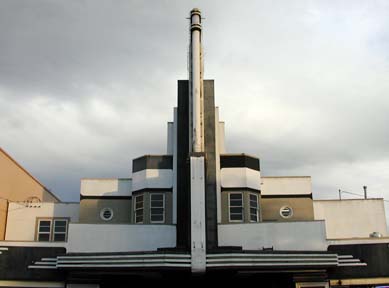
![Man with a Plan [photo of Nathan Kaplan in front of Arcata Theatre's marquee]](cover1114-photohed.jpg)
Nathan Kaplan
has a vision.
What he doesn't have yet is the money.
by BOB DORAN
by
BOB DORAN
NATHAN KAPLAN IS ON A MISSION.
THE FORMER ADVERTISING salesman has spent the last five months
working on a plan to purchase the Arcata Theatre, a landmark
building just off the city's plaza. Kaplan has assembled an investor
group and a board of directors for something he calls the Arcata
Theatre Multimedia Group.
Kaplan's grand plan: "bring
the building back to its original Art Deco state" while
adding "complete 21st-century technology," including
state-of-the-art digital sound and video recording equipment.
He has a deal on the table.
The building's owner, Robert White, has agreed to a $455,000
purchase price. All Kaplan needs to do is find the money -- and
fast. The agreement has an expiration date, Nov. 15, and it is
not certain that White will extend it.
Up until last Wednesday, Kaplan
-- who has never before attempted a project of this kind -- was
confident that the city of Arcata would provide a sizeable loan,
$364,000, to help with the purchase. But after making a presentation
at the Nov. 6 City Council session, he stormed out when it became
apparent that his request would not be granted.
The council continued the discussion
in his absence, with at least one council member expressing unease
at Kaplan's inexperience. The council ended up deciding that
Kaplan could apply for a loan for as much as $100,000, one that
could be approved by staff and the city manager without a vote
by the council.
Bolstered by that development,
Kaplan by week's end seemed optimistic, saying he was looking
for additional funding and hoping that White will give him more
time.
A love for music
Born in San Francisco and raised
in the East Bay, Nathan Kaplan says he "got into music in
the fourth grade -- and it's been an integral part of my life
ever since." After graduating from San Ramon High School
in Danville, where he played drums in "an award-winning
jazz band," he attended California State University at Hayward
and earned a music degree. After college he joined his father
in a firm that franchised convenience food stores in the Bay
Area and worked there from 1982 to 1990.
"I got married in 1984,
had my first child in '86, my second in '88, a boy and girl respectively,
and shortly after that their mother abandoned them and she hasn't
been heard from since," he said.
Kaplan moved to Humboldt County
in 1992. "I came here with my children and a car that barely
ran. It was a hard thing to go through. I had to learn how to
be a mom and a dad.
"I worked for KXGO [radio
station] from '93 until '98 doing advertising sales, then worked
for KWPT down in Fortuna for about two years. And here I am today."
Where is he? Well, when he's
not playing drums at a recording studio in his Arcata home or
with the local group Stone Crazy, he's working on his proposal
to purchase the Arcata Theatre, a former movie palace that, aside
from two shows in May, has been dark since the beginning of the
year.
The deal
For more than a quarter-century
the Arcata was owned by David Phillips and the Minor Theatre
Corporation. Phillips, who bought the Arcata in 1974, still owns
the Minor Theatre, along with the Broadway Cinema and The Movies
at the Bayshore Mall. (See "A Love Affair with Film," North Coast
Journal, Jan. 27, 2000.)
The economics of today's movie
business, in which it is difficult to run a large single-screen
theater like the Arcata, eventually persuaded Phillips to sell.
When he put it on the market, he was approached by Robert White,
an investor from out of the area.
White got interested after being
contacted by music promoter Lincoln Wachtel, who formerly handled
booking for Café Tomo. The plan was for Wachtel and White
to work together in turning the theater into a music venue. A
purchase agreement was forged, one that involved a complex three-way
land swap that included local developer Don Murrish of Murrish
and Associates.
Murrish got involved in the
transaction because he owned a piece of land behind the Mill
Creek Shopping Center in McKinleyville where Phillips wanted
to construct yet another movie complex: the McKinleyville Cinema.
When the transaction was completed, Phillips had a site for his
new multiplex (now under construction), White owned the Arcata
and Murrish held a $135,000 note on the building.
When White took possession in
April of this year, he and Wachtel got to work immediately. Unfortunately,
they moved forward without keeping city officials informed about
what they were planning. The city balked at requests for a dance
permit and a beer and wine license and White found himself enmeshed
in a bureaucratic quagmire.
The theater finally opened in
mid-May for two poorly attended shows, where White lost money.
White and Wachtel subsequently had a falling out. At that point
White decided to cut his losses. He put the theater up for sale
and left town.
The darkened marquee of the
Arcata left a hole in the city's nightlife. Not long after White
left, rumors started flying about who might take over; according
to one story, Nathan Kaplan was spearheading a group of investors
who wanted to purchase the Arcata.
In July, Kaplan confirmed that
he had made an offer and publicly laid out his plan. "Cities
all across the U.S are faced with converting these old theaters.
We're at the right place at the right time," he said.
Summer turned to fall, Kaplan
made an offer, White countered, the two failed to come to terms.
Kaplan regrouped and, with Murrish acting as his agent, negotiated
a price of $455,000. Murrish agreed to carry his $135,000 investment
forward. Kaplan lined up $80,000 from his investors and looked
at getting redevelopment funds to make up the remaining balance
for purchase and start-up costs. While the deal was different,
his plans for the building remained the same.
THE PLAN
Kaplan's Arcata Theatre Multimedia
Group has admittedly ambitious long-term plans -- Kaplan envisions
turning the Arcata into a high-tech venue and recording studio.
But Kaplan says he's ready to start small.
"The first year we will
concentrate on community-based type events," he said. "We'll
start with elementary school, junior high, high school, college
community oriented performing arts type shows that will be very
affordable for all ages. There's a great need for kids to have
a place to go that will be drug and alcohol free.
"That will probably account
for 30 percent of our revenue. The other 70 percent will probably
come from major shows and booking out daytime use for conventions
or for gatherings, whatever."
Kaplan has laid out a day-by-day
schedule for what will go on in his "multimedia performing
arts venue" once it opens.
"To start out, we feel
Mondays will probably be dark, and if not, that will be one of
the days when major events will roll through town. Groups often
stop off here on Mondays and Tuesdays," he said.
"Tuesday night we plan
on having a [Grateful] Dead night. We might have a drum circle
where you come in and pay $2.50 or three bucks to join in for
a few hours, followed by local entertainment by jam-type bands
-- and Humboldt has a prolific number of those.
"Wednesday night will be
the blues night, kind of like we used to have at the Jambalaya.
Thursday night would be alternative. Friday night would be country
and bluegrass. Saturday night would be hip-hop.
"During the day Saturday,
we will have a musical matinee featuring up-and-coming artists
from all grade levels including college. On Sunday we'll have
a classic movie matinee. Now that might take a while to get all
that together, but those are absolutely our plans."
Over the long term, Kaplan wants
to turn the facility into a high-tech multimedia theater.
"My estimate is by the
third or fourth year we will start implementing state-of-the-art
digital technology: digital movie cameras and projectors, full-on
DVD capability so bands can come in and mix and master their
DVDs," he said.
"There will be data cable
wired throughout the building so we can do satellite hook-ups
with VH-1 or perhaps a simulcast with a venue in Petaluma or
Manhattan, New York. These are the types of things we want to
do, to [apply] emerging technology."
He estimates the cost of the
improvements at "anywhere between $1 million to 2 million."
Where will that money come from?
"From grants, from revenue generated. The revenue will be
generated based on community participation."
Kaplan is adamant in his belief
that he can turn a profit. "We are a for-profit company.
That's the only way it will work." He dismissed the suggestion
that turning a profit by booking touring acts is often easier
said than done, making comparisons to the Eureka Theater.
"What do you think Merle
Haggard is bringing in?" asked Kaplan, referring to a concert
held the same night he was making his presentation to the Arcata
City Council. "If they sell out, what do you think the booking
agent stands to make? Well, between $10,000 and $15,000, and
that goes right into his pocket. We will have an in-house booking
agent on either a commission or a salary, and that profit will
go back into the company."
At the Eureka Theater that night,
the promoter, Washington Vera, said that the Haggard show did
not in fact sell out. Asked if he expected to make $10,000, Vera
replied, "I wish." He said he is hoping Kaplan's group
gets the building because he is interested in booking shows there.
Kaplan says Vera is a member
of his board of directors. Other members include a scientist
at Lawrence Livermore National Laboratory and an international
music marketing executive who, according to Kaplan, discovered
the pop group The Cranberries.
High hopes
Kaplan had high hopes for his
presentation before the Arcata City Council last Wednesday. City
staff had looked over his plans and helped him draft an ambitious
proposal for a $364,000 business loan that entailed waiving some
rules to shift funds from the first-time homebuyers program and
the housing rehabilitation program into economic development.
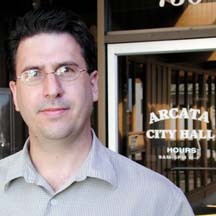 Kaplan felt
he had support from City Manager Dan Hauser and from planner
Larry Oetker [in photo
at right], who oversees the Community
Development Block Grant program (CDBG), the likely source of
the loan. He had also run things by the Redwood Region Economic
Development Commission (RREDC), which had agreed to perform underwriting
services. He assumed that the council would respond with an enthusiastic
yes. Kaplan felt
he had support from City Manager Dan Hauser and from planner
Larry Oetker [in photo
at right], who oversees the Community
Development Block Grant program (CDBG), the likely source of
the loan. He had also run things by the Redwood Region Economic
Development Commission (RREDC), which had agreed to perform underwriting
services. He assumed that the council would respond with an enthusiastic
yes.
Things did not go as planned.
To begin with, his item did not come up until two hours into
the meeting, and by then his supporters had left. When his time
finally came, City Attorney Nancy Diamond informed the council
that because of the nature of the proposal, protocol required
a hearing with 10 days notice. After some wrangling the council
moved the item to new business so Kaplan could speak.
Kaplan made his presentation,
there was some comment from others in attendance and the council
began its discussion.
Connie Stewart started things
off by saying that she did not feel the council should waive
its rules to allow for such a large loan and should stick to
its usual $100,000 limit. Bob Ornelas was far less enthusiastic
and said so flatly.
"All that was presented
to the council was a concept paper, a sketch of possible uses
for the theater," Ornelas reiterated the following day.
"There was no income projection, no payment reschedule.
It just listed some of the things that could happen in the building."
"City staff were the only
ones who saw my numbers," said Kaplan, also speaking the
day after the meeting. "We're not expecting the moon, but
it is going to generate revenue. The City Council had not seen
that. With Bob [Ornelas'] comment, I got upset and walked out.
I said, `Thank you very much' and waved at them."
"I might have been abrupt,"
Ornelas acknowledged, "but we were talking about funneling
money from other worthy causes into [this business]. It did not
seem fiscally responsible."
For Ornelas it boiled down to
a simple question: "Where's the money?"
"I saw no money-making
aspect within his concept paper. Where are the income projections?
Where's a realistic look at the overhead and costs, the management
team? How many employees? All those things belong here. It was
full of holes. I don't see how [his plan] could pay for the utilities
and the staff, let alone pay for what was described as a loan.
"This is not an easy business
to get into," he went on. "It is high risk. The chance
of losing money was made apparent by Robert White. Owning and
operating a building like that is big business. And we don't
really know [Kaplan] as a business person. He's so underfunded
and the city should not take such a huge risk with someone who
has no track record.
"[The council] even talked
about the city buying the building. But is Nate Kaplan the person
we would want to manage the facility? I had to ask myself that
when he walked out."
You would think that the council's
response would leave Kaplan crestfallen. It did not.
"Wednesday's council meeting
did not set us behind," he said on Friday. "It moved
the timeline a bit, but we do not consider it a setback, nor
are we discouraged. We are moving ahead as scheduled."
Kaplan was mollified, in part,
because Oetker had informed him that the city was moving ahead
with a petition for a $100,000 loan. "To make a long story
short, the city is going to be helping out. They just couldn't
do what the staff recommended, so they are going to do what they
feel comfortable with, the maximum by the guidelines.
"My investment group has
to come up with probably another $40,000 and then RREDC is going
to go ahead and lend for the acquisition. We just have to get
the numbers right and make sure it's all copasetic. We're just
looking at RREDC lending more than the city of Arcata. That's
it."
White is skeptical
But according to Realtor Debbie
Bindel, who represents White in the sale, it might not be so
cut-and-dried. She explained that the deal on the table has a
rapidly approaching expiration date.
"We have to have an answer
by Nov. 15 as to whether the city will approve his loan,"
she said. "We'd love to see Nathan work it out. I think
he certainly has worked hard on it. It's too bad he didn't get
the funding."
Kaplan is hopeful that White
will extend the deadline. He assumes that since White will begin
making payments on his loan some time early next year, he should
be eager to get out from under.
"I'm in no hurry,"
said White in a call from his office in El Sobrante. While he
did not close the door on an extension, he expressed dismay that
Kaplan had led him to believe funding from the city was "a
done deal."
"Bottom line is when you're
entering into a real estate contract and making a bid, you should
have your ducks in a row," said White.
According to Bindel, there have
been other serious inquiries about purchasing the theater.
"We've had quite a bit
of interest but we haven't had any other written offers,"
she said. "One thing that's been a little discouraging is
the media keeps saying that this guy [Kaplan] is going to get
it, but they have never talked to me. That makes my job harder
because people call and say, `I've heard it's sold.'"
White, for his part, said "Nathan
has his work cut out for him.
"I would like to say I
have faith in his belief that he can make this thing happen.
But I also believe these other interested parties are much more
viable. Nathan [has to] somehow create a miracle in the very
near future before these other people create an offer."
RREDC TO the rescue?
If Kaplan is looking for a miracle,
Redwood Region Economic Development Commission's executive
director, Gregg Foster, may be an angel. At least that's the
impression you might have if you read a story in the local daily
last Friday.
"You may have read in the
paper that we've committed $200,000. I read it too," said
Foster, speaking Friday afternoon. "The deal is, I think
[Kaplan will] make applications here and we will consider them,
but we've made no commitments at this point."
Under RREDC guidelines Kaplan
could potentially ask for as much as $300,000 as long as he has
collateral. "The security would be the building," said
Foster. "We would probably be looking at a second position
mortgage behind Murrish."
Foster said that is something
his organization, which often lends to people who can't get financial
assistance elsewhere, has done in the past. "The theory
is, if the loan goes bad, we could both get paid off from the
proceeds from the sale of the building."
There is some uncertainty about
how much money Kaplan can borrow since Kaplan has not yet had
the theater appraised. He says his investors were hesitant to
pay the cost, which could run as much as $10,000. Without that
appraisal, RREDC would look at the building's most recent purchase
price to set a value -- the $385,000 White paid to Phillips.
"We might have to get a
broker's opinion or some third-party review," said Foster.
"Because it's a special purpose building we'd want to be
able to do some due diligence, [investigating] to be sure that
the value is there and the salability is there."
Foster said that RREDC has occasionally
lost money on defaulted loans over its 25-year history, "But
now we're pretty good about making sure we're covered by the
assets of the business."
Humboldt County's redevelopment
agencies have ended up in some awkward situations in connection
with past loans. The city of Arcata lost a bundle when the Hotel
Arcata project went bankrupt. Foster pointed out a more recent
deal where a number of agencies made loans to North Coast Hardwoods.
"People were lending much
more against the business than it was worth, so when it went
bankrupt, lots of money was lost, hundreds of thousands of dollars.
Six Rivers Bank lost money and Arcata some lost money."
The city may still
chip in
As for the possibility of getting
a loan of up to $100,000 from the city, Oetker, the Arcata planner,
said that since no council action is required it could happen
relatively quickly.
"It will take some time
to do the underwriting, but we are hoping to do a preliminary
assessment with some contingencies by the Nov. 15 deadline. There
are a host of things that need to be completed: environmental
documents, credit reports, title reports, those sorts of things.
There's no way we can get all of that by Nov. 15, but we should
be able to get sufficient information to be able to say, if all
those things are a go, then we would be able to loan them the
money."
The money would come from Community
Development Block Grant funding, normally used for housing rehabilitation
programs and homeless services. But CDBG money can also be used
for economic development, as long as it results in new jobs.
Rules specify that at least one job must be created for each
$35,000 loaned. Recent CDBG loans include a $50,000 expansion
loan to Wing Inflatables and a loan to Munki Munki, a children's
apparel company, used for materials.
"Generally you can use
the money for any purpose as long as the ultimate beneficiaries
are low-income individuals. In this case the low-income person
would be the one who gets a job," he said.
But Oetker had more on his mind
than jobs when he looked at Kaplan's plan. He sees it as a step
in the right direction for downtown revitalization.
"When you walk down H Street
at night, it's dark; there aren't many people walking around.
What the city is all about is getting people walking around,
shopping, going to theaters. The hustle and bustle of when 50,
100, 200 people join together for one event and come out all
at the same time, that's what we want to see."
Kaplan is the first to admit
that his plan will "take a lot of work and support from
the community. Every business needs a lot of support -- and an
A, B, C and D plan. You never give up. You never say no to an
obstacle.
"I feel like I'm the guy
for the job," he says with passion. "If anybody can
do this, I can."
IN
THE NEWS | IN THE GARDEN | GOOD NEWS | CALENDAR
Comments? E-mail the Journal: ncjour@northcoast.com
© Copyright 2002, North Coast Journal,
Inc.
|