|
 
COVER
STORY | ELECTION
RESULTS | CALENDAR
November 7, 2002
Sierra
Pacific Arcata mill in violation of Clean Water Act
by
KEITH EASTHOUSE
Sierra Pacific Industries Arcata
mill has illegally discharged pollutants into the Mad River Slough,
an arm of Humboldt Bay, since 1995, a federal judge has ruled.
U.S. Magistrate Judge Maria-Elena
James, in a 56-page ruling issued last week, said that Sierra
Pacific, one of the largest landowners in the country, has been
in chronic violation of the Clean Water Act for the past seven
years.
The act allows for civil penalties
of up to $27,500 per day per violation. Given that the court
found Sierra Pacific in violation of three provisions of the
act on a daily basis, along with an additional 57 instances of
non-compliance, the company could theoretically receive a financial
penalty of a whopping $180 million.
The courts typically don't fully
impose such penalties. Nonetheless, because of the magnitude
of the violations, a large financial penalty seems inescapable.
Sierra Pacific, the 167th largest
company in the country, had annual revenues of over $1.5 billion
last year and presumably could absorb a serious financial blow.
Judge James' ruling represents
a significant victory for the Ecological Rights Foundation, a
Garberville-based environmental group that first brought suit
against Sierra Pacific two years ago.
"It's an unambiguous message
from the court telling Sierra Pacific to get its act together
and stop polluting Humboldt Bay," said Fred Evenson, an
attorney with the group.
Mark Emmerson, chief financial
officer for the company, said in a telephone interview from the
company's headquarters in Anderson, Calif., that the company
did not knowingly violate the Clean Water Act.
"Clearly, we didn't know
we were doing that. We thought we were in compliance," Emmerson
said.
Evenson took issue with that,
pointing out that the North Coast Regional Water Quality Control
board has issued numerous notices of violation against the company
dating back to the 1980s over its chemical discharges.
In the legal proceeding, Sierra
Pacific's lawyers argued that because the water board had never
issued an enforcement action against the company, it was implied
that the company was not in violation of the Clean Water Act.
Judge James, however, pointed out that that was irrelevant as
the Clean Water Act allows for citizen's suits.
The violations, which include
discharges of contaminants off site, continue to this day. The
company, under a cleanup and abatement order from the state,
is in the process of determining the extent of the contamination
as a first step in dealing with the problem.
A groundwater plume underneath
the site, located off Samoa Blvd. in Manila, contains high levels
of pentachlorophenol, a wood preservative that Sierra Pacific
used from the 1960s until it was banned in the mid-1980s. PCP
or penta, as its called, has as one of its byproducts dioxin,
one of the most toxic of all man-made chemicals.
The lawsuit now moves to a trial
phase in which a single overriding question will be at issue:
whether the company's discharges endangered public health and
the Humboldt Bay environment.
Earlier this year, dioxin was
detected in shellfish immediately adjacent to discharge points
at the mill and near a popular fishing spot in Mad River Slough.
Potentially hazardous levels of dioxin were also found in commercial
oysters out in the bay, but it was not clear whether the mill
was the source of the pollution.
The Humboldt Bay oyster industry,
the largest in the state, provides shellfish to restaurants and
groceries up and down the West Coast.
Sunny
Brae forest not saved yet
by
KEITH EASTHOUSE
When the letter arrived, Mark
Lovelace didn't waste much time getting angry. He mainly got
busy.
It was February 2000 and the
letter was notification from the California Department of Forestry
that Sierra Pacific Industries was planning to log in a 171-acre
chunk of mostly redwood forest on the southwest slope of Fickle
Hill, directly above Sunny Brae. Lovelace and about 60 other
property owners were notified because state law requires that
anyone living within 300 feet of a planned logging operation
be told in advance.
Lovelace, a quietly determined
man in his late 30s, immediately saw that that right there was
screwy. There had to be several hundred homes within the general
vicinity of this proposed "timber harvest plan" (known
as a THP), and yet far less than half had been alerted. Why?
Because the 300-foot notification requirement was devised for
thinly populated rural areas, not the urban-timberland interface,
which is exactly what this was.
Sensing an injustice, Lovelace
sat down and wrote what he would later describe as a "mild,
objective flyer, just dry information" that he had gotten
from a Sierra Pacific forester about the timber sale -- things
like how long the logging would last (three months); how many
trees would be taken (20 percent); and how many logging truck
loads would be needed (400). He included points of contact for
more information -- Sierra Pacific, CDF, the city of Arcata.
And he dropped in a blandly worded paragraph about "important
issues to be addressed," such as run-off and siltation during
winter rains, visual impacts and heavy truck traffic on Buttermilk
Lane.
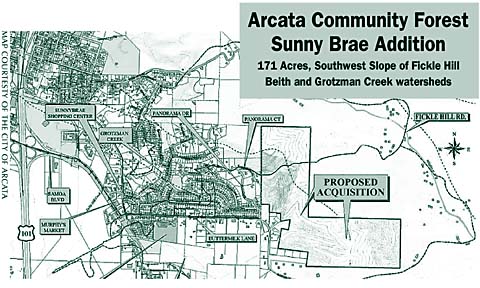
Despite its low-key tone --
or maybe because of it -- the letter had an impact. Distributed
to about 150 homes -- those along Buttermilk Lane and those in
the eastern half of Sunny Brae -- it helped galvanize a neighborhood.
When a meeting was held a few months later, 100 people showed
up, almost all of them opposed to the logging; when Sierra Pacific
refused to agree to limitations -- such as a ban on herbicide
spraying and having pilot cars guide logging trucks to increase
traffic safety -- the Sunny Brae-Arcata Neighborhood Alliance
(SANA) that formed under Lovelace's leadership threatened a lawsuit;
when CDF finally approved the timber harvest this past January
-- without the mitigations most important to citizens -- Lovelace
and SANA turned to the city for help.
That step, essentially Lovelace's
refusal to give up, produced results faster than he could have
hoped for. In March, less than two months later, the company
made the surprise announcement that it had dropped its logging
plans altogether and would instead sell the 171 acres to the
city of Arcata for $1.7 million.
It was a huge victory, both
personally for Lovelace -- whose property off Buttermilk Lane
abuts the land that would have been logged -- and for SANA. But,
as Lovelace pointed out during an interview at his home last
week, the battle's not over yet. "It got overreported when
it first came out," Lovelace said of the announcement of
the deal. "A lot of people thought SPI had given the city
the land. What we have is an agreement to sell."
Sierra Pacific has agreed to
hold off logging until January 2004 -- by which time, everyone
hopes, the city of Arcata will have come up with the money to
buy the land, an L-shaped parcel that rises from 160 feet up
to 900 feet above sea level across a series of moderate and steep
slopes.
So far, $15,000 to $20,000 has
been raised for what is known as the Arcata Forest Fund. The
money has "come from a number of people who have donated
up to $1,000 apiece," Lovelace said. Lovelace is hoping
that the fund will double in size after a fund-raiser this Saturday
at Jacoby's Storehouse in Arcata. The event, which runs from
6 to 10 p.m., will feature live and silent auctions, food, drink
and music, and a few "special packages" -- including
dinner for two with Humboldt State University President Rollin
Richmond and his wife, Ann, at Folie Douce; and a vegan dinner
for four, cooked in your own home by forest activist Julia Butterfly
Hill.
Even if the event is a success
and the forest fund swells to $40,000 or so, it would only be
a small fraction of the $1.7 million that's needed to buy the
land from Sierra Pacific. But, fortunately, the city doesn't
need to raise nearly that much money. Instead, if it can come
up with $350,000, -- 20 percent of the total price tag -- the
remainder will be paid out of a federal program called Forest
Legacy Funds. That would be a tad ironic, as the purpose of the
program is not to protect lands from logging but instead to prevent
timberlands from succumbing to urban sprawl. Still, the Sunny
Brae forest seems to fit the bill, as the city plans to eventually
do some logging in the area -- although probably not for "several
decades," according to city forester Mark Andre.
Of course, $350,000 is still
a lot of money. But the city is also applying for various state
grants, which would also require matches from the community.
The best-case scenario, according to Lovelace, is if the state
covers 80 percent of the $350,000 -- which would mean that the
community would need to pony up $70,000. Which means, assuming
this weekend's event is well-attended, that the fund-raising
effort would be halfway home.
"A $50,000 to $70,000 commitment
from the community would speak volumes about how important this
project is to Arcata," said Robin Park, field representative
with the San Francisco based Trust for Public Land, a land conservation
organization that is brokering the Sunny Brae forest deal.
The deal has been billed as
a win-win for all involved, and it's easy to see why. It would
be an opportunity for the city of Arcata to expand its community
forest, where only slow-paced, sustainable logging is allowed.
And it would be good PR for Sierra Pacific, which was having
to expend a good deal of time and energy on what, for the largest
landowner in the county, was a relatively minor logging operation.
"Legally, we had the right
to carry on with the harvest, but we just didn't want to stir
up the community," Chief Financial Officer Mark Emmerson
explained in a telephone interview this week from the company's
headquarters in Anderson, Calif. Emmerson noted that his family
has a personal tie to Arcata -- "We all grew up there,"
he said -- that played a role in the decision. But it remains
a bit of a mystery as to why the company, after having prevailed
over citizen opposition and after having spent approximately
$100,000 on the project, would turn around and abandon it so
quickly. Some have wondered whether CDF chief Andrea Tuttle,
who lives near Sunny Brae, might have intervened, but that has
never been confirmed. What is known is that Emmerson called up
Arcata City Manager Dan Hauser one day last spring and everything
changed.
As for Lovelace, he has learned
a few things -- one of which is that when push comes to shove,
CDF sides with logging companies, not with citizens living near
planned logging operations. Given that, he regrets not having
gone directly to the Emmerson family two years ago. "Ultimately,
the only entity that can stop [a logging operation] is the landowner.
I regret that I just didn't push things a notch and deal with
SPI on a corporate level," Lovelace said.
More profoundly, though, he
has learned that if you want justice, you've got to fight for
it. "I didn't come into this as an anti-corporate desperado
or an anti-timber activist, but to look for fairness, that our
concerns would not be subjected to theirs."
Redding
Medical Center scandal:
local patients may have had bogus surgeries
by
GEOFF S. FEIN
AN ATTORNEY REPRESENTING PATIENTS
of two Redding doctors who may have performed unwarranted heart
surgeries said at least one is from Eureka. And a Humboldt County
physician said there may be more local patients who were referred
to the Redding Medical Center and underwent unnecessary operations.
Dr. Chae Hyun Moon, 55, the
director of cardiology at Redding Medical Center, and Dr. Fidel
Realyvasquez Jr. 53, chairman of the cardiac surgery program
there, are being investigated by the FBI, the Justice Department,
the IRS and the U.S. Department of Health and Human Services
for performing unnecessary cardiac surgeries and for questionable
Medicare billings that netted the two doctors more than $2 million
in 2001.
Last week, 40 federal agents
seized patient records, angiograms and other medical documents
from the Redding Medical Center as well as the offices of Moon
and Realyvasquez.
According to a 70-page affidavit,
filed by the FBI in the U.S. District Court in Sacramento, the
doctors had scheduled surgery for healthy patients then billed
Medicare -- the federal health insurance program primarily for
the elderly. The affidavit said the government is focusing on
201 patients, 167 of whom were Medicare patients who died while
under the care of the two doctors. Coronary surgeries stretching
back to 1995 are being scrutinized.
Dugan Barr, an attorney representing
at least one former patient of Moon's, said he has spoken with
a Eureka woman whose case is one of the 201 being investigated
by the FBI. However, Dugan said he could not discuss the case
because of attorney-client confidentiality and because the woman
wishes to remain anonymous.
There is also one reference
to a Eureka patient contained in the affidavit. A Eureka man
received coronary artery bypass grafts after having been one
of Moon's patients. An unnamed cardiologist told the FBI the
patient's angiogram -- an X-ray taken by shooting dye into the
heart -- revealed no artery disease and that the heart operation
had been unnecessary.
Of the three cardiologists in
Humboldt County, two said they did not know the man (the third
was not contacted). Almost all of the patients and doctors listed
in the affidavit are identified only by code numbers in order
to protect their privacy and because of doctor-patient confidentiality.
One former patient of Moon's
was Loralee Muno, a former teacher at St. Bernard Catholic School
and Loleta Grammar School. She died last year, one week after
undergoing heart surgery at the Redding Medical Center. However,
it's unknown whether she is one of the 201 patients referred
to in the affidavit. Barr said he was unfamiliar with Muno.
Many will also remember Lewis
Klein, who taught at Humboldt State University and served on
the McKinleyville Community Services District board of directors.
Klein was a popular McKinleyville activist who died in 1997 at
age 57 following heart surgery. Klein, too, was a patient of
Moon, but again, it is not known if he was one of the patients
in the affidavit.
A local physician, who asked
to remain anonymous, said Moon and Realyvasquez were known to
be aggressive -- meaning they usually recommended surgery. The
doctor said that cardiologists here have probably all seen patients
who had coronary surgeries performed on them by Moon and Realyvasquez
that they may not have needed.
"(Moon's and Realyvasquez's)
numbers exceed the norm. Their numbers are extraordinary,"
the doctor said, referring to the number of patients Moon and
Realyvasquez saw.
The 238-bed Redding Medical
Center was probably handling upward of 700 heart bypasses and
heart valve replacement operations a year. In comparison, Santa
Rosa Memorial Hospital, which has a larger population area than
Redding, handles about 350 cases a year, the local doctor said.
"The two doctors have been
on the radar screen for a long time," the source said. "I'm
not surprised by the allegations."
Although physicians associated
with Mad River Community Hospital and St. Joseph Hospital referred
patients to Redding Medical Center and to Moon and Realyvasquez,
it's not clear how many patients were referred over the years
or who those patients were.
A spokesperson for Mad River
Community Hospital said about three patients per months from
the Arcata hospital are referred to Moon and Realyvasquez. The
spokesperson was quick to point out, however, that referrals
are initially requested by patients and are made by their physicians.
St. Joseph Hospital had transferred patients to the Redding facility
in the past, but those numbers have dropped as its own heart
program has grown, a hospital spokesperson there said.
The affidavit identifies fewer
than six patients who believe they had unnecessary surgery. None
of those six are from Humboldt County.
On Nov. 1 Barr filed the first
of what is likely to be several lawsuits. His client, Rev. John
Corapi, 55, was a patients of Moon's. The Redding priest was
scheduled for a triple bypass in June but instead sought a second
opinion and then contacted the FBI.
According to one local physician,
Redding Medical heavily promoted its heart practice in Humboldt
County and had ties to Mad River Community Hospital. In 1998
the Redding helped build Mad River Community Hospital's cardio
catherization lab. The lab ceased procedures about a year ago
due to lack of an Arcata-based cadiologist.
The
impact on the North Coast
by
JUDY HODGSON
THE NEWS LAST WEEK THAT TWO
REDDING heart doctors are being investigated for fraudulently
performing unnecessary surgeries on patients at the Redding Medical
Center may hasten the end of hospital competition in Humboldt
County.
Some physicians are saying privately
that the financially troubled Mad River Hospital had hoped to
sell to Tenet, owner of Redding Medical Center, to avoid either
closing its doors or being purchased by Sisters of Orange/St.
Joseph Health System, owner of St. Joseph in Eureka and Redwood
Memorial in Fortuna, the only other hospitals in the county.
Mad River Administrator Doug
Shaw confirmed Tuesday that a lease or outright sale to Tenet
has been "in the range of options" in ongoing conversations
with Redding administrators.
"The facility [Redding
Medical] is certainly under a cloud of suspicion right now. But
it's a large regional medical center and has many centers of
excellence, not just its heart program," Shaw said.
"This is not a death knell,"
he said. But any discussions about the future relationship of
Mad River and Redding Medical are "understandably not on
the front burner right now" for Redding officials, he added.
Mad River is part of an alliance
of 10 smaller hospitals that have cooperative operating agreements
with Redding. The alliance shares purchasing power and advanced
training for staff. The physicians who practice at the feeder
hospitals often refer patients to Redding when more advanced
treatment is required.
Redding Medical Center is one
of Tenet's most profitable hospitals and its heart program is
one of the busiest in the state. According to the state Office
of Health Planning and Development latest report in 1998, Redding
ranks 14th of the state's 117 hospitals in the number of surgeries
performed. In national studies, the program has a consistently
high success rate. Those ratings are now in question with the
investigation of Dr. Chae Hyun Moon, cardiologist, and cardiac
surgeon Dr. Fidel Realyvasquez, who head Redding's heart program.
(See separate story above)
News of the investigation broke
in the Redding Record Searchlight Thursday after the newspaper
received a press release from the FBI. News quickly spread to
the coast via fax and phone calls. By that night it was on the
network TV news.
Local physicians say the news
will have profound impacts on the medical community for years
to come. NorCal, the malpractice insurance provider for physicians
here and in Redding, may face large settlements if the Redding
pair are tried and found guilty. Large settlements could mean
higher premiums for all.
If patients and their physicians
lose faith in the Redding heart program, that could lead to a
jump in business for St. Joseph.
It is estimated that the North
Coast generates about 300 patients per year who need open-heart
surgery. The St. Joseph program, which restarted two years ago
after a rocky beginning, has been performing about 100 to 120
surgeries per year with good results. About 70 patients choose
the Redding Medical program for open-heart surgery and the remainder
use facilities in Santa Rosa, San Francisco or Redding Medical's
cross-town competitor, Mercy Medical.
Not surprisingly, Tenet's stock
dropped sharply last week. A financially weakened corporation,
even one as large as Tenet, would be in less of a position to
pursue any lease or sale of Mad River.
St. Joseph Hospital has financial
woes of its own and has been operating in the red for the past
several years. But by being part of a large network of Catholic
hospitals, it is better able to withstand short-term financial
losses especially if it means less or no competition in the future.
St. Joseph also substantially strengthened its market position
in 2000 by purchasing General Hospital, eliminating its only
competitor in Eureka.
At the time St. Joseph said
it would consolidate services but would retain both campuses,
with General Hospital housing rehabilitation and urgent (non-emergency)
care. Last week it announced it may close the General Hospital
facility altogether in a cost-saving move.
Shaw says Mad River Hospital,
founded in 1968 when the closely held corporation purchased the
old Trinity Hospital in Arcata from Sisters of Orange, is one
of half a dozen independent, non-chain hospitals remaining in
the country.
Sheriff
Philp can get sued
The U.S. Supreme Court has refused
to hear an appeal of a lower court's decision that allowed Earth
First protesters to sue current Humboldt County Sheriff Gary
Philp and his predecessor Dennis Lewis in a notorious pepper-spraying
incident in 1997.
That year, nine logging protesters
who staged sit-ins at Pacific Lumber Co. headquarters in Scotia
and then-Congressman Frank Riggs' office in Eureka, had pepper
spray swabbed in their eyes on the orders of Lewis and Philp.
The activists plan to employ
the same legal team that won fellow-activist Darryl Cherney $4.4
million in damages from a federal court in Oakland earlier this
year.
General
Hospital going...
In a move aimed at consolidating
health-care services in the Eureka area, St. Joseph's Hospital
announced that it is considering moving all services out of the
General Hospital building on Harris Avenue.
The idea, according to a press
release, is not to eliminate services, but to try and bring the
two hospitals operations together in one space.
General Hospital was bought
by St. Joseph in December 2000 and some services were immediately
moved out. This is the first declaration of any intention of
shutting down General completely.
Freshwater
heats up
Pacific Lumber Co. began logging
in a hotly contested area Tuesday: Unit two of the McCready and
Cloney Timber Harvest Plan in the Freshwater Creek Watershed.
Downstream residents of Freshwater
have been plagued by flooding in recent years that they believe
has been exacerbated by logging.
The logging sparked calls to
local media and drew protestors to the area. One man and one
woman were arrested.
An observer raised concerns
that trees were being felled too close to protestors.
A long-time treesitter, Remedy,
spoke to the Journal via cell phone as she sat in a tree
several hundred feet from where logging was taking place.
"Even I can't keep track
of all the treesits up now. They [PL] might think they know where
all the treesits are, but they don't."
The company was not reached
for comment.
Jacoby Creek
Forest to expand
The City of Arcata is negotiating
the purchase of 285 acres of land to add to the 866-acre Jacoby
Creek Forest.
The land, currently owned by
Barnum Timber Company, is west of Jacoby Creek and includes the
creek's scenic inner gorge.
The forest is proposed to serve
as a long-term buffer between the Jacoby Creek Forest and the
rural residential areas to the west.
The purchase is contingent on
a grant from the California Wildlife Conservation Board, which
is considered likely to approve it at their November meeting.
If all goes well the purchase
will be announced on Nov. 22 in Sacramento with state Sen. Wes
Chesbro presiding.
Van Duzen
study blasted
A study by the Pacific Lumber
Co. of the Van Duzen River valley downplays logging's effects
and, if used as a basis for future cutting, will further damage
the hard-hit watershed, according to residents and scientists.
The company's analysis, two
years overdue, is seeking to escape the logging restrictions
in place now in favor of looser controls that the company says
are more tailored to the watershed.
In a press release, a citizen's
group called Friends of the Van Duzen, faulted the company for
failing to include the rate of harvest in their analysis.
A Pacific Lumber scientist said
this week that the steepness of the Van Duzen watershed produces
more sediment from erosion than is generated by logging activity.
Former CR
president dies
Former College of the Redwoods
President Cedric Sampson died Tuesday at the U.C. Davis Medical
Center. Sampson, who served as president from 1988 to 1998, had
leukemia. Sampson, who was 60, is survived by his wife Judy,
daughter Mandy and sons Scott, Kevin and Colin.
COVER
STORY | ELECTION RESULTS | CALENDAR
Comments? E-mail the Journal: ncjour@northcoast.com
© Copyright 2002, North Coast Journal,
Inc.
|