|
 
COVER
STORY | SPECIAL
REPORT | IN
THE GARDEN | CALENDAR
Sept. 19, 2002
New
bank in the works: Former exec says banks 'no longer local'
by
JUDY HODGSON
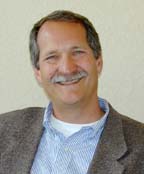 FORMER
PRESIDENT OF HUMBOLDT BANK last week that he and a group of investors
are launching an as-yet-unnamed bank based in Eureka that will
likely open next year. The move is certain to spark a debate
on just what constitutes a local bank. FORMER
PRESIDENT OF HUMBOLDT BANK last week that he and a group of investors
are launching an as-yet-unnamed bank based in Eureka that will
likely open next year. The move is certain to spark a debate
on just what constitutes a local bank.
"We want to re-establish
community banking in Humboldt County," said John Dalby,
former branch manager in Fortuna and Eureka and bank president
from 1999-2001. [photo
ar right] The two existing North
Coast banks claiming to be community-based in advertising campaigns
are today regional banks with administration headquarters out
of the county, according to Dalby.
There was a significant shift
in Humboldt Bank ownership toward nonlocal shareholders after
the corporation was listed on the NASDAQ in March 2000, Dalby
said. Local ownership was further diluted when Humboldt merged
with Tehama Bank in 2001.
"When ownership is outside
this community, you are answering to investment bankers and investment
analysts. Goals and objectives are set for you by analysts who
say, `If I'm going to recommend your stock, you need to do this,'"
Dalby said.
"It's been my experience
that the economy of a community takes a back seat to what is
perceived as shareholders' needs."
Dalby said he resigned as bank
president last year but remained on staff in another capacity,
head of commercial lending. However, he said his frustration
continued to grow earlier this year when Humboldt Bancorp, the
parent corporation, combined the independent charters of its
three banks -- Humboldt, Tehama and Capitol Valley -- into one
regional bank and moved its top administrators from Eureka to
Roseville, Calif.
Paul Ziegler, who replaced Dalby
as president last year, agreed that listing on the NASDAQ "certainly
brought on institutional investors" and the ownership "broadened"
when Humboldt purchased Tehama Bank.
"We have certainly grown
outside our original service borders in Humboldt County. I don't
think that means that Humboldt is less important or isn't going
to get the resources it needs."
Ziegler estimates that the bank
has about $550 million in deposits from this county "and
roughly $400 million in loans." The bank is the leading
lender in the region for commercial, Small Business Administration
loans and residential real estate.
Competition is always good,
he said, but Humboldt Bank is not particularly worried with the
proposed start-up.
"We have a very loyal and
diverse customer base. We will continue to have a high profile,
active voice in the community regardless of the percentage of
local ownership or where our executive offices are located,"
Ziegler said.
Ironically, Humboldt Bank and
Six Rivers Bank were both launched as local banks in Eureka in
1989, one year after locally owned Bank of Loleta was sold to
one of the major banking chains. What followed was a decade of
rapid consolidation in the banking industry across the nation
-- independents selling or merging into regional chains, and
regional chains being bought up by major banks.
"Bank of Loleta sold, Six
Rivers Bank sold [to North Valley Bank in 2001], Humboldt Bank
didn't sell, but it merged itself and moved," Dalby said.
The key difference between major
bank chains and independent banks is reinvestment in the community,
he added.
"There are only so many
dollars [in deposits]. In Eureka about 40 percent of all deposits
are with major banks," Dalby said. "Outside of standard
consumer loans, those major banks do very little reinvesting
in their community. When's the last time you saw a construction
loan sign with Wells Fargo or Bank of America on it? It doesn't
happen.
"Banks have the ability
to take deposits here and deploy them in the form of loans elsewhere,"
Dalby continued. "When things get tough in Humboldt County,
all [major and regional banks] have to do is turn down the credit
screws and stop making loans. It exacerbates the problem at a
time the local community needs a shot in the arm."
So how can a new bank maintain
independence when others have failed?
"I cannot tell you our
bank will remain a community bank forever -- I can't promise
[because of fiduciary responsibility to shareholders]. But what
we can do is learn from history and not repeat those errors,"
Dalby said.
"With Six Rivers, it was
performance. They had problems with loans and they had significant
regulatory problems [in the mid and late 1990s]. Whether it was
bad loans or poor management, frankly their return to shareholder
wasn't sufficient to keep them from having to find a suitor.
"Unfortunately, Humboldt
Bank forced their hand by being so aggressive," Dalby said.
[In 1994, 1997 and 1999 Humboldt Bank failed in three hostile
takeover attempts of Six Rivers Bank.]
Dalby said he has no ill feelings
about his former bank and maintains many friendships. He just
doesn't agree with where the bank is headed.
"Humboldt made some decisions
-- not today, but years ago -- that sent them in a direction.
They are absolutely doing what's right based on current circumstances.
But those circumstances were really created when they began to
cater to investment bankers and analysts," Dalby said.
"Technically the only locally
owned financial institution is Coast Central. It's one of the
largest credit unions in the country. It's extremely well run,
but they have limitations. Their niche is the individual. If
you were sitting in my office and wanting a car loan, I would
tell you the best deal you can get is at the credit union.
"We are going to cater
to individuals, too --and moderate income up to doctors and lawyers,
but primarily small business people. Our primary focus will be
commercial lending, to help fund small business."
The new bank will be full service
and will tie into a national ATM service.
Dalby estimates he will need
to raise $8.5 million to $10 million to open the doors. He said
he is not ready to reveal the names of his financial partners
until the name of the bank is chosen and they have regulatory
approval to began raising capital. He did confirm that he has
the backing of one key person in the local financial world, Eureka
businessman Rob Arkley.
Arkley told the Journal
he agrees that there is a strong need for a local bank. He said
he was investigating starting one himself this past year but
ran into potential conflict-of-interest problems. (The bank will
be located in Eureka's redevelopment zone. Arkley's wife, Cherie
Arkley, sits on the Eureka City Council and is running for mayor.)
Arkley said he has agreed to
purchase a block of shares (less than 10 percent) in the new
bank and will give the stock to the 125 employees of his Security
National Servicing Corp., headquartered in Eureka.
"We will be not be participating
in any ownership or management in any way. The Arkley family
will have no financial ties or interest," Rob Arkley said.
The Arkleys have made a number
of philanthropic gifts to the community in recent years. Some
have been highly visible -- like the $2 million check to the
city of Eureka to speed up completion of the Boardwalk project.
Not-so-well known is a similar-sized donation made this year
to the zoological society to revamp the city zoo. Other gifts
include significant funding for restoration of the Carnegie Building
(now the Morris Graves Museum of Art), the Eureka Theater, Vance
Hotel, Redwood Concert Ballet building, Christ Episcopal Church,
Eureka High School pool and stadium, and the Willow Creek downtown
improvement project. The Arkleys gave nearly $200,000 to St.
Bernard Schools when it was threatened with closure two years
ago.
Dalby said he appreciates Rob
Arkley's support for the new bank and his financial guidance.
"I began to do due diligence
to see whether there was a need [for a new bank]. Later I began
hearing rumblings that Rob Arkley was going to the same thing
so I went to see him," Dalby said.
"The last thing I wanted
to do is compete with him in putting together a financial institution.
I told him about my plan and he said, `Good. Now I don't have
to.'"
Dalby said he does not think
the new bank will have a financial impact on Humboldt Bank. Even
if it is "wildly successful" in its first year and
grows assets to $100 million, "We'd still be a pimple on
the butt of Humboldt Bank," Dalby said.
Humboldt Bancorp current assets
are $982 million.
McKinleyville
strip mall burns
story & photos by BOB DORAN
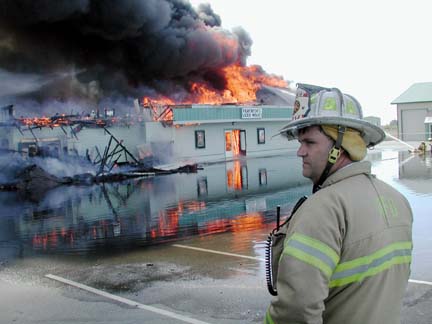
Chief Dave White of the Arcata Fire Department
OSCAR GUERRERO STARED INTO THE
BURNT-OUT SHELL of Don Juan's Mexican Restaurant, the family
business where he used to work, shook his head and said, "I
don't know what we'll do now, maybe rebuild, maybe find another
place."
 Officials
believe the fire that burned Don Juan's and several other businesses
in a McKinleyville strip mall on Monday may have originated in
the kitchen of the restaurant that morning. It raged out of control
until the afternoon, filling the sky above town with thick black
smoke and ultimately destroying five businesses: Live From New
York Pizza Restaurant, HealthSPORT Annex, Added Touch Family
Styling Salon and Figueiredo's Video Movies, which housed 12,000
videos. H & R Block Financial Advisors was the only business
in the mall -- a single building -- that survived. Officials
believe the fire that burned Don Juan's and several other businesses
in a McKinleyville strip mall on Monday may have originated in
the kitchen of the restaurant that morning. It raged out of control
until the afternoon, filling the sky above town with thick black
smoke and ultimately destroying five businesses: Live From New
York Pizza Restaurant, HealthSPORT Annex, Added Touch Family
Styling Salon and Figueiredo's Video Movies, which housed 12,000
videos. H & R Block Financial Advisors was the only business
in the mall -- a single building -- that survived.
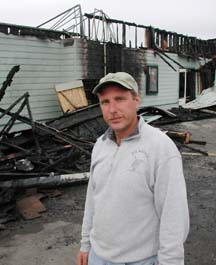
Surveying the gutted structure
the following day, owner Dave Figueiredo estimated the damage
at "over $1 million." [photo
below right]
"It's up to the insurance
people at this point" to sort things out, he said. He added
that he felt "numb" after spending a sleepless night
Monday.
According to Chief Dave White
of the Arcata Fire Department, "the fire was well involved
in the attic (above Don Juan's) by the time we got to it."
At one point the firemen thought they had suppressed the blaze
at least enough to save Figueiredo's, the business at the other
end of the mall from Don Juan's. But the fire proved difficult
to stop because the attic stretched the length of the building.
With flames shooting through the roof, White conceded the blaze
was out of control and pulled firefighters out of the doomed
structure.
The damage might not have been
so extensive had more water been available to fight the fire.
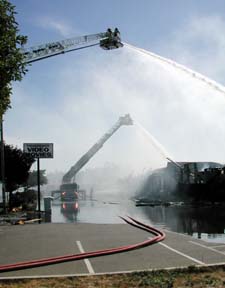
Truck 3, Arcata's brand new ladder truck, a rig capable of pumping
2,000 gallons of water per minute, was called into play to douse
the flames from above. [see
photo above left] Unfortunately,
with the fire hydrant closest to the fire already in use, the
nearest available hydrant was at Thomas' Building Supply, a block
away. According to Capt. Tad Sundquist of the Eureka Fire Department,
whose ladder truck crew was called in to help put out the fire,
the distance reduced the hose's capacity by half: to about 1,000
gallons per minute.
 Still,
Sundquist said that by the time a ladder truck is put into use,
it's usually too late. "When the ladder goes up, the building
is coming down," he said. Chief White concurred, explaining
that ladder trucks are "not really effective until the fire
burns through the roof." Still,
Sundquist said that by the time a ladder truck is put into use,
it's usually too late. "When the ladder goes up, the building
is coming down," he said. Chief White concurred, explaining
that ladder trucks are "not really effective until the fire
burns through the roof."
Sundquist said the shared attic
-- a common feature of strip malls -- made it "a tough fire
to fight. These strip malls are notorious." Sundquist said
there are shopping complexes with the same problem all over the
county, including "quite a few in Eureka" and the Valley
West and Uniontown shopping centers in Arcata.
Live From New York's owner,
Paul Amato, was philosophical as he watched a fire crew douse
the rubble of his pizza place. The former New Yorker said he
saw the fire as a sign. "I've been working too much lately,
now I guess I get a vacation. I'll go back to New York, maybe
even Italy."
Figueiredo expressed concern
for the Guerrero family. "That was their whole life,"
he said, gesturing toward the charred remains of the restaurant.
Figueiredo, who owns another
video store in Arcata and one in Fort Bragg, said he was not
too concerned about his own future and promised to rebuild. "We'll
be up and running as soon as we can. At least it will be a brand
new building when we return."
Youthful
spirit
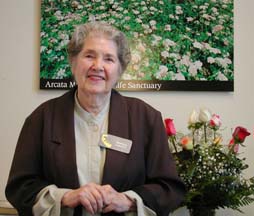 Most
people retire at age 65. Not Muriel Hayes. In 1978 she began
a new career that lasted 22 years and ended with cake and punch
at a reception earlier this month. Hayes, with her husky voice
and New York accent, was the official greeter at the Arcata Chamber
of Commerce and the California Welcome Center. "She had
an incredible amount of patience, answering the same questions
over and over again with the same enthusiasm to share all the
wonderful things to see and do on the North Coast," said
Jody Hansen, former executive director of the Arcata Chamber.
"People visiting from New York and the East Coast loved
hearing that familiar voice. We loved hearing her stories about
Manhattan during World War II." (Her late husband served
in Eisenhower's headquarters in Europe while Hayes worked in
the financial district.) Hansen, who now is director of the Chamber
of Commerce in Cupertino, said Hayes often fooled people about
her age with her youthful spirit and "the best octogenarian
skin around." Most
people retire at age 65. Not Muriel Hayes. In 1978 she began
a new career that lasted 22 years and ended with cake and punch
at a reception earlier this month. Hayes, with her husky voice
and New York accent, was the official greeter at the Arcata Chamber
of Commerce and the California Welcome Center. "She had
an incredible amount of patience, answering the same questions
over and over again with the same enthusiasm to share all the
wonderful things to see and do on the North Coast," said
Jody Hansen, former executive director of the Arcata Chamber.
"People visiting from New York and the East Coast loved
hearing that familiar voice. We loved hearing her stories about
Manhattan during World War II." (Her late husband served
in Eisenhower's headquarters in Europe while Hayes worked in
the financial district.) Hansen, who now is director of the Chamber
of Commerce in Cupertino, said Hayes often fooled people about
her age with her youthful spirit and "the best octogenarian
skin around."
Fishing
ban imposed
Facing the collapse of an entire
fishery, federal regulators have banned bottom fishing next year
on most of the Continental Shelf stretching from Mexico to Canada.
Meeting in Portland, Ore., last
week, the Pacific Fisheries Management Council slashed quotas
for several species of rockfish -- often called red snapper --
by as much as 80 percent. The council -- long criticized for
favoring the fishing industry -- also designated for the first
time no-fishing zones in the ocean depths where rockfish tend
to concentrate.
"It's no longer sufficient
to regulate the kind of fish people can land. We have to regulate
where they actually put their lines in the water," L.B.
Boydstun, a council member and a California Department of Fish
and Game official, told the press after the vote.
While applauding the council,
environmentalists complained that the ban has loopholes. For
example, while fishermen will not be able trawl in the heart
of the depth zones where bocaccio -- perhaps the most imperiled
rockfish species -- lives, they will be able to fish around the
edges. And restricted shrimp, prawn and flatfish trawling will
be allowed to take place in the protected depth zones.
"The council is talking
about closures, but it's more like Swiss cheese," complained
Mark Powell of the Ocean Conservancy, an environmental group.
The new restrictions are likely
to hit Humboldt Bay's struggling fishing industry hard. Pete
Leipzig, executive director of the Eureka-based Fisherman's Marketing
Association, said small fishermen could be put out of business.
(The Journal wrote about the rockfish crisis in a July 18, 2002
cover story, Deep Trouble).
BSS building
to be redesigned
In a major compromise, new Humboldt
State University President Rollin Richmond has agreed to redesign
-- at a cost of $1 million -- the controversial Behavioral and
Social Sciences building.
The planned building, designed
previously for a cost of $1.1 million, has been a sore point
between the university and the city, with residents contending
that its height and size would make it an eyesore as well as
a traffic problem. The city of Arcata even filed a lawsuit over
it (the suit was recently dropped).
The proposal is a clear indication
that Richmond is giving top priority to improving the university's
relations with the communities that surround it.
The building's basic location,
on top of the hill at 15th and Union streets, is not going to
change. What will be different is the building itself. Instead
of soaring five stories upward it will be more horizontal and
will possibly spread further downhill -- perhaps even deeper
underground -- than originally planned.
The redesign will be tricky
-- if the university changes the design too much it will have
to undertake another expensive review of potential impacts.
It's also not a done deal. Voters
must approve a state education bond in November or there won't
be any money to do the job.
Thron pulls
political ad
Doug Thron, Green Party candidate
for State Assembly, has decided to move his political advertisement
from a billboard located just north of Eureka along Highway 101.
The advertisement has been an
embarrassment for Thron, whose campaign is based primarily on
his environmental credentials. The billboard is located on a
protected wetland inside Humboldt Bay National Wildlife Refuge.
The U.S. Fish and Wildlife Service
has been in a battle with Viacom Outdoor Products for illegally
using federal land for its billboards.
Thron maintains that he told
Viacom officials he didn't want his ad placed on a billboard
that stood in the refuge.
Sheriff
Lewis retires
After 35 years in law enforcement,
Humboldt County Sheriff Dennis Lewis has retired, four months
early, from the position he has held since 1994.
In a ceremony before the Humboldt
County Board of Supervisors Tuesday, Chief Deputy Gary Philp,
who beat Lewis in the March elections, was sworn in as the new
Sheriff.
The supervisors honored Lewis,
presenting him with a commendation for his years of dedicated
service.
"I wouldn't be here today
without my wife," Lewis said after receiving the commendation.
"The commendation should go to her."
Lewis' tenure as sheriff was
not without controversy. In 1997, he ordered deputies to daub
pepper spray on the eyelids of timber protestors. Last year,
he refused a judge's order to return confiscated medical marijuana
to a patient.
Lewis began his career in 1968
as a police officer for the city of Arcata. Within five years
he was promoted to lieutenant.
In 1975 he was hired as an investigator
with the Humboldt County District Attorney's office. He worked
primarily on welfare fraud and child custody cases.
Arcata
relents
Less will mean more for future
events on Arcata's Plaza.
On Sept. 4, the City Council
removed a requirement that any event serving alcohol have two
on-duty Arcata police officers patrolling the festivities.
The city's decision to drop
the requirement could potentially save event organizers upwards
of $700 in costs. That could result in additional income for
many of the nonprofits that hold fund-raising events on the Plaza.
Event organizers hire their
own private security when there will be alcohol served. And Arcata
police officers already patrol the Plaza area as a regular part
of their beat.
The council also plans to hold
a study session to determine if there are alternatives to fencing
in the Plaza when alcohol-serving events are held.
Rancheria
drops suit
Blue Lake Rancheria has dropped
its lawsuit against the city of Blue Lake, after the two sides
reached an agreement over the city's ability to impose water
and sewer mitigations against the tribe.
Under terms of the agreement,
the city retains the right to address issues with the tribe,
while the rancheria retains the right to contest any action by
the city.
The suit was filed when the
tribe said the city didn't have the right to stop water and sewer
service as a way to force the rancheria to address issues under
an existing agreement. The agreement between the rancheria and
the city called for a cooperative effort on providing water and
sewer services to the tribe.
The city had agreed to offer
water and sewer services to the rancheria in return for user
fees, connection fees, reimbursement for police services, improvements
on Chartin Road and environmental review services.
A
new Sphinx riddle
by
ANDREW EDWARDS
WHAT IF ALL WE KNOW ABOUT ANCIENT
history is wrong? What if, for example, civilization extended
back before the last Ice Age?
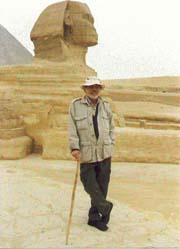 If
that kind of question gets your juices flowing, attend a lecture
this Sunday by rogue scholar and Emmy Award winner John Anthony
West and have your view of Egyptology turned on its head. If
that kind of question gets your juices flowing, attend a lecture
this Sunday by rogue scholar and Emmy Award winner John Anthony
West and have your view of Egyptology turned on its head.
"Modern history says that
the fount of ancient knowledge was the Greeks," West said
in a phone interview this week from upstate New York. "But
the Greeks were the first to admit that the source of wisdom
in the ancient world was Egypt."
To hear West tell it, it's not
just the Egypt of the Pharaohs that built the pyramids, entombed
mummys and deified cats. His view, known as the Symbolists Theory
of Egyptology, postulates the existence of a civilization in
Egypt much older than is commonly believed -- so old, in fact,
that its origins extend back before the last Ice Age (about 13,000
years ago.)
In ancient texts, "the
Pharaohs themselves seem to say that their civilization started
36,000 years ago, and I'm inclined to agree."
Humboldt State historian Louis
Okin expressed skepticism, noting the absence of any other evidence
for the existence of a civilization that old. He also said that
the "cutting style" used to carve the Sphinx "fits
nicely with the style of the Old Kingdom," which dates to
3,000 B.C.
Direct study of the rocks making
up the Sphinx cannot resolve the issue as radioactive dating
of the material is impossible.
West started out studying the
work of the late R. A. Schwaller de Lubicz, the adopted son of
a Lithuanian prince who developed the Symbolist theory in the
early part of the 20th century.
"I stumbled upon this little
passage, `of course the great Sphinx has been weathered by water,
not wind and sand,'" West said. "He didn't himself
understand" the significance of that.
But West, who has studied ancient
Egypt for 35 years, understood. Knowing that there hasn't been
significant rain in the area where the Sphinx is located since
it became part of the Sahara desert 10,000 years ago, West reasoned
that the Sphinx must have been created before then.
With the work of Boston University
geologist Robert Schoch backing him up, West went public and
produced an Emmy-winning documentary on the subject `The Mystery
of the Sphinx,' with Charleton Heston as host. It first aired
in 1993.
Since that success West, 70,
has been working to spread the word about his revisionist view
of ancient history. The lecture Sunday is a benefit for his Ancient
Wisdom Foundation, which is attempting to raise money to send
an expedition to Egypt to determine once and for all if the Sphinx
was weathered by water.
If the answer is yes, "then
at least some of the [scholars in] opposition will have to say
`okay, we were wrong,' and look into it."
West said a determination that
civilization in the Mediterranean region began much further in
the past than anyone suspected would hold "immense implications."
The Sept. 22 lecture is
at 1:30 p.m. in the Wharfinger Building in Eureka. The price of admission is $18. Call 268-1973 for
more information.
Speeders'
beware
Speeding fines along the Highway
101 corridor between Eureka and Arcata will double beginning
next year.
The speed limit through the
six-mile safety zone is 50 mph. Currently, exceeding the posted
speed limit by up to 15 mph costs $86; going between 16 and 25
mph over the speed limit costs $145; and going faster than 26
mph over the speed limit costs $280.
The stretch of highway between
Eureka and Arcata has averaged 55 collisions per year and has
had six fatalities since 1997, according to the state Department
of Motor Vehicles.
Co-op workers
unionize
For the first time, the 170
employees of the North Coast Co-op grocery stores have unionized.
The workers voted last week
to accept a contract with the United Food and Commercial Workers
union, completing 10 months of negotiations begun soon after
the employees voted to be represented last year.
According to a press release
from Co-op management, the union will provide employees with
more stability through a better-paid, more experienced work force.
The Co-op has stores in Arcata
and Eureka.
Toilet
tax
Registered voters in Ferndale
will have the final word on whether the city should increase
its business license fee from $48 to $90 a year to continue to
have public restrooms along Main Street.
City officials said the increase
was necessary because they could not find funding for maintenance
of the restrooms in the current city budget. The license fee
is expected to generate $10,000 annually.
The restrooms are used by visitors
to Main Street and are an alternative to people seeking to use
a business' facilities.
However, in order for the proposal
to take effect, it must receive the support of more than 50 percent
of Ferndale's registered voters. Ballots are being mailed out
and must be returned to City Hall before the Oct. 14 City Council
meeting.
Labor's
choices
The 10,000-member General Labor
Council of Humboldt/Del Norte Counties, AFL-CIO, have thrown
its support behind candidates Patty Berg for state Assembly,
1st District; Jill Geist, for the Humboldt County Board of Supervisors,
5th District, Peter LaVallee, for mayor of Eureka; and Mary Beth
Wolford, for Eureka City Council, Ward 1.
"These are the people who
bothered to contact us and present their candidacy to us,"
said James A. Smith, president of the Humboldt County labor organization.
The organization has also endorsed
Wesley Chesbro, for state Senate, 2nd District; Congressman Mike
Thompson, 1st Congressional District; and Gov. Gray Davis, who's
running for a second term.
State grants
awarded
Humboldt County will receive
$35,000 in state planning grants for a feasibility study for
an industrial park in Samoa. Another $35,000 will go toward a
survey of exterior housing conditions and an evaluation of affordable
housing in the region.
The city of Arcata also received
two $35,000 grants to help update a housing study and to look
at the practicality of building an "ecolodge."
The grants, to be used for planning
and technical assistance on community projects, are part of the
state's Community Development Block Grant Program to benefit
low-income households.
Meet the
chief
Every fourth Thursday of the
month, Arcata Police Chief Chris Gallagher will hold office hours
at Denny's, 3525 Janes Rd., to allow northside Arcata residents
a chance to meet with him one-on-one .
Southside residents will also
get a chance to meet with Gallagher every second Thursday at
Coffee Break, 700 Bayside Road.
The meetings will begin at 7
a.m. and last one hour. Discussion will not be limited to police
business, Gallagher said.
The first meeting is Thursday,
Sept. 26.
Woolley
named to rail board
If you want a job done right,
you've got to do it yourself.
In that spirit, the Humboldt
County Board of Supervisors last week elected 3rd District Supervisor
John Woolley to the North Coast Railroad Authority. Woolley replaces
Dan Opalach of Simpson Timber Co., who left due to time constraints.
The authority has been struggling for years to get the rail line
between Eureka and Healdsburg operational, but heretofore the
supervisors had only played an advisory role. Woolley said that
his addition takes their interest to the next level.
Election
forums
KEET, the North Coast's public
television station, will broadcast 12 call-in candidate forums
for the November election. Each of the forums will be broadcast
live at 7 p.m. on Channel 13. A phone number to call in and ask
candidates questions will be provided during the forums.
The first of 12 forums will
air Sept. 26 and will feature Ben Shepherd and Jill Geist, candidates
for the 5th District seat on the Humboldt County Board of Supervisors.
The remaining election forum
schedule is as follows:
Del Norte County sheriff, Friday,
Sept. 27
Eureka City Council, Ward 3,
Thursday, Oct. 3
Del Norte County District Attorney,
Friday, Oct. 4
Eureka City Council, Wards 1
and 5, Tuesday, Oct. 8
Eureka mayor, Thursday, Oct.
10
Crescent City Harbor District,
Friday, Oct. 11
State Assembly, 1st District,
Monday, Oct. 14
State Senate, 2nd District,
Thursday, Oct. 17
Arcata City Council, Friday,
Oct. 18
U.S. Representative, 1st District,
Monday, Oct. 21
Eureka Utility Tax Measure,
Tuesday, Oct. 22
Clean it
up
Volunteers are needed to help
remove trash and debris from Humboldt County beaches as part
of the annual California Coastal Clean-Up.
The event will be held Saturday
from 9 a.m. to noon.
The cleanup effort, which is
statewide, has been dubbed the largest trash collection effort
on the planet by the Guinness Book of Records. In 17 years, approximately
500,000 Californians have removed more than 7.5 million pounds
of debris from the state's shoreline. About 40,000 people volunteer
annually to clean up more than 400 sites statewide.
Humboldt County's event is organized
by the Northcoast Environmental Center. The center held its first
all-volunteer clean-up day in 1985.
Volunteers will be given plastic
trash and recycling bags and gloves as they scour Humboldt County's
shoreline to remove cigarette butts, beer bottles, fishing lines,
tires and other debris.
Participants will receive a
commemorative mug for their efforts.
For further information or to
volunteer, call 822-6918.
Bank deal
stalled
Humboldt Bancorp announced last
Friday that the $34 million deal to sell its merchant bankcard
division to iPayment Holdings Inc., in Tennessee, is not going
as smoothly as expected.
iPayment has refused to sign
an amendment to the deal that would extend escrow past the Aug.
30 deadline.
"We did not meet our original
date to close the deal," said Humboldt Bancorp president
Paul Ziegler. Ziegler did not elaborate on the reason for the
hitch.
Ziegler said he was anxious
for the deal to go through as soon as possible as he wants the
company to focus on its core banking operations without having
to worry about the merchant bank card division.
Animal
abuse trial
The operators of the Band of
Mercy animal shelter will have their day in court.
On Monday, Humboldt County Superior
Court Judge Timothy Cissna declared that the case against Linda
Sue Martin and Larry Decker Lawson was sufficient to justify
a trial.
Martin and Lawson are charged
with felony animal abuse for mismanaging the Band of Mercy Animal
Rescue. In July, it was discovered that nearly 100 animals --
mostly dogs and cats -- were being kept in filthy conditions.
The decision came after testimony
from Shannon Miranda of Miranda Rescue in Fortuna, and Deputy
Doug Pool of the Humboldt County Sheriff's office, both of whom
assisted in clearing out the Eureka house that Band of Mercy
operated in.
The next hearing is scheduled
for Sept. 25. Meanwhile Martin and Lawson remain free on their
own recognizance.
COVER
STORY | SPECIAL REPORT | IN THE GARDEN | CALENDAR
Comments? E-mail the Journal: ncjour@northcoast.com
© Copyright 2002, North Coast Journal,
Inc.
|