|
 
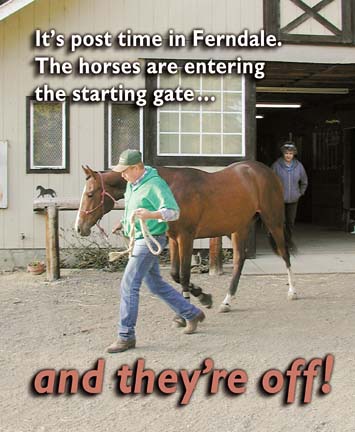
Story & photos by BOB DORAN
HORSE RACING HAS BEEN PART OF
THE HUMBOLDT COUNTY FAIR in one form or another since the fair's
inception in 1896," said Stuart Titus, Humboldt County Fair
general manager [in photo
below right]. "There was a
different format back then of course. But -- with the exception
of some years around the turn of the century when gambling was
prohibited in the state -- there has always been racing as part
of this fair.
![[photo of horse race]](cover0809-running.jpg) "What differentiates modern
horse racing from the olden days is the type of wagering that
is allowed. Pari-mutuel wagering (where the take is split according
to predetermined percentages) went into effect in California
in 1933. It was an initiative adopted by the voters. When it
took effect the California Horse Racing Board was created and
with it came racing as we know it today." "What differentiates modern
horse racing from the olden days is the type of wagering that
is allowed. Pari-mutuel wagering (where the take is split according
to predetermined percentages) went into effect in California
in 1933. It was an initiative adopted by the voters. When it
took effect the California Horse Racing Board was created and
with it came racing as we know it today."
How important are the races
to the Humboldt County Fair?
"Very important,"
said Titus. "Our annual budget [for the fairgrounds] is
about $1 million. Of that, 75-80 percent is generated during
the 11 days in August when we hold the fair. My estimate would
be that 60-65 percent of that is directly or indirectly related
to racing."
About 80 percent of the money
bet on a race, called the "handle," goes to pay off
those bettors holding winning tickets. "The other 20 percent
gets split up between various parties," said Titus. "The
state gets some as license fees, we retain some as a commission,
some goes to the purse."
The track is small, in fact
at a half mile, it's the smallest in the state, and since Humboldt
County doesn't have a lot of people, our crowds are smaller.
Fortunately the track's revenues get a boost from the outside
via satellite.
![[photo of Titus]](cover0809-Titus.jpg) "We
have our own racing and money bet by people who come to this
fair," said Titus. "And our races are also satellited
out statewide. Interestingly enough, of the total bet on Humboldt
races, a full two-thirds is bet outside the county. We're very
dependent on the satellite system in that regard." "We
have our own racing and money bet by people who come to this
fair," said Titus. "And our races are also satellited
out statewide. Interestingly enough, of the total bet on Humboldt
races, a full two-thirds is bet outside the county. We're very
dependent on the satellite system in that regard."
With money bet on Humboldt races
at other tracks the total take is "about $3 million over
the 10 days," said Titus. "Out of that our commission
is somewhere in the neighborhood of $150,000. We pay out about
$280,000 in purses total."
A recent bill put forth by assembly
person Virginia Strom-Martin and signed by Gov. Davis helped
protect that revenue.
"Bay Meadows, where the
San Mateo County Fair runs its races, is going to be liquidated
someday," Titus explained. "There won't be a track
there. What our bill did was preserve the existing language which
provides us with certain economic privileges and advantages regardless
of where San Mateo may run its dates in the future."
San Mateo is one of the tracks
on the Northern California fair circuit that has seen trouble
brewing lately. A number of factors have led to horse trainers
leaving the state and the smaller tracks are often having a hard
time filling their race cards. In response the California Horse
Racing Board recently proposed reducing the number of race days
for 2002.
"They are making adjustments
elsewhere with other fairs to address what appears to be a problem
statewide; that is a shortage of race horses. This year everybody
was running scared because there were some trainers who left
the state for their own reasons. Jerry Hollendorfer and a couple
of others took their stables back east and did very well.
"One way to address the
problem is to reduce the number of races run each year either
by reducing the number of days that they allocate or by running
fewer races each day. It's still up in the air. I don't think
they'll make the decision until next month."
Difficulty filling the race
card is nothing new in Humboldt County.
"We're always challenged
to attract horses up here," Titus admitted. "We've
always predicated our race meet on how many horses we're fortunate
enough to get. Our purse money, the prize money we offer them,
is less than anywhere else in California, but it's still better
than they receive in other states like Oregon and Washington.
And there's still no better racing overall than what you find
here in California. There's still a lot of good trainers here."
With trouble on the fair circuit
around the state, you'd think the smallest track, Humboldt's,
would be in serious trouble this year. But for a combination
of reasons that isn't the case.
"We're looking very very
good," said Titus. "In fact we've already began discussions
with the California Horse Racing Board about adding races to
this year's program. It appears we'll be able to run more races
than we have in 15 years. It looks as if it's going to be the
best race meet in some time.
"We're pleasantly surprised.
We receive stall applications on a preliminary basis as a way
of knowing who's coming and how many stalls they need. We're
at a record high right now. We've got stall aps for over 500
horses."
In part the increase is due
to a windfall from the north.
"We're getting a lot of
horses from Oregon and Washington this year, mostly because the
racing that usually occurs at the Oregon State Fair in Salem
will not be happening this year.
"Usually the horses go
from Grant's Pass to Salem. This year they had nowhere to go,
so even a week or more out we already have horses on the track
from Oregon. It's put us in a pretty good position for this year.
We'll treat them well and hope they come back next year."
Among the perks for trainers
-- cash bonuses for showing up and to offset the cost of entering
races. A fish fry and a golf tournament are scheduled for Tuesday,
the one day during the fair when there are no races.
![[photo of Ralph Shiflet and Little Fette]](cover0809-Shiflet.jpg) Ralph Shiflet
[in photo at left] is among those who came down from Oregon. The
trainer from Salem brought two of his horses down and on a foggy
morning a week before fair time. He has them on a device called
a hot walker. Ralph Shiflet
[in photo at left] is among those who came down from Oregon. The
trainer from Salem brought two of his horses down and on a foggy
morning a week before fair time. He has them on a device called
a hot walker.
"I normally race the Oregon
circuit, but they can't decide what they're going to do up there.
I race all over up there, and everybody said my horses would
do well down here in Ferndale."
Shiflet said this is his first
time racing in California, "and after here I'm going to
Sacramento, to the State Fair. I brought down two thoroughbreds;
Aldebaran Dancer is the bay and Little Fette [with Shiflet in photo at left, and in photo below
right] is the other. I'll enter
both of them on the 9th, that's the first day of racing. Then
I'll probably wait a day then enter them again and maybe again
on a third day. It all depends on how they come back, if they
come back sore. It all depends on how the horse feels."
He also owns a quarterhorse
but left it back in Salem since there were only three races for
quarterhorses on the bill this year.
"And they throw in mules
and Arabians here and there. Horse people don't consider an Arabian
or a mule to be a horse -- but they can run."
Shiflet, who has earned his
living as a trainer for the last six years, trains his own horses.
They didn't cost him very much. He paid $1,000 for each one.
![[photo of Little Fette]](cover0809-hotwalker.jpg) "Fairs like this that just
last nine or 10 days mostly bring horses like mine. The two barns
over there are the Quillan's horses. They live in Washington
and run the same circuit as me. I'm always running against them.
They've got 40 head; they've got a lot." "Fairs like this that just
last nine or 10 days mostly bring horses like mine. The two barns
over there are the Quillan's horses. They live in Washington
and run the same circuit as me. I'm always running against them.
They've got 40 head; they've got a lot."
How much does he know about
his horses? "Plenty. You can tell a lot from the twinkle
in their eye. If they're bright and shiny, if their ears are
perked up like these guys, they're ready to go out on the track.
"I know when they've got
a pain. Every morning before I take `em out of the stall I run
my hands down their knees, down their ankles. The best thing
is for them to be cold, that's what you want, nice and cold.
If there's any heat you know something's going on inside."
Both horses are 5 years old,
"just coming into their prime," Shiflet said. "Dancer
is Washington-bred. All I know is his father came from Ireland
and he was bred by a sheik, an Arab, Abdul something. Little
Fette is California-bred. He's by Unpredictable and out of Beautiful
Rose. ("By" is the sire, "out of" is the
dame.)
Ray MacMullin [in photo, below left], a trainer from Grant's Pass walks up and joins
the conversation.
All the Oregon trainers are
familiar with the problems the Northern California fair circuit
is facing. MacMullen blames a lot of the trouble on OSHA, California's
Occupational Safety and Health Administration. He says that's
what drove trainers out of state.
![[photo of Ray MacMullin and Dr. Kitten]](cover0809-Ray.jpg) "Jerry Hollendorfer
was perennially the leading trainer in Northern California,"
said MacMullen. "One thing that happened to him, he got
fined by OSHA $1,500 because one of his grooms wasn't wearing
socks under his shoes." "Jerry Hollendorfer
was perennially the leading trainer in Northern California,"
said MacMullen. "One thing that happened to him, he got
fined by OSHA $1,500 because one of his grooms wasn't wearing
socks under his shoes."
MacMullen ambles over to his
stalls to introduce his small herd.
"I brought this maiden
down here, a 3-year-old, Classy Mar Ket. She's out of a mare,
Supermarket. That's where we got the name. Then there's Dr. Kitten.
He's an old campaigner. He's raced here before a couple of times." [Dr. Kitten is with Ray in photo at
left]
Nearby Charlotte Robertson and
Juanita Jones sit on lawn chairs drinking coffee, smoking cigarettes
and talking with Bill Quillan while three horses circle nearby
on a hot walker. Quillan introduces himself, and when asked if
he's the one who owns 40 head, says, "My wife does,"
a remark that elicits laughter from all present.
"I've got 15 head down
here," said Robertson. "Right now we have over 60 horses
here who would normally be in Oregon. The reason we're here is
they condemned the grandstand at Salem so they're not having
horse races at the Oregon State Fair."
With the grandstand problem
compounded by other troubles, including an allegedly unsympathetic
fair director, the circuit in Oregon is even worse off than in
Northern California.
"What happened in Oregon
was they took the simulcast money and split it between the two
major tracks, the dog track and Portland Meadows," said
Robertson. "With the dogs getting the money there's no money
left for the little fairs for the purses. The state fair was
subletting (the racing) to a private company, but without the
simulcast money, there's no purse money.
"Now we have a new fair
manager in Salem and she's into show horses; she's not into race
horses. She forgets that it's the backbone. It's a multimillion
dollar industry.
"You don't just go grab
a horse and enter them in a race. These horses have to have breeding
behind them. They have to have a foundation before you can run
them. These babies have to be galloped a 100 miles hundreds of
times before you can even enter them."
![[photo of Charlotte Robertson and horse]](cover0809-Robertson.jpg) Robertson works
as trainer for four owners including Jones, who owns five of
the horses in nearby stalls. Getting the horses fit to race is
just one part of her job. Robertson works
as trainer for four owners including Jones, who owns five of
the horses in nearby stalls. Getting the horses fit to race is
just one part of her job.
"The trainer is ultimately
responsible for everything to do with the horse," she said.
"I'm the one that decides when they need to gallop on the
race track. I choose which races to put them in.
"The trainer saddles them
in the paddock, then the state vet checks them after the race.
They take blood and urine and if there's a foreign substance,
the trainer's the one who's responsible, who gets fined or suspended.
The trainer is responsible for everything."
The foreign substances she mentions
range from morphine and performance-enhancers to an excess of
vitamins or bute -- phenol butanol, -- an anti-inflammatory that
is allowed, if used properly.
Robertson points out a horse
that had suffered a minor injury from an accident in a horse
trailer. "At the time the vet gave her some penicillin to
keep her from getting infected. I couldn't enter her in any races
for at least 30 days after the shot or the penicillin would show."
This is her first time in California
as a trainer, but she is no stranger to California racing.
"I grew up on the race
track. I worked as a groom, then I was an owner for years and
years. Then my trainer retired and I started training. I've been
running in Oregon because the insurance in California is for
rich people, not poor people. You need a wheelbarrow full of
money to race in California.
"One of the problems is
the workman's comp insurance. They have a special deal they came
up with for Ferndale --$750 just for 10 days. That's $75 a day
and you might only run once or twice so it's a little spendy.
Ordinarily you pay a deposit and so much per start to run the
whole year in California.
"In Oregon you have a lot
of mom-and-pop operations who do this for fun. It's a business,
but you can't keep pouring more into a business than you get
out of it. They're just forcing the little guy out of racing."
At the Bollmann Farm
THE DRIVEWAY LEADING TO THE
BOLLMANN Farm in the Elk River Valley winds through pastures
bordered by redwoods. Just past a pond circled with cattails
is a stately barn. Inside Larry Bollmann is taking care of his
evening chores.
![[photo of horse at Bollmann Farm]](cover0809-bollman.jpg) Bollmann works 9 to 5
at his business in town, Bollmann's Taxidermy, but he starts
and ends each day with the horses. For Larry and his wife, Suzanne,
horses are clearly a passion and an obsession. Larry speaks of
horse breeding as "an addiction." Bollmann works 9 to 5
at his business in town, Bollmann's Taxidermy, but he starts
and ends each day with the horses. For Larry and his wife, Suzanne,
horses are clearly a passion and an obsession. Larry speaks of
horse breeding as "an addiction."
His chores on a Wednesday evening
in late July revolve around two young horses, yearlings he and
Suzanne are preparing for the August Del Mar Sale next Monday,
one of the most prestigious in the country.
We begin by talking about the
"nick."
"The Jockey Club publishes
a brood mare/sire index each year," said Bollmann. "There
are roughly 36,000 foals born in the United States each year.
They group brood mares based on the sire's ability to produce
runners. You get a chance to look at different flow pattern.
Some people like to do line breeding and inbreeding to take advantage
of what's known as hybrid vigor. It's similar to what people
do in gardens.
"Once you decide what you're
looking for it's a matter of evaluating the information. And
when you decide what bloodlines you want to follow, you make
price comparisons. In California stud fees range from basically
free on unproven stallions to the top stallion in the state,
General Meeting, he stands for $40,000."
Bollmann took one of his brood
mares to the stallion In Excess, "an Irish bred who made
$1.7 million on the race track. He stands in Bonsell, Calif.,
just east of Oceanside. His stud fee is $25,000."
Bollmann drove down with his
mare in foal. "The foal is born on the farm, then the mare
is rebred as soon as possible, either in 15 days or 28 days."
Then she comes home and if everything goes as planned gives birth
11 months and one week later.
"You can spend as much
money as you want in this business. It's amazing. They just had
the Keeneland July Sale (in Lexington, Ky.). It's actually the
No. 1 sale in the world. They sold 129 animals. I think the top
seller was $4 million. Of the 129 there were probably 25 or 30
that sold for a million bucks. The average sale was $780,000."
To get into the Keeneland or
Del Mar sale you have to nominate your horse. The Bollmanns submitted
two yearlings for Del Mar. Both were accepted. Animals are selected
based on pedigree (bloodline) and confirmation, "an analysis
of how well the animal is put together."
"Of the 660-plus animals
nominated only 149 got in the sale. It's tough competition."
At this point in our conversation
Larry's wife Suzanne arrives. "Did you get carrots?"
he asks. "And oil," she replies. Both are for the horses.
"He doesn't care about any other groceries," she adds
as Larry launches into a detailed discussion of horse nutrition.
The upshot is their horses eat very well.
"There are maybe 15 people
in the local industry who are serious about this business,"
said Larry, "those willing to put in the effort -- and to
pay rather high prices for good quality stock."
He says at this point he has
spent about $30,000 on the In Excess filly, Neverenough Jewels,
known on the farm as Soxx. "The industry usually works off
of three times the stud fee at sale, so she needs to sell for
between $60,000 and $100,000."
But he's not just looking for
a return on his short-term investment. He is interested in the
long-term reputation of his farm.
"I'm more interested in
my horses getting into the hands of good trainers, those who
will give them the time they need to develop, who won't push
them or compromise their health.
"So many trainers are pushed
so hard by their owners that they do things they wouldn't normally
do -- take horses out and run them when maybe they need a break.
But if you're paying a bit more, you're more careful about protecting
your investment.
"It's the same with breeders.
We have a vested interest in the animals and we do our utmost
to be sure we deliver a good athlete to the sale. These fillies
have never had an internal parasite. They've never been on steroids.
They've had the top care they can get. The bottom line is you
have to perform on the race track or you as a breeder will not
be successful in pursuing your bloodline."
His goal is to raise horses
that compete at the top level in what are called non-restricted
races.
"You go through what they
call the claiming ranks. This is what you'll see at Ferndale.
You'll see horses that for one reason or another are not able
to compete at the higher level race tracks -- Santa Anita, Golden
Gate Fields, Bay Meadows.
"The horses that run at
Ferndale have been sifted down to a level dictated by the size
of the purses they run for. The top purse at Ferndale is going
to be around $10,000. I don't believe there are any purses that
low at any of the majors, but those at Ferndale will be very
competitive for those purses.
"Even though it's a small
track, that doesn't mean it isn't a lot of fun. That's a very
important part of racing -- the enjoyment. The people who bet
on the horse, that's a form of entertainment and there's a price
on that. If they lose a hundred bucks, that's what they were
willing to lose. It doesn't matter if they use a sophisticated
analysis or the color of the horse's feet, they have fun doing
it and that's what it's all about."
FAIR FACTS
AUG. 9-19, 11 a.m. to 9 p.m. daily (carnival remains open
until 11 p.m.)
- Fair admission:
$6/Seniors $3/kids 6-12 $2/under 6 free; parking $1.
- Race track admission: $2.
HORSE RACING POST TIMES:
(No racing Tuesday, Aug. 14)
- Humboldt County Fair races 2:25 p.m. Monday, Wednesday, Thursdays; 3:25 p.m.
Fridays; 1:55 p.m. Saturdays and Sundays
VIA SATELLITE:
- East Coast races
9:30 a.m. (except Aug. 14)
- San Mateo County Fair 1:15 p.m. (all days except Fridays) Fridays 6:45
p.m.
- Del Mar
2 p.m. (all days except Fridays) Fridays 6 p.m.
More information about the Humboldt
County Fair is at
www.humboldtcountyfair.org
|
IN
THE NEWS | CALENDAR
Comments? E-mail the Journal: ncjour@northcoast.com
© Copyright 2001, North Coast Journal,
Inc.
|