|
 
IN
THE NEWS | CALENDAR
![Shorty's boys [photo of Shorty Ames and Crabs team]](cover0801-photohed.jpg)
by GEOFF
S. FEIN
THE 27 COLLEGE baseball players
who make up the Humboldt Crabs come to Arcata because it's a
relaxing place.
The cool weather offers a nice
alternative to the heat that covers most of the country in the
summer.
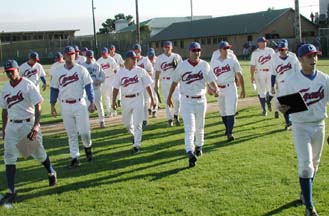 They
come to the Crabs because at 58 years it's the oldest semipro
baseball team in the country. They come because of the team's
winning tradition (The Crabs have had an annual winning percentage
of about .750 for at least 50 years, said Ned Barsuglia, 82,
current scout for the Crabs.) Many players come on the advice
of their college coaches. They
come to the Crabs because at 58 years it's the oldest semipro
baseball team in the country. They come because of the team's
winning tradition (The Crabs have had an annual winning percentage
of about .750 for at least 50 years, said Ned Barsuglia, 82,
current scout for the Crabs.) Many players come on the advice
of their college coaches.
"Their coaches know of
our program, they know it's quality or they wouldn't send the
kids year in and year out," said Ken "Shorty"
Ames, a former minor leaguer and coach of the Crabs for the past
seven years.
Because most of the players
hail from Division I NCAA programs, they are ready to play when
they arrive in Arcata, Ames said.
"You don't want to change
them," he said. "You want to nurture them and help
them with the mental part of the game."
About a third of the team is
drawn from local talent. And about the same number will be invited
to return for another season, according to Ames.
Every kid who comes to the Crabs
gets his share of innings, Ames said.
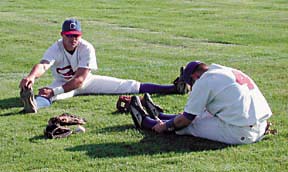 Third
baseman Chad Kinyon came to the Crabs from Lima, Ohio. It was
his first trip to California. He traveled farther than any of
his teammates to play here. They call him "the flatlander"
because there are no mountains in Ohio. The Arcata summer lacks
the humidity of Ohio, and there are probably not as many people
wearing dreadlocks back home in Lima. But his dad lives in Humboldt
County, so the 21-year-old has family to play in front of. Third
baseman Chad Kinyon came to the Crabs from Lima, Ohio. It was
his first trip to California. He traveled farther than any of
his teammates to play here. They call him "the flatlander"
because there are no mountains in Ohio. The Arcata summer lacks
the humidity of Ohio, and there are probably not as many people
wearing dreadlocks back home in Lima. But his dad lives in Humboldt
County, so the 21-year-old has family to play in front of.
Kinyon plays for Kent State.
He has played summer baseball for the Lima Locos semipro team
in the Great Lakes League but hopes to return to the Crabs next
year, unless of course he is drafted by a major league team.
It's every player's goal to
make it to the big leagues. Ask any of the Crabs players and
they'll tell you that is why they play summer baseball. "They
wouldn't be competing at this level" if they didn't dream
of getting to the major leagues, said catcher Brandon Marcelli.
Semipro clubs are not affiliated
with any major league team and the players aren't paid. Minor
league teams are usually part of a major league team's farm system
and the players, who range from promising prospects in their
late teens to those who have had a number of years in the big
leagues, are paid professionals.
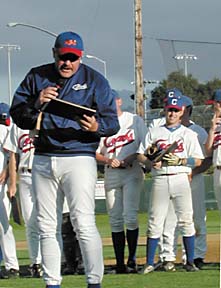 Left: Coach Ken "Shorty" Ames
presents the All-American Left: Coach Ken "Shorty" Ames
presents the All-American
Invitational MVP award to catcher Brandon Marcelli
Making it to
the 'Show'
Although it is a long way from
semipro baseball to the majors, some former Crabs players have
gone the distance. Dane Iorg, who was a pitcher and infielder
for the Crabs in 1968, played nine seasons in the majors. Iorg
made it twice to the World Series: with the St. Louis Cardinals
in 1982 and the Kansas City Royals in 1985. Pitcher Dennis Springer,
who won 11 games for the Crabs in 1986, threw for the Los Angeles
Dodgers last year. Mike Kinkade, a member of the 1993 Crabs,
played for the Baltimore Orioles last year; Mike Thurman, who
was also on the 1993 team, pitched for the Montreal Expos from
1997 to 2001; and catcher Mike Redmond, a Crabs player in the
early 1990s, played for the Florida Marlins in 1998.
From this year's Crabs' roster,
pitcher and outfielder Horace Lawrence III hopes to work out
with the Philadelphia Phillies single A team next year.
Pitcher and infielder Adam Carr, who just graduated from
high school, was drafted by the Toronto Blue Jays in the 41st
round but opted not to sign. He just left the Crabs to play in
an American Legion regional tournament in Sacramento, an event
watched closely by college and major league scouts alike.
"It's a good place to show
off his skills," Ames said. "Anytime a kid gets to
go and succeed at something that's OK by me. The experience of
going helps you grow."
Pitcher Gregg Reynolds grew
up in Arcata watching the Crabs. A student at the University
of Pacific in Stockton, he has come home this summer to play
baseball in front of family and friends. Donning the Crabs uniform
has a special meaning for him.
"It was weird putting the
uniform on the first time," he said. "It's like I finally
grew up."
Reynolds was invited back
to play for the Crabs next season, but his goal is to play
ball in another part of the country.
"But if that doesn't work
out I'd love to come back," he said.
Pitcher Leo Rosales has never
been away from Los Angeles for an entire summer before. A senior
at California State University Northridge, Rosales said he talks
to his family about once a week. Because of work and school schedules,
none of his family have been able to make the almost 600-mile
trip up to Arcata to see him play.
Rosales found the semipros to
be challenging.
"That's the good thing
about it, the quality teams," he said. "It makes you
a better pitcher."
When they leave for college,
many go with new insight, maturity and a sense of community.
Those perspectives come courtesy of Ames. His goal is to influence
the lives of his ballplayers.
Ames, who is of medium height,
was nicknamed Shorty when he was two weeks old. The name stuck.
"Everyone's called me that for 41 years," Ames said.
Ames keeps tabs on the players
during the collegiate season, which takes place in the spring.
He uses the Internet to follow their statistics. He'll talk to
coaches and on occasion the players will call him. Even though
the Crabs season only runs from June to August, Ames has developed
a special relationship with his players.
"They are all my kids.
All the kids that come to the park are mine," said Ames,
who is married but does not have children. "I like to think
I can influence the kids in a positive manner."
Always the
home team
With the three-month season
coming to a close Saturday, Kinyon, Reynolds, Rosales and the
other 24 players will add their names to a long list of athletes
who have played for the Crabs.
The Crabs are not like any baseball
team around. With the exception of the annual All-American Invitational
tournament, held in different locales each year, they play all
their regular season games at home. There are no deep pocket
benefactors to pay for players' travel expenses or buy equipment.
Even extra baseballs are hard to come by. (Foul balls are retrieved
by Crabs' volunteers and then used in the Crabs Summer Youth
Baseball Camp).
 Because
the players are still in college, the NCAA prevents them from
earning a living playing summer ball. But the Crabs help the
players find summer jobs and housing. Kinyon does maintenance
work at the Quality Inn. Other players work in restaurants, at
the Bayshore Mall or at any number of small businesses around
Arcata and Eureka. Some live in apartments, others like Rosales
stay at the Colony Inn. Because
the players are still in college, the NCAA prevents them from
earning a living playing summer ball. But the Crabs help the
players find summer jobs and housing. Kinyon does maintenance
work at the Quality Inn. Other players work in restaurants, at
the Bayshore Mall or at any number of small businesses around
Arcata and Eureka. Some live in apartments, others like Rosales
stay at the Colony Inn.
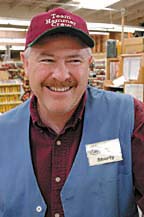
Even Ames [photo at left] ,
41, has to work during the Crabs' season. He's a manager at Pierson
Building Center. But unlike his players, he doesn't return to
college at the end of the season. He continues to work. Regardless,
he is a happy man in the summer.
"I get to be 20-years-old
for (three) months out of the year," he said.
The Crabs help opposing teams
with travel expenses; and the team pays for the uniforms and
travel expenses of the Humboldt All-Stars, a squad made up of
players who didn't make the Crabs.
This year the 22-member, all-volunteer
board of directors that has run the team since 1995 started a
new program to let Arcata families take a Crabs player out for
dinner. For the players, it helps take away the feeling of being
homesick, Ames said.
"It gives the community
a chance to treat these kids to a nice steak dinner," he
said. "It's another way (for the players) to get in touch
with the community."
Every year the Crabs' board
brainstorms on ideas to make the experience enjoyable for the
players, Ames said.
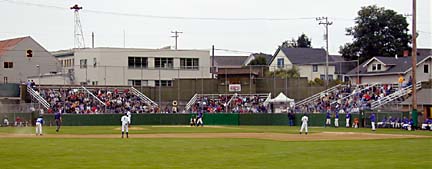
But what really sets the Crabs
apart from the rest of the field are the fans. Although the Arcata
Ball Park seats only about 500, it's more fans than many of the
Crabs players see at the college level.
"We are fortunate to have
fans to play in front of," Kinyon said. "It's crazy.
I don't know many summer ball (teams) that sell alcohol,"
he added, referring to the fact that beer is sold at Crabs' games.
 Marcelli,
who attends Fresno State, said fans in the Central Valley tend
to be of the fair weather variety. He estimates the Fresno State
team draws only about 50 fans a game. Marcelli,
who attends Fresno State, said fans in the Central Valley tend
to be of the fair weather variety. He estimates the Fresno State
team draws only about 50 fans a game.
"It doesn't compare to
(Arcata)," where the ball park is usually packed, he said.
Rosales also said he wasn't
used to fans turning out for games.
"(It's) nothing like compared
to here," he said. "(At Northridge) they're not into
it like the crowds here."
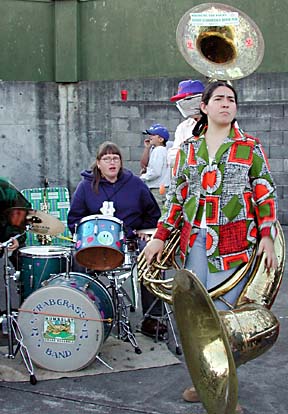
Another thing that sets the
Crabs apart from other semipro teams is the band: the "Crab
Grass" band. The group, formed in 1983, is made up of current
and former members of the Humboldt State University Marching
Lumberjacks as well as die-hard Crabs fans. [photo at right shows drummer Jesica Bishop and
sousaphone player Christina Velasquez.]
Ames said the Crabs are all
about community. He praised the support of the fans, the employers
who give jobs to the players and the people who buy ads in the
Crabs program. And he said the Crabs are an economic shot in
the arm to the community.
"We bring annually 16,000
to 20,000 people within one block from the center of town,"
Ames said, referring to a typical season's total attendance for
the 52-game regular season. "They stay here, eat
here and shop here," he said. "A legitimate amount
of revenue comes into this town. I hope the business owners understand
that."
Ames makes sure his players
also give back to the fans.
"I tell the players they
have to stick around and sign autographs," he said. "This
might be the best level of baseball kids see. These players are
heroes to the kids."
Kids often come out to the games
early asking to be the bat boy for a night.
Seeing the smiles on kids' faces,
seeing the bleachers filled with families and players seeing
their own parents in the stands makes the Humboldt Crabs a perennial
draw for college players from across the country, Ames said.
No World Series
This year's team has had its
share of ups and downs. In the third week of July, the team won
the All-American Invitational, held this year in Gresham,
Ore., a suburb of Portland. Many of the players say the Crabs
came together as a team during the tournament, the first time
the club has gone on the road since 1997.
The team won four straight games
to earn the title, including a come-from-behind victory over
the Gresham Kings in the first round and a final-round 5-4 triumph
over the Seattle Studs.
Reynolds said the competition
was very stiff. "We had our backs up against the wall, but
we played our best baseball."
For Ames winning the tournament
was a dream come true.
Ames is from Oregon and his
mom and sister came out to watch the Crabs play.
"My mom is still (my) biggest
fan," he said. "She spent a lot of years in the bleachers
watching her little boy. That's important to me."
The victory earned the Crabs
$6,000. It also gave them a berth at the National Baseball Congress
World Series in Wichita, Kan., the most prestigious tournament
for semipro teams. The tournament, in which 48 squads vie for
the top prize, also draws scouts from major league teams.
But scheduling conflicts and
the $30,000 cost to send the team to Wichita led the board to
make a painful decision. It voted not to send the team.
"It was a heart-wrenching
decision," said Carl Pellatz, president of the Crabs board
and the team's beer concession man.
 In order to
have gone to the tournament, which began on Sunday and runs to
Aug. 11, the Crabs would have had to cancel the last four games
of the season, breaking contracts with teams and disappointing
season ticket holders. The team also would have had to cancel
the final session of its youth baseball camp, a week-long intensive
held throughout the summer that costs $70 per kid. Additionally,
team officials are under a bit of financial pressure at the moment
-- they're trying to raise $47,000 to match a $325,000 city grant
for much needed repairs and upgrades to the venerable ballpark,
which has been built piecemeal since the 1870s. In order to
have gone to the tournament, which began on Sunday and runs to
Aug. 11, the Crabs would have had to cancel the last four games
of the season, breaking contracts with teams and disappointing
season ticket holders. The team also would have had to cancel
the final session of its youth baseball camp, a week-long intensive
held throughout the summer that costs $70 per kid. Additionally,
team officials are under a bit of financial pressure at the moment
-- they're trying to raise $47,000 to match a $325,000 city grant
for much needed repairs and upgrades to the venerable ballpark,
which has been built piecemeal since the 1870s.
"We did call to see if
the [opening] game [of the tournament] could be rescheduled,"
Pellatz said. "It's a definite blow that they won't be able
to go."
Making the decision even tougher
was the fact that the Crabs haven't been to the World Series
since 1985.
Back then transportation to
Wichita and hotel rooms for the players and coaching staff was
affordable, said Barsuglia. He said the team played games along
the way to Wichita to help offset the costs.
Barsuglia has been with the
Crabs for more than 50 years. In addition to his current job
as scout, he has served as board member, president and general
manager.
He recalls when teams could
go to Wichita for less than $15,000. This year it was expected
to cost the team just $18,000 for plane tickets and hotel rooms.
On top of everything else, the
first place prize money is only $15,000.
"It's a prestige to go
back there, but why go in the hole?" Barsuglia said. "For
$15,000, it's not worth it."
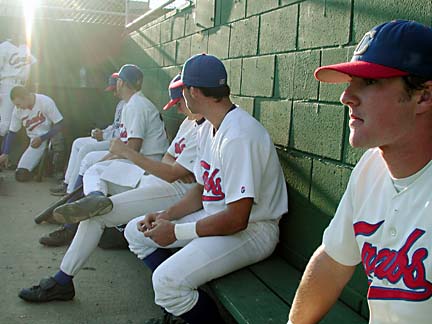 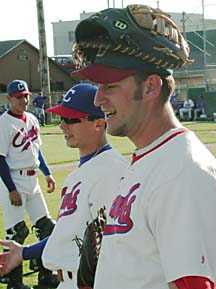
Left: Dan Evans, seated closest,
keeps an eye on the action during the Crabs game against the
Humboldt All-Stars.
Right: Nick Giacone hams it
up before a Crabs game.
Some of the players see it differently,
particularly those who were looking forward to the chance to
impress a major league scout. Kinyon, along with many of his
teammates, questioned why the Crabs board sent the team to the
All-American Invitational if they knew the team wouldn't be able
to go to Kansas.
Marcelli was even more blunt.
"It was pretty rough,"
he said "(I) had a hard time swallowing the story they gave
us."
Ames said the team knew if it
won the invitational it would get a spot in the World Series.
"We thought we'd cross
that bridge when we got to it," he said. "Maybe (Gresham)
was our Wichita."
Had the Crabs gone to Kansas,
Ames may not have been able to go because of his job with Pierson's.
Disappointment is not only part
of the game, it's part of life. That is the message Ames tries
to install in the players.
"Life's not fair all the
time," he said. "Baseball is a game; life is an experience."
One example of Ames' positive
influence was demonstrated at the All-American Invitational.
He said Seattle players yelled at the umpires and were not very
good sports.
"I [told the] kids to be
a class act. It doesn't do any good to be a jerk," Ames
said. "Hopefully they can take that home with them and pass
it along to another kid."
Happy with
the Crabs
 Ames
has been with the Crabs for 11 years, the first four years as
assistant coach. After that long a time, some coaches in semipro
baseball might consider moving on or retiring, but apparently
not Ames. He just signed his first two-year contract. Ames
has been with the Crabs for 11 years, the first four years as
assistant coach. After that long a time, some coaches in semipro
baseball might consider moving on or retiring, but apparently
not Ames. He just signed his first two-year contract.
Coaching the Crabs takes about
three months out of the year, Ames said. And at the end of each
season, Ames and his wife of 15 years, Leslie, sit down and evaluate
the past season.
"It's something we look
at every year," he said.
But Ames still feels he has
a debt to pay to baseball.
"There was someone there
for me when I was their age," he said. "I feel obligated
to give the experience back."
For a time, Ames lived
out almost every kid's dream. Within a few days after graduating
from high school in Oregon, Ames was playing in the minor leagues
for the Atlanta Braves organization. He spent almost five years
in Tennessee and Georgia, hoping to make it as a pitcher. He
even roomed with outfielder Brett Butler, an all-star who played
with the Atlanta Braves, San Francisco Giants and Los Angeles
Dodgers.
Although a shoulder injury ended
his career, Ames said he wouldn't trade the memories for a "bag
of gold."
The experience lets Ames not
only help his players develop their on-field skills, but also
their off-field attitudes.
Ames tells his players they
need to get their college degrees and they need to be active
not only in Arcata but in their own communities.
"On the field baseball
has to be No.1. But it's a different life off the field,"
he said. "If a kid has success in baseball it doesn't mean
`jack' if he's not successful in life."
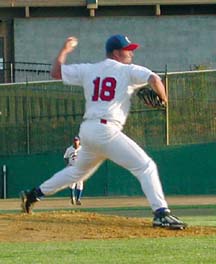
[Above left photo:
Donnie Bair winding up to throw another strike]
IN
THE NEWS | CALENDAR
Comments? E-mail the Journal: ncjour@northcoast.com
© Copyright 2002, North Coast Journal,
Inc.
|