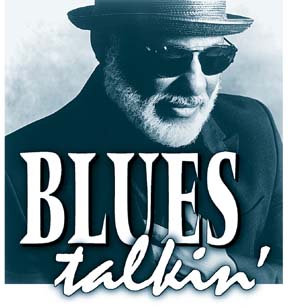
Some say the blues is a scale
with flattened thirds and sevenths or a 12-bar structure with a simple
chord progression. Others say it's a feeling, a way of life.
At Blues by the Bay Vol. 4,
the two-day event that takes place at Waterfront Park in Eureka this weekend,
you will hear the blues in many forms. Performers include several fiery
guitar slingers, a young singer from Colorado who mixes gospel, jazz and
reggae with her blues, a couple of bluesmen from Louisiana, a keyboard
player who's working on his blues doctorate, and one of the founding fathers
of raw Southern soul.
How do all of these disparate
styles fit together under the blues umbrella?
Mighty Mo Rodgers (photo at
top) is looking for the answer. His master's degree thesis at California
State University Northridge is titled "Blues as Metaphysical Music:
Its Musicality and Ontological Underpinnings."
"I got tired of blues
being put down as uneducated music created by illiterates," Rodgers
said in a call from Los Angeles. "I wanted to show that blues is a
profound music with spiritual ramifications and philosophical foundations.
"Blues is an existential
music. The foundation is freedom. Ironically it came from a people who
were not free. Blues takes in the totality of a people who came through
the Diaspora across the middle passage. People who lost everything: their
names, their religion, their gods.
"Blues came as a gift
from God to deny the lie of our nothingness. It came as an answer to the
question: Who am I? It wasn't merely a response to the brutality of slavery.
"Blues is what I call
the holy howl, the voice that says, `Remember me.' When Afro-Americans
invented the blues they did it to tell their story and all blues is a vernacular
text, as Henry Louis Gates talks about in Signifying Monkey. We
are an oral people as Alex Haley said in Roots, speaking of the
Griots in Africa. There's a straight line from the talking blues of the
'20s to hip hop."
Rodgers grew up in East Chicago,
Ind., near Gary. "It's a steel mill town. It's grimy and in bad shape
today, but in the '50s there were a lot of jobs."
In high school Rodgers played
music by Chuck Berry, Little Richard and Jerry Lee Lewis with the Rocketeers,
a rock 'n'roll band. He didn't last long in college and after dropping
out he took off for California to try to make it in the music world.
He joined a soul band that
ended up backing Brenton Wood, a singer who had a surprise hit with "The
Oogum Boogum Song." You can hear Rodgers' Farfisa organ on the follow
up, "Gimme Little Sign." In the '70s he went on to produce records
including an album called Sonny and Brownie by folk bluesmen Sonny
Terry and Brownie McGee.
Rodgers became a staff writer
for Motown but left in 1983. "Disco was in. Hollywood seemed stupid,
and I was tired of being part of a package where I didn't control my own
destiny, so I just quit." Instead of playing music he became a teacher.
Then in 1998 he put his own record together.
"I had all of these songs,
I had never stopped writing. Five years ago I started playing again, working
the songs up and touring. I went in the studio and took a year and a half
putting the record together, paying for it myself using credit cards. I
put it out on my own small label and looked around for distributorship.
I started getting these incredible reviews: Living Blues gave it
a great review, a French magazine raved."
Ultimately Blues Is My Wailing
Wall was picked up by Blue Thumb, a division of Universal which is
a division of Polygram now owned by Seagram LTD which just completed a
$34.4 billion merger with the French company, Vivendi.
"Music is a billion dollar
business in America and if you go into any club from Singapore to Stockholm,
you will find American-derived music. It could be rock 'n' roll, it could
be hip hop, it could be heavy metal, but it will be a form of the blues
text.
"It was a text first,
it was storytelling. It was a chant in the fields, it was call and response,
it was the song of the slave ships. It started as a text telling a story
and that's where it's going to end up."
Mighty Mo plays Sat.
July 8, 2:40 p.m.
![[photo of Joe Louis Walker]](cover0706-louis.jpeg) Joe Louis Walker plays his blues on a guitar.
It's music that goes back as far as he can remember.
Joe Louis Walker plays his blues on a guitar.
It's music that goes back as far as he can remember.
"When I was kid my mother
and father would play blues all of the time on the record player or the
radio," he recalled in a call from his home in Pittsburg, Calif. "I
liked it so I gravitated towards it. I had four cousins who were all musicians.
I hung out with them and when I got old enough I joined the family band."
Walker grew up in the Fillmore
District in San Francisco, but now he lives east of there in the Delta,
the Sacramento River Delta -- not the Mississippi. At 19 he was living
in an apartment in San Francisco when guitarist Mike Bloomfield moved in.
Bloomfield had left Chicago where he was part of the Butterfield Blues
Band.
"A lot of people would
come out from Chicago and stop over at the house, people like Carey Bell
and others."And through those Chicago connections Walker got wind
of an opening for a rhythm guitar player in the Otis Rush band and headed
east.
"I went out for a while
and played a little music, but I wasn't cut out for it, I wasn't a Chicago
kind of guy so I didn't stay long. At the time Chicago was pretty polarized
racially and I wasn't used to that, coming from the Haight-Ashbury and
the Fillmore District.
After returning to the West
Coast, Walker decided to take a respite from the destructive lifestyle
of the blues. When he was younger he sang in church and he found solace
in the music. For 10 years he performed with the Spiritual Corinthians,
a traditional gospel group.
"Gospel and blues are
like cousins, just like the blues and jazz are cousins. It's all roots,
different branches of the same tree."
In 1985 Walker was invited
to join the Mississippi Delta Blues Band. A promoter used the name for
a group assembled annually for a European tour.
"He would get different
musicians to be the front man: Sam Myers was out front for quite awhile,
then a friend of mine, Cool Papa. I went with my friend Eddie Ray; we were
out front one year.
"I'd been playing gospel
for 10 years and I'd stopped playing blues. I'm sort of a restless musician
and I was ready for something new. I actually went over to Europe to get
some money to make a demo to send out to the record companies. I did that
and got a recording contract."
The album, Cold as the Night,
was released on High Tone Records.
"It was a mix of everything
I'd done before: playing with my cousins, living with Bloomfield, playing
with gospel groups and soul groups, playing with fusion groups.
"I'm not a pure 1-4-5
24/7 blues guy, I'm a combination of a lot of things. The best way I heard
it put, was by my ex-ex-ex-old lady. She said, `You know you're all over
the f-ing place.' And that's exactly what I am -- all over the place."
Fans and critics have lauded
his forays into different styles: Great Guitars paired Walker with
an all-star collection of bluesmen, and on Preacher and the President
he worked in Muscle Shoals with Stax/Volt soul man Steve Cropper. His
latest, Silvertone Blues is a rootsy acoustic collection.
"It's the only straight-up
blues record I ever did. There ain't no funk on there, no soul, nothing
but blues."
Silvertone finds Walker working with Alvin Youngblood Hart.
The two bluesmen met years ago when Hart was working in a guitar repair
shop.
"We'd have a lot of fun
because we both play like 10 instruments. I'd do these acoustic shows sometimes
at the Freight and Salvage in Berkeley and he'd come down and play. We
got to be good friends. I told him if I ever did an acoustic album I'd
let him know. It finally happened."
Joe Louis Walker plays
Sat., July 8, 4:20 p.m.
![[photo of Alvin Youngblood Hart]](cover0706-hart.jpeg) Alvin Youngblood Hart, blues guitarist, singer and songwriter, is a second generation
country bluesman who started with the folk blues of artists like Leadbelly
and mixed in ideas and influences from all over the map. He was raised
in the Bay Area but he grew to love the rural blues he heard on regular
visits to the South.
Alvin Youngblood Hart, blues guitarist, singer and songwriter, is a second generation
country bluesman who started with the folk blues of artists like Leadbelly
and mixed in ideas and influences from all over the map. He was raised
in the Bay Area but he grew to love the rural blues he heard on regular
visits to the South.
"I'd go visit my grandma
in Mississippi in the middle of nowhere and I'd see people living the lifestyle
of 100 years ago," he said during a phone interview from his home
in Memphis, Tenn. "The music was just part of that, a thread I could
bring forward."
While his debut, Big Mama's
Door, established him as a master of the acoustic Delta blues, his
1998 release, Territory, was completely different, an eclectic set
that shifted from Bob Wills-style Texas swing to classic blues, through
an electric Capt. Beefheart cover, back to the blues and into ska. On his
latest, Start with the Soul, released just a month ago, he works
with a rock combo.
"That's one way to keep
enjoying music. It's like food, you keep it varied. I don't concentrate
on trying to stick to any tradition. I just try to sing and play well."
Hart will sit in for part of
Walker's set Sunday; what they will do is still up in the air. "I
know we'll have some fun and cut loose," said Walker. "I have
to see what he wants to do. And Alvin loves to do the opposite of what
he is expected to do."
Alvin Youngblood Hart
is special guest of Joe Jois Walker and plays Sat., July 8, 4:20 p.m.
![[photo of Tommy Castro]](cover0706-castro.jpeg) Tommy Castro
says his music is a mixture of blues,
soul and rock and roll. "My influences include traditional blues,
soul music, those classic Stax things. My favorite stuff is that post-war
Chicago blues, and the swing blues of T-Bone Walker, Big Joe Turner and
Ray Charles -- all that stuff that happened a long long time ago,"
said Castro in a call from his home in the Bay Area.
Tommy Castro
says his music is a mixture of blues,
soul and rock and roll. "My influences include traditional blues,
soul music, those classic Stax things. My favorite stuff is that post-war
Chicago blues, and the swing blues of T-Bone Walker, Big Joe Turner and
Ray Charles -- all that stuff that happened a long long time ago,"
said Castro in a call from his home in the Bay Area.
"But I'm not a guy who
grew up in 1945 in Chicago. I was raised on rock and roll in the '60s so
I've also been influenced by the Rolling Stones and by James Brown. All
those things mesh together and it comes out sounding like me."
Castro worked his way up in
the Bay Area blues scene, sat in on jams in the South Bay then moved to
the city and started a band. A taut sound and relentless club gigs quickly
earned his group a rep as the best bar band in town and he knew it was
time for the next step.
"From the start I knew
what I wanted to do, I wanted to make good records. I wanted to get the
band on the road and tour the world. We wanted to go as far with it as
possible."
Asked his opinion on where
the blues is going, Castro hesitates. "I guess I think it's none of
my business where the hell the blues goes," he says with a laugh.
"I'll write songs that
come from my own experience for the most part so that it comes from a real
place, from the heart. It's just basic and to the point. I think that's
what the blues is all about."
Tommy Castro plays Sun.
July 9, 3:50 p.m.
![[photo of Nina Storey]](cover0706-storey.jpeg) Nina Storey
is at home in Boulder, Colo., taking
a break from the road, "doing a zillion things that are not as glamorous
as performing, but plugging away, pushing the cause." The cause includes
promoting her third solo album, Shades, by hitting the festival
and club circuits.
Nina Storey
is at home in Boulder, Colo., taking
a break from the road, "doing a zillion things that are not as glamorous
as performing, but plugging away, pushing the cause." The cause includes
promoting her third solo album, Shades, by hitting the festival
and club circuits.
At 26, Storey has already been
working for more than a decade. She started singing R & B professionally
at the age of 15.
"I listened to a lot of
music growing up so I developed my own style based on music I'd heard like
Stevie Wonder, Billie Holiday and Billy Joel, so it was a bizarre mix.
"I've always been drawn
to music that has compassion and soul, music with some sort of truth behind
it. Blues was something that I connected with sooner than with any other
type of music. I was always going towards the bluesy soulful vein."
Storey plays at a lot of blues
festivals, but she also performed at the Lilith Fair and was the final
performer at Woodstock. But is she a blues singer?
"I tend to flip-flop when
I'm asked that question. Blues is a major component of what I do, and I
think it's inherent to my songwriting. But it depends on what you think
the word means. I think the blues is about passion and that you don't necessarily
have to be heartbroken to feel something painful or to express something
that transcends your being.
"I feel blessed that I
can play to a group of high school kids, play the same thing at a blues
festival, or a biker bar in the middle of God-knows-where, perform for
my grandmother's friends who are in their 70s and 80s, and have this incredible
warm wonderful response from all of them. For me that's the ultimate compliment."
Nina Storey plays Sun.
July 9, 1:10 p.m.
Cathy Lemons is from
Dallas, Texas but today she calls San Francisco home. Before moving west
she played with Anson Funderburgh and Stevie Ray Vaughan. After relocating
she landed a job with harp player Mark Hummel and toured for several years
with boogie man John Lee Hooker.
For the last decade she has
led her own bands and last year she released her debut album, Dark Roads,
on the Saloon label. She put it together with her longtime partner and
bassist Johnny Ace who was part of Boz Scaggs' band when he played at the
Muni. Steve Freund, Rusty Zinn and Tommy Castro all contributed guitar
licks. And the word is Zinn, who turned in a smokin' set at Blues by the
Bay Vol. 2, will come along to lend a hand.
   days
at the festival will feature a taste of Louisiana. Each day before the
headliner takes the stage there will be an electrified New Orleans-style
second-line parade led by "Dr." Richard Ross and the latest incarnation
of his Soul Twisters. Percussionists Danny Montgomery and Ed Campbell,.
bassist Ken Lawrence and horn players Randy Carrico, Julie Froblem and
Sam Maez and will join the doctor playing the music of New Orleans legends
like Professor Longhair, the Meters, the Wild Tchoupitoulas and Fats Domino.
Cathy Lemons Blues Band
plays Sat. July 8, 1:10 p.m.
![[photo of Tab Benoit]](cover0706-benoit.jpeg) Tab Benoit
is from Houma, Louisiana, a small
town in the bayous. He grew up listening to Cajun music and zydeco, but
instead of learning accordion he took up guitar. In traditional Cajun music
the guitar seldom takes the lead, and at first he was content to play rhythm.
But when he heard the music of John Lee Hooker and B. B. King, he found
the sound he was looking for -- the blues.
Tab Benoit
is from Houma, Louisiana, a small
town in the bayous. He grew up listening to Cajun music and zydeco, but
instead of learning accordion he took up guitar. In traditional Cajun music
the guitar seldom takes the lead, and at first he was content to play rhythm.
But when he heard the music of John Lee Hooker and B. B. King, he found
the sound he was looking for -- the blues.
These Blues Are Mine is his fourth album and his first for the Vanguard
label. It demonstrates his stripped-down style and shows the range of his
influences. Originals like "Crawfishin' and "Bayou Boogie"
are mixed with covers of Hank Williams' "Jambalaya," Willie Dixon's
"29 Ways," an acoustic take on Memphis Slim's "Mother Earth"
and several instrumentals by his prime inspiration, Albert Collins, the
Texas bluesman known as the "Master of the Telecaster."
Tab Benoit plays Sat.,
July 8, 3:50 p.m.
![[photo of Walter Washington]](cover0706-washington.jpeg) Walter Washington, a.k.a. "Wolfman,"
is another Louisiana native; born and raised in the Garden District in
New Orleans. In a call from the Big Easy, he said that a deejay, Poppa
Stoppa, deserves the credit for his early music education.
Walter Washington, a.k.a. "Wolfman,"
is another Louisiana native; born and raised in the Garden District in
New Orleans. In a call from the Big Easy, he said that a deejay, Poppa
Stoppa, deserves the credit for his early music education.
"He was on WBOK, the only
station at the time that played rhythm and blues. He's play Bobby Blue
Bland, Little Willie John, B.B. King, all those cats along with spirituals."
His own music career began
in the choir of the New Hall Missionary Baptist Church.
"My momma and my auntie
encouraged me and my cousin, Ernie K-Doe, to sing in the choir because
we always liked to sing.
"Nobody had a guitar or
knew how to play music at the time, so I took it on my own to play guitar.
I made my first one out of a cigar box, a clothes hanger and some rubber
bands. Then an old man we called Uncle Davie, he bought me my first acoustic
guitar. My cousin, K-Doe, bought me my first electric. He had some money
from making that record `Mother-in-Law.'"
Washington went on the road
for the first time with Lee Dorsey, another New Orleans singer who scored
a couple of national hits, "Ride Your Pony" and "Workin'
in a Coal Mine." After two and a half years he came back to New Orleans
and landed a job with Irma Thomas, mostly touring on weekends which allowed
him to play around town during the week and establish a reputation. He
joined with Dorsey's bass player to form an R&B band called the A.F.B.'s.
Washington says there's a difference
between blues and rhythm and blues. "Blues gives you the foundation,
R&B is the body and funk, well that's the mind."
His band, The Roadmasters,
came together 15 years ago. Back home they number as many as 10, but on
the road the band includes seven: Washington on guitar, a two-piece rhythm
section, keyboards and three horns.
Walter Wolfman Washing
and the Roadmasters play Sun. July 9, 2:40 p.m.
![[photo of Wilson Pickett]](cover0706-pickett.jpeg) Wilson Pickett, soul music legend, closes the show Sunday night. He's the man
behind "In the Midnight Hour," "634-5789," "Mustang
Sally" and "Land of 1,000 Dances."
Wilson Pickett, soul music legend, closes the show Sunday night. He's the man
behind "In the Midnight Hour," "634-5789," "Mustang
Sally" and "Land of 1,000 Dances."
Pickett got his start singing
in Baptist choirs in his hometown, Prattville, Ala., and on the streets
of Detroit, where his family moved when he was a teenager. After working
for four years with the gospel-harmony group, the Violinaires, he hit the
national airwaves in 1962 singing "I Found a Love" with The Falcons,
an R&B group that also included Eddie Floyd. Pickett soon ventured
forth on his own, signed with Atlantic Records and eventually hit his stride
working at the Stax/Volt studios.
"In the Midnight Hour,"
recorded in 1965, topped the R&B charts, broke into the top 40 on the
pop chart, and inspired musicians across the country. Wolfman Jack adopted
it as his theme song, all bar bands included it in their repertoire and
dozens of acts recorded cover versions.
In 1991 Pickett was inducted
into the Rock and Roll Hall of Fame, but he was almost invisible during
the '90s. He says he basically just stayed home. He resurfaced in 1998,
pulled out of retirement by Dan Aykroyd for the movie Blues Brothers
2000 where he sang "634-5789" with Eddie Floyd and Johnny
Lang.
But Pickett is not merely an
oldies act, as evidenced by his showing this year in the Blues Foundation's
W.C. Handy Awards, the blues equivalent of the Grammys or Oscars.
Pickett's 1999 release, It's
Harder Now, his first in over a decade, was selected "Comeback
Blues Album of the Year" and "Soul/Blues Album of the Year."
And "Wicked" Wilson Pickett was chosen "Soul/Blues Artist
of the Year."
Wilson Pickett plays
Sun. July 9, 4:20 p.m.
© Copyright 2000, North Coast Journal, Inc.