|
 
IN
THE NEWS | CALENDAR
by ARNO HOLSCHUH
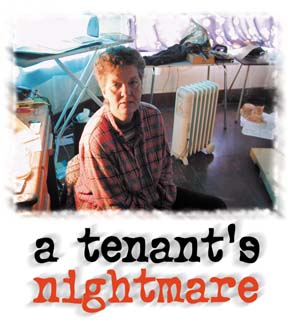
MALLOY CHAPELLE [photo above] WISHES
she'd never seen the apartment, or ever heard of Floyd Squires
III.
When Squires, her prospective
landlord, showed her the second-floor walkup in an old Victorian
in midtown Eureka last summer, she thought it was reasonably
cute if you could look beyond the empty Jack Daniels bottles
the former tenant had left scattered around the floor.
But her enthusiasm for the place
and her relationship with Squires quickly soured. Simple maintenance
issues blossomed into a court battle and ultimately an eviction.
What's more, she believes she may have been exposed to potentially
lethal carbon monoxide fumes for most of the winter.
These days, Chapelle's possessions
are in storage. She's living week-to-week in a run-down motel,
just one step away from homelessness. She sits on her unmade
bed, watching TV or looking out at the traffic droning along
101.
How did Chapelle get from that
Victorian flat in the 1800 block of C Street to the motel? The
answer has to do, in part, with the landlord, Squires.
Squires rents to a lot of people
-- he owns 24 rental properties in Eureka, each subdivided into
several individual units. Almost all the rentals are low-income,
and many have been found to be in violation of basic housing
standards at some point over the last 10 years.
In a way, Squires is providing
a public service. He rents to people that others tend to shy
away from, keeping marginal tenants off the street. Of course,
in some of his properties you have to be willing to put up with
leaky roofs, roaches, fire hazards, exposed wiring, rotting stairs,
busted windows, defective plumbing, faulty heaters or no heat
at all. If you can think of a problem, one of Squires' properties
has probably had it.
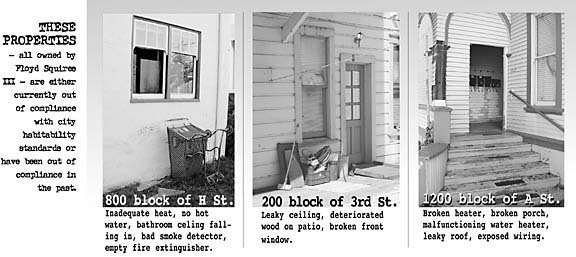
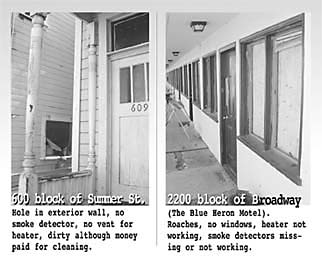
Descriptions are from City of Eureka
Building Department files.
Several of Squires' tenants
have complained to the authorities about the condition of their
apartments, and some have been evicted soon after. Strictly speaking,
kicking someone out because they complained -- called "retaliatory
eviction" -- is illegal under California law. But Squires,
who did not return several calls for this report, does well in
court. Few tenants have won against him when fighting evictions.
Squires knows the system. With
around 20 years of experience under his belt as a landlord, he
has frequently avoided timely repairs without being financially
penalized. Enforcement of building codes on his properties eats
up an immense amount of city resources but the violations continue.
A tenant's rights advocate put
it bluntly: "He provides unsafe housing."
"I moved in during the
summer of 2001 and everything was OK," Chapelle said. Sure,
there were some issues -- the steps leading to her door were
in need of repair, and there was a leak under the sink.
But they were issues that Malloy
Chapelle [in photo below
left] was by and large willing
to work around.
![[Photo of Malloy Chapelle]](cover0425-chapelle.jpg) That
worked until last November when the Eureka winter started to
fasten its cold, wet grip on the building. "When it got
cold, we [in the building] started to have problems." That
worked until last November when the Eureka winter started to
fasten its cold, wet grip on the building. "When it got
cold, we [in the building] started to have problems."
She learned that the family
living below her wasn't using their heater--the Eureka Building
Department would later confirm that the heater didn't work properly.
They tried using space heaters, but the excessive electricity
use would trip the circuit breakers. That was a chance they couldn't
take, because the fuse box was locked in the garage.
And when she started talking
to the other tenants, she found out about other problems. There
was exposed wiring, a dripping ceiling and some leaky plumbing.
To Chapelle, however, the most glaring problem was the lack of
a functional heater downstairs.
"They were down there with
no heat in the middle of winter," Chapelle said. When she
saw the family's children bundled in jackets against the cold,
she took it upon herself to do something.
Chapelle was uncertain about
what her rights under the law were, or how to best pursue them.
So she called the number she had found on a flier from the Tenants
Union of Humboldt County, a renters' rights group.
A woman named Sarah Sherburn-Zimmer
[in photo below right]
answered the phone and suggested
they hold a meeting with all the tenants in the building so that
they could present Squires with a united front.
"I went and met with her
and everyone in the building on Nov. 28," Sherburn-Zimmer
said. She was shocked at what she found; not just at the number
of problems, but at the tenants' attitudes about their landlord.
"Everyone was really afraid,"
she said. They were living in substandard conditions but didn't
know what to do about it.
![[photo of Sarah Sherburn-Zinner]](cover0425-sarahS-Z.jpg) Sherburn-Zimmer
suggested they try to make the situation work with Squires. After
deciding what the most urgent repairs were, a letter was written
Dec. 11, civil but firm in tone. It was signed by tenants living
in five units in the building. Squires was reminded of his legal
duty to maintain his rental properties to certain minimum standards
of habitability, and told exactly what needed to be done. The
tenants needed access to their fuse box; faulty heaters needed
to be replaced in two units; the roof needed to be fixed. A timeframe
of seven days was suggested for Squires to meet with tenants
and discuss the repairs. Sherburn-Zimmer
suggested they try to make the situation work with Squires. After
deciding what the most urgent repairs were, a letter was written
Dec. 11, civil but firm in tone. It was signed by tenants living
in five units in the building. Squires was reminded of his legal
duty to maintain his rental properties to certain minimum standards
of habitability, and told exactly what needed to be done. The
tenants needed access to their fuse box; faulty heaters needed
to be replaced in two units; the roof needed to be fixed. A timeframe
of seven days was suggested for Squires to meet with tenants
and discuss the repairs.
Seven days passed and nothing
happened; no repairs were made. Christmas came and went, as did
New Year's, with no action. In early January, Chapelle decided
it was time to take a new tack.
This time she didn't write a
letter or contact Squires directly. Instead, she called the building
department. Her Jan. 7 call brought a building inspector to the
house the next day. He was treated to a guided tour of the building
by Chapelle and uncovered 15 violations of building codes.
The Eureka Building Department
sent a letter Jan. 10 advising Squires that the house was considered
to be a public nuisance and he needed to take out building permits
for the repairs within five days.
Floyd Squires is well-known
in the Eureka Building Department. The landlord has frequently
run afoul of the department over the last 10 years, accumulating
a stack of correspondence more than a foot thick. Often, violations
are found but no building permit is taken out for the repair,
making a second notice necessary. More than once, the city threatened
to file civil suits against him to force him to make repairs.
Squires maintains he's a responsible
landlord. In a letter dated Dec. 23, 1997, he said that he tries
"very hard to keep our properties in excellent condition."
The blame, Floyd maintains, rests with the tenants.
When informed in September 1997
that one of his buildings was out of compliance -- roaches, broken
windows, rotted flooring and "general dilapidation"
were cited -- he responded that, "It is not dilapidation.
It is TENANT ABUSE."
"Unfortunately," the
letter explains, "I rented to [the tenants] without fully
checking their references, and after I did find out about how
[they] had destroyed prior apartments, I served [them] with an
eviction notice. So they started tearing up my apartment."
The letter even says that there
were no insects in the apartment aside from those collected by
the tenants.
The pattern appears frequently
in his files: One letter from Squires states that tenants who
had complained about their lack of electricity were actually
stealing his electricity. Another letter claims a tenant who
had complained about lack of heating was in reality breaking
out windows and tearing the building apart. Another tenant, this
one with a leaky roof, was really just "out to cause me
problems." In another building with the same problem, the
tenant was simply "lying," Squires writes, and was
being held on $125,000 bail. A tenant brazen enough to ask for
a functioning toilet and heater, "is on her way back to
State Prison for drugs."
After dismissing the tenants
as delusional, Squires then often goes on to directly contradict
the results of the building department's inspection. Take a July
2001 inspection that revealed that one of Squires' properties
had a heater with a faulty thermostat.
Squires' response? "There
is only one heater and it works fine. There is no problem with
the thermostat."
Such a response "doesn't
stop our processes," said Eureka building official Mike
Knight. "Floyd has to find a way to make those repairs."
Knight said building inspectors
have the same procedure, no matter who the landlord is: After
getting a complaint, they conduct an inspection, document any
violations, notify the landlord and try to bring him or her into
compliance with the law.
In the case of Squires, it has
not been unusual for him to take months to respond to violation
notices from city hall. Nonetheless, Knight said that the process
has often worked with Squires. "Floyd may not always react
in the timeframes the tenants would want and perhaps not as quick
as I would like to see, but he has been reasonably responsive
to phone calls and letters."
And while a number of his buildings
appear dilapidated, Squires does eventually do repairs -- particularly
when threatened with a lawsuit.
Others in the Eureka city government
were more critical than Knight. Attorney Brad Fuller said that
in the four years he has had his job, he has seen "a hugely
disproportionate amount of time spent on Floyd Squires and his
properties."
"He wouldn't keep coming
to the top of my pile with requests for last-chance notices and
possible filings of complaints in court for being a public nuisance
if he wasn't doing something wrong. It happens way too much."
The city of Eureka, Fuller explained,
has a "complaint-driven, compliance-oriented" code
enforcement program. Inspections only happen when there are complaints,
and the enforcement measures are designed to move a landlord
toward compliance, not penalize him. The system works well most
of the time. It's only occasionally, as in the case of Squires,
that it falters, Fuller said.
"And I don't know what
kind of system would work perfectly," Fuller added.
"We continue to search
for the tool to convince him to maintain his properties,"
Fuller continued. One option, he said, would be for the city
to sue Squires for using unfair business practices.
"The law is against anyone
who knowingly violates the law in order to gain an unfair advantage
over his competitors," Fuller said. If Squires skirts the
law while other landlords comply with legally required maintenance
on their property, he might be legally vulnerable, Fuller said.
"I think this is something
that should be considered with someone like Floyd Squires."
"So on Jan. 8, after the
inspector came, I found a red notice on my door," Chapelle
said. She was behind on her rent, it said, and needed to get
in touch with her landlord.
Chapelle knew she owed Squires
money. When she moved in, she didn't have enough cash for a security
deposit. She said Squires agreed to let her pay it at a later
date.
So she called Squires' home
and talked to his wife, Betty. Chapelle said she was told she
should not have involved herself in the affairs of other tenants
-- specifically the family below.
"I said it was my business
as a human being to get involved when I see little kids bundled
against the cold," Chapelle said. "I told her I had
been the one who called the building department."
The next day she received a
notice to pay the money Squires said she owed him -- $600 --
or get out.
She tried to make arrangements
to pay Squires. "I talked to him the next day and he said
he didn't want the money. He wanted his property back."
In the meantime, repairs were
begun on the building. Squires worked on the leaky roof and fixed
the heaters in two of the apartments. The most urgent problems
were dealt with.
But the eviction proceedings
against Chapelle continued.
Retaliatory eviction is illegal
under state law, but it happens all the time, said Jan Turner
[in photo below left] , staff attorney with Legal Services of Northern
California. Her group represents the poor and the elderly, and
she's seen lots of retaliatory evictions by landlords who never
get caught.
![[photo of Jan Turner]](cover0425-Turner.jpg) "If
a tenant has complained or exercised his or her legal rights,
the landlord is not supposed to be able to evict without good
cause," she said. "That section is violated extremely
frequently." "If
a tenant has complained or exercised his or her legal rights,
the landlord is not supposed to be able to evict without good
cause," she said. "That section is violated extremely
frequently."
Sherburn-Zimmer said landlords
act with relative impunity because they are better equipped for
a court battle.
"From all the renters I
have talked to, I have gotten the impression that judges are
more likely to believe a landlord. That's especially true when
you have a well-dressed landlord against a not-so-well spoken
tenant who can be pretty chaotic."
"Going to court hasn't
been very productive for most tenants," Sherburn-Zimmer
admitted. That is especially the case with Squires' tenants,
she said, who tend to be easy to best in court. She said that's
partly because they are usually living on the margins of poverty
and are too poor to afford an attorney; and also because some
of them suffer from a mental disability -- like Chapelle, who
is on permanent disability insurance for post-traumatic stress
disorder. Six other tenants interviewed were on disability insurance,
two of them for mental illness.
Chapelle lost her fight against
eviction. During the Jan. 31 court proceeding, Squires convinced
the judge that he had acted in good faith. Chapelle wasn't an
activist, he maintained, but a mentally ill drug addict who wouldn't
pay her rent. A week later Chapelle was told to get out.
By that time, there was another
reason for her to leave the apartment.
Throughout the winter, Chapelle
had been getting headaches and feeling tired and out of sorts.
For a long time, Chapelle paid the symptoms no mind -- at least
she had heat.
Then a friend in another of
Squires' buildings told her about how his gas had been shut off
because of a faulty heater.
Chapelle called PG&E to
check out her own heater in early February. The inspector from
the gas company came out and found that there was indeed an improperly
vented floor furnace that could well be allowing carbon monoxide
fumes into her apartment.
Carbon monoxide leaks are no
joke. It's a building code violation where negligence can lead
to death. It's happened before.
In 1996, an improperly vented
water heater killed two young men. According to the County Coroner's
report, Chris Dixon, 17, and Clarence Lee Moore, 20, had apparently
left the hot water running so they could do the dishes at their
apartment in the 900 block of F Street. Moore was sitting on
the couch with the television on and Dixon was in the bed when
his parents came by to check up on him and found both men dead.
Dixon, who had only recently
moved out of his family home, had just gotten his high school
equivalency diploma and was showing an interest in computer programming.
"It was the kind of thing where we thought, OK, now he can
move out," the youth's father, Paul Dixon, recalled.
But the young man had unwittingly
moved into a bad situation -- very bad. When the fire department
showed up and tested the air for carbon monoxide, their meters
went off the scale. The level of the gas in the apartment's air
was enough to kill most people in less than an hour. When the
elder Dixon climbed into the apartment through an open window
to unlock the door from inside, he was immediately affected by
the gas, becoming disoriented and fumbling with the door knob.
The father, who supervises a
construction company and is familiar with building codes, places
the blame squarely on the landlord. In this case, that landlord
was Floyd Squires II -- father of Floyd Squires III, Chapelle's
landlord. [A wrongful death lawsuit was filed by Dixon's family.
The case was settled out of court.]
For Dixon, it's amazing that
problems with improperly vented heating appliances have cropped
up at the son's properties in the years following this tragedy.
"It's like he's just waiting
for another death to happen. What are they going to do then?"
Chapelle's eviction came not
long after she found out about the faulty heater. With nowhere
else to turn, she ended up at the motel.
Now she's worse off than she
was when she first started renting from Squires. An eviction
on anyone's record is a black eye when landlords are looking
at potential renters.
Making things more dire, she
recently lost her Section 8 housing assistance, which brought
in $283 a month. That leaves her with only a monthly $750 Social
Security disability insurance check. It is not clear why Chapelle
lost the Section 8 money; she plans to discuss the matter soon
with the Housing Authority for the city of Eureka. It is clear,
however, that after successfully evicting Chapelle, the Squires
wrote a letter to the Housing Authority requesting that Chapelle
be removed from public assistance.
"Some people are very deserving
and needy," the letter begins. It goes on to note that there
are a few bad apples -- like Malloy Chapelle.
The letter claims Chapelle failed
to pay rent, used drugs and disturbed the other tenants -- all
of which Chapelle denies. She was also a bad housekeeper, used
foul language and hung signs in her window declaring Floyd Squires
a "slum king," the letter said.
The city eventually could file
suit against Squires and the tenants union might organize his
renters, but that's not going to help Chapelle. She continues
to look for a place to live on her limited income, so far for
naught. If she faces one unexpected expense -- if her dog needs
to go to the vet or she needs to go to the doctor, for example
-- she fears she will be unable to make her week's rent and will
be thrown out of her bleak motel room.
It's all the more bitter because
she tried to work within the system, first by contacting Squires,
then the city, then by pleading her case in court.
For Chapelle, the message from
the system is quite clear.
"Everybody thinks I'm a
throw-away person," she said, slumped on her bed. "Unwanted."
IN
THE NEWS | CALENDAR
Comments? E-mail the Journal: ncjour@northcoast.com
© Copyright 2002, North Coast Journal,
Inc.
|