|
 
IN
THE NEWS | GARDEN | GOOD NEWS | CALENDAR
by KEITH EASTHOUSE
KEN IRWIN WAS GETTING TIRED.
He'd been out for about seven hours, watching birds. It was early
in the afternoon on a day in late August 2001. A group of greater
yellowlegs, a type of shorebird, was playing near the mouth of
the Mad River. Irwin, an avid birder in his 50s, was thinking
it was time to knock off.
He'd looked at thousands of
yellowlegs over the years -- they're not rare in the Humboldt
Bay region -- and as always he was looking for one thing: a white
wedge-shaped patch running from the upper tail to the upper shoulders.
Yellowlegs don't have such a patch. That's precisely the point.
Irwin was searching for something he'd never seen before.
Three of the birds flew over
in his direction and, as Irwin would put it later, practically
"landed in my lap." They touched ground not all at
once, but one-two-three. Irwin quickly ascertained that the first
two were yellowlegs. As the third bird came down, though, Irwin
got "just a hint of white" before it folded its wings,
concealing its back.
Thinking "wait a minute,"
Irwin pulled out his binoculars. The legs were green, not yellow.
He looked at the bird's bill, in profile, and here was where
his obsession, all the reading and all the studying of photographs
and illustrations, paid off. He didn't need a field guide. The
picture was in his head. And what he was seeing right before
him, he was certain, was not the bill of a yellowlegs. It didn't
have a smooth arc on both the top and bottom edges; instead,
the top edge was at a bit of an angle.
"I was pretty sure at that
point," Irwin recalled. But he knew that such a subtle distinction
would not be enough; other birders would ask about the white
patch. So Irwin did what birders often do: He waited. After 20
minutes, all three birds began to separate their wings and preen,
and then Irwin had absolute proof -- the third bird was a bird
that wasn't supposed to be there. It should have been in Korea,
or somewhere on the other side of the Pacific. Instead, here
it was, a -- badly misnamed in this instance -- common greenshank.
Never before seen in the continental United States. And it had
found Ken Irwin, landed right smack in front of him as if to
say, "Look at me."
Seeking
the lost
Greenshanks had been seen in
Alaska and Canada before, so a sighting in the Lower 48 had "sort
of been anticipated," according to another local birder,
Tristan McKee. Nonetheless, Irwin's discovery was remarkable,
a "first-record," or "mega-rarity," to use
the lingo of birders.
 Just
like collectors of coins and baseball cards, birders prize uncommonness.
But the "valuable" birds are usually not rare in the
sense that they belong to a thinly populated species, or a species
that is on its way out; instead, they are simply birds that are
out of place, "vagrants," birders call them. "It's
a completely lost individual that are the trophy birds,"
said Rob Hewitt, one of the founding members of Godwit Days,
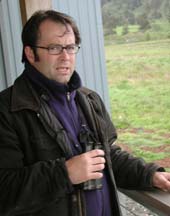
the local bird festival that takes place this weekend. [in photo at left] Just
like collectors of coins and baseball cards, birders prize uncommonness.
But the "valuable" birds are usually not rare in the
sense that they belong to a thinly populated species, or a species
that is on its way out; instead, they are simply birds that are
out of place, "vagrants," birders call them. "It's
a completely lost individual that are the trophy birds,"
said Rob Hewitt, one of the founding members of Godwit Days,
the local bird festival that takes place this weekend. [in photo at left]
Proof that birders value vagrants
came in the days immediately after Irwin's sighting, when hundreds
of birders from all over the country came to have a look at the
displaced avian milling about the gravel bars of the Mad. "It
stayed around for two weeks or more," Irwin said.
How did his greenshank get lost?
The most likely explanation is that this Asian bird simply overshot
its range and ended up summering in Alaska rather than Siberia.
When it came time to fly south for the winter, it joined flocks
of North American birds and flew down the Canadian coast and
eventually to the Humboldt seashore, where Irwin put it into
the record books. A greenshank was spotted last year as well,
at the Arcata Marsh. "Although I can't be absolutely certain,
I strongly suspect it's the same bird," said Irwin, who
went out and looked at it after he heard about the sighting.
"It's too much of a coincidence."
Another off-course bird that
created a stir not long ago was a black-capped petrel, sighted
off the California coast near Santa Barbara. That was surprising
because the species normally migrates up the Atlantic seaboard.
"It's basically a bird of the Gulf Stream," explained
McKee. "It had never been seen in the Pacific before."
McKee speculated that a hurricane had blown it west over Central
America.
An even more startling find
came in February 2001, six months before Irwin spotted the greenshank,
when a greater sand-plover was seen around Bolinas Lagoon in
Marin County. It's a central Asian bird, so the sighting initially
touched off a debate about whether the bird was being confused
with something else. Eventually, though, experts with the Pt.
Reyes Bird Observatory, an internationally recognized science
and conservation organization, determined through direct observation
and photographs that the bird was what it appeared to be.
"It was a big surprise,"
said McKee, a member of the California Bird Records Committee,
which reviews rare bird sightings for Western Field Ornithologists,
a bird society. "It's a bird that doesn't migrate over very
long distances, which is the biggest requirement for a vagrant."
Noting that the greater sand-plover had never before been seen
in North America, McKee said the tiny bird must have landed at
Bolinas Lagoon after flying over the Pacific.
Competitive
birds
It's feats like that which explain,
in part, Hewitt's love for birds. There are, of course, those
who feel birders should remain at a skeptical distance from their
subject so as to retain scientific objectivity. But to Hewitt
that can interfere with appreciating the creatures. "I often
say that birds are just little people," said Hewitt, who
owns LBJ Enterprises, a Eureka-based consulting firm that does
endangered bird surveys for the timber and gravel industries
and the U.S. Forest Service. "If you look at it from that
perspective, you get a sense for their doggedness. Take hummingbirds.
They fly here from Mexico on sugar water. You have to admire
the strategies [birds] adopt, their ability to survive."
Godwit Days celebrates the spring
migration and attracts birders from around the country. Named
for the marbled godwit, a sandpiper with cinnamon-lined wings
that is ubiquitous around Humboldt Bay in the spring, the event
is in its eighth year and runs from this Friday through Monday.
Among the activities: an ocean venture to see pelagic birds such
as the black-footed albatross, shearwaters, Cassin's auklet,
Sabine's gull and jaegers (gray whales, dolphins and seals are
also likely to be seen); a morning visit to Elk Prairie at Prairie
Creek Redwoods to see birds that frequent "edge habitat"
between meadow and old-growth redwood forest; a workshop on how
to recognize birds by ear; tours of local birding hotspots, like
the Arcata Marsh and the Humboldt Bay National Wildlife Refuge;
and much more.
One of the programs, the Humboldt
"Big Day" Field Trip, reveals something about birders
that does not fit with the popular stereotype of dottering nature
lovers: they are -- some of them at any rate -- competitive as
hell.
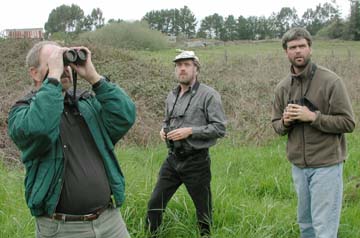
Birders Ron LeValley, Sean McAllister and David Fix.
The whole point of the trip,
an all-day bus tour of Humboldt's most popular birding spots,
is to identify as many different kinds of birds as possible.
David Fix and his wife, Jude Power, also a birder, are leading
Saturday's expedition. The record, Fix said, is 118, set a couple
of years ago.
Seems like a lot. But not compared
to what Fix and three other birders achieved on May 4, 1996,
a "big day" competition for Humboldt's most accomplished
birders. Actually, "day" is a bit of a misnomer, as
Fix, Power and two other local birders went on a midnight-to-midnight
dash up and down the county in search of as many different species
as they could find. The goal was simple: surpass renowned local
birder Ron LeValley's 24-hour record of 176 species, which had
stood for 13 years.
They were out on the North Jetty
at sunset when they tied the record, and they soon broke it when,
in the failing light, they saw a barn owl flushed off a fence
post in the Arcata Bottoms. They racked up two more later on,
when they heard the hoot of another type of owl and the call
of a Virginia rail.
There is no "big day"
scheduled for the expert birders this year, which is fine with
Fix. "I'm just puffing cigars. If someone breaks my record
I'll just take it right back."
While noting that there are
a number of accomplished female birders in Humboldt, like Power
and Brooke MacDonald, Hewitt admitted that the "hard-core
element is dominated by Type A males." Is Hewitt in that
category? Well, let's just say that he doesn't waste much time
telling you that he was one of the first people to see a ruby-throated
hummingbird in Humboldt County; or that he's got 502 species
on his "California list;" or that in England, where
he hails from, he saw a rare (for the British Isles) western
sandpiper, which he spotted as a young man in a mudflat in Essex.
Actually, Hewitt is more modest than he seems. It took some questioning
to elicit one of his major accomplishments: the first sighting
of a yellow wagtail in Humboldt, a songbird that is normally
found in Asia.
 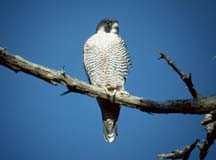
Left: Ron LeValley. Photo by Bob Doran
Right: Peregrine Falcon - Photo by Ron LeValley
Hewitt didn't say how many are
on his "life list," the list of how many birds he's
seen in his lifetime, but then we forgot to ask. Even though
he's only 38, the chances that he could break the all-time record
-- somewhere in the 6,000 to 7,000 range (there are about 10,000
known species in the world) are slim. Still, Hewitt is not likely
to quit trying. "If you become a serious birder," he
said, "you want to die with your binoculars in your hands."
Another
dimension
But there's more to birding
than simply racking up new species. As an example, consider how
Hewitt spent his time last Friday morning. He showed up at the
Humboldt Bay Wildlife Refuge south of Eureka 15 minutes early
for a rendezvous with some Irish birders as well as a couple
of members of the media. Parked at a pull-out not far from Highway
101, he could have sat in his Nissan Pathfinder and listened
to music, or the latest BBC broadcast on the Iraq war. Instead,
he opened his door and looked out at a blackberry bush, where
some blackbirds -- Brewer's blackbirds, to be precise -- were
going about their business. He observed one bird, obviously a
male, puffing himself up to get the attention of females. "I
observed courtship behavior," he explained doing a little
bird dance to demonstrate.
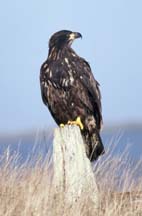 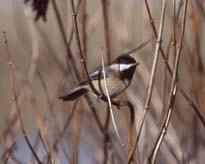 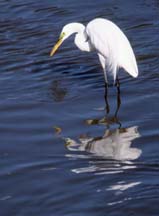
Left to right: Bald Eagle, Black-capped
Chickadee, Great Egret.
Photos by Ron LeValley
"So that's the dichotomy"
of birdwatching, Hewitt went on. "There's the pleasurable
experience of enjoying something beautiful and interesting compared
to getting your name in lights" by identifying as many bird
species as possible.
In other words, while birders
are a compulsive, competitive lot, they are also attuned to a
dimension that most people are unaware of. The world, to put
it another way, is enriched for them because of their knowledge
of birds.
Here's another example. When
McKee hikes through the woods in Humboldt, he is often struck
by the fact that, though distinctive, they are essentially an
overlap of forests far to the north and far to the south. Why
does he perceive them that way? Because he hears the rising zu-wee
and descending zoe zoo of Hutton's vireo, a bird found
in the Sierra Madre range of central and western Mexico; and,
on the same walk, hears the whistle and chuck of a gray jay,
a bird of the boreal forests of northern Canada.
Birdsong deepens things for
Fix as well. On a spring morning, he takes pleasure in attending
to the multiple bird voices. "I parse the morning chorus,"
is how he put it, explaining that the music "is different
almost everywhere you go" because of variations in the mix
of birds.
Given all this, it shouldn't
be surprising that most birders have a strong conservation ethic.
If the scale of logging and development in an area is extensive
enough, there is, in Fix's words, "a general trend toward
degradation and simplification of native habitat and vegetation."
That, in turn, has an impact on birds. "If you degrade and
simplify habitat, you degrade and simplify the suite of birds"
in a given location. "You lose the diversity."
Put another way, "If you
swap a forest for a Kmart parking lot, you're swapping screech
owls for Brewer's blackbirds."
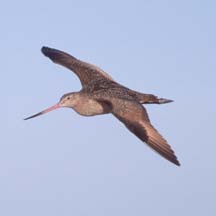 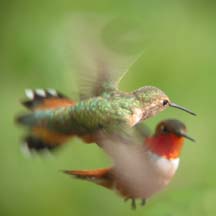
Left: Marbled Godwit. Right: Selasphorus
Hummingbirds.
Photos by Ron LeValley
IN
THE NEWS | GARDEN | GOOD NEWS | CALENDAR
Comments?
© Copyright 2003, North Coast Journal,
Inc.
|