|
 
Story & photos by BOB DORAN
AFTERNOONS IN THE TOURIST OFF-SEASON
ARE a quiet time in Ferndale. But not this year. Main Street
is bustling with activity. Another movie company has come to
"the Victorian Village."
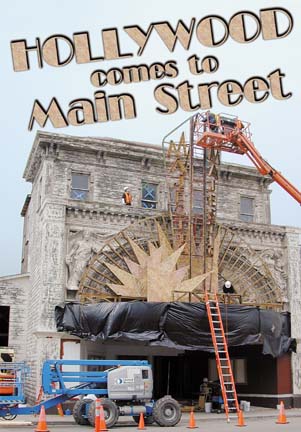
As men in hard hats put the
finishing touches on three buildings fabricated for a film called
The Majestic, Karen Pingitore, (In photo below) president
of the Ferndale Chamber of Commerce, is working with a video
crew shooting a TV commercial. Behind her, at the corner of Ocean
and Main, is the town hall, an imposing building with a clock
tower.
![[photo of Karen Pingitore]](cover0315-karen.jpg) Left:
Karen Pingitore and husband Carl, owners of the Ferndale Clothing
Co., have lived in Ferndale 11 years. Karen formerly worked in
Hollywood as head of post-production for Warner Bros. and Carl
worked in the industry for 42 years as a television and film
producer and editor. His credits include Dirty Harry and
Play Misty for Me. Left:
Karen Pingitore and husband Carl, owners of the Ferndale Clothing
Co., have lived in Ferndale 11 years. Karen formerly worked in
Hollywood as head of post-production for Warner Bros. and Carl
worked in the industry for 42 years as a television and film
producer and editor. His credits include Dirty Harry and
Play Misty for Me.
Wait a minute. Ferndale doesn't
have a town hall. Looking closely you see that this is one of
the sets under construction. The clock that goes in the tower
has just arrived on a fork lift. Hollywood masons on one side
of the building are troweling faux cement, crafting an imaginary
basement. On the other side a painter dabs red paint creating
a brick effect that completes the illusion.
The three-story building completely
envelops U.S. Bank. The bank's parking lot is undergoing its
own transformation. A crew unloads several kinds of trees creating
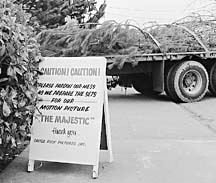
a city park on top of the asphalt. Out front a sandwich-board
sign informs the public that the bank is still open for business.
Below left: Shayne
McLaughlin from Los Angeles unloads town hall's clock and at
right,
James Evenson from Fortuna paints bricks.![[photo of James Evenson painting]](cover0315-paint.jpg)
![[photo of Shayne McLaughlin with clock]](cover0315-clock.jpg)
The sign was created by Castle Rock, the film production
company that's transforming Ferndale into a small coastal town
called Lawson. Besides supplying similar signs for every business
along Main, the folks from Hollywood are funding an advertising
campaign and the TV commercial is part of it. A print ad in the
Ferndale Enterprise reads, "Hollywood hasn't gone
to our heads! It's still business as usual in Ferndale's unique
shops and restaurants."
This isn't the first time Ferndale
has experienced the thrill of having Hollywood take over the
town. Along with a number of smaller productions, director Tobe
Hooper's adaptation of a Stephen King story, Salem's Lot,
was filmed in the town in 1978. And in 1994 Warner Brothers used
the village as the backdrop for Outbreak, a film about
a deadly epidemic infecting a small town. Before the story reached
its semi-happy ending, the military had cordoned off the town
and was ready to destroy it.
The Outbreak experience
is still fresh in the minds of a group of Ferndale's civic leaders
invited by the Journal to attend a showing of State
and Main, a movie that was shot in another small town. Writer/director
David Mamet's film opened two weeks ago at the Broadway in Eureka.
According to the plot, a Hollywood film crew comes to a quaint
New England town called Waterford. The crew is intent on using
Main Street, Waterford, as the set for The Old Mill, a
period piece about the quest for purity. By the end of State
and Main, Waterford has sold its soul, exchanging some of
its purity for a pile of cash.
How does Ferndale's experience
with Hollywood relate to what unfolds in State and Main?
"Money is everything,"
said Caroline Titus, publisher and editor of the Ferndale Enterprise.
"You don't sell your soul,
but you sell a block of time to the movies when a production
is in town," said Joe Koches, who owns The Blacksmith Shop
on Main Street. (In photo
below left) "Hollywood buys
a certain amount of your time and a certain amount of your city.
That's the movie biz.
![[photo of Joe Koches]](cover0315-blacksmith.jpg) "I think it's a wonderful thing
to have happen and it's exciting as hell. Think of all the hopes
everybody has that they're going to get a part, all of the construction
that's going on, all of the commerce happening in our town, across
the river and up here in Eureka, all of the smiles. All simply
because of this movie." "I think it's a wonderful thing
to have happen and it's exciting as hell. Think of all the hopes
everybody has that they're going to get a part, all of the construction
that's going on, all of the commerce happening in our town, across
the river and up here in Eureka, all of the smiles. All simply
because of this movie."
Koches knows the production
of The Majestic will effect his business. He and the rest
of the community have had the opportunity to express their concerns
at meetings with Castle Rock.
"Is it going to affect
my business? Yes. It already has. My January was the biggest
January I've had in 21 years. February's the same way. The effect
on a retail store is very positive.
"There will be a certain
block of time where it will be a little bit hard for people to
get into my store. That's what we sell -- and that's the only
soul we're selling. Hollywood buys your town for that block of
time and they get to do whatever the hell they want to do because
that's what they've paid for. Isn't that the way it works?"
Not exactly, said Karen Pingitore
who owns Ferndale Clothing Co. on Main. "I wouldn't say
they get to do whatever they want to."
State and Main includes a subplot about the negotiations for
use of Main Street. The town's star-struck Mayor George Bailey
is happy to oblige the film company. (Does his name ring any
bells?) The local lawyer has other feelings. At first he suggests
asking $40,000 for the use of Main Street. Before the story ends
he's demanding 3 percent of the adjusted gross. "The whole
town has been warped by the presence of the movie company,"
says the lawyer's fiancée, just before she dumps him for
a screenwriter who has come to town with the crew.
Pingitore saw a parallel in
the dark humor. "There are elements in Ferndale, individuals
negotiating on their own. There were things I related to on a
funny side. The bottom line is there's a great infusion of cash
that we wouldn't otherwise have in the county where all of us
are trading the same dollars.
"It takes something like
a film company of this magnitude coming in to generate that kind
of money, whether it's at a retail store or resident occupancy
tax, or restaurant food, buying supplies or whatever. [Castle
Rock] is consciously going out of their way to deal on a local
level instead of importing everything from Southern California.
And when they're done they will leave behind a lot of money."
How much money? Humboldt County
Film Commissioner Jensen Rufe estimates around $6 million. "Outbreak
shot for 14 days in Ferndale and this is about twice that. We
estimate Outbreak spent about $3 million, so I infer this
will bring in twice that," he said.
"It effects a wide range
of people in a wide range of ways. There's a major influx of
cash coming into town. The businesses affected include building
supply companies, restaurants and, of course, lodging, plus locals
get to work on the film. My roommate's working on the film."
![[photo of Curley Tate]](cover0315-curley.jpg) "They're
living here in town," adds Curly Tate who runs Curley's
Grill at the corner of Main and Ocean. "They eat at the
restaurants, they're there -- and they're interesting people.
It's not only the money aspect, it's the people that you meet.
You hang out with them and see how their life is different than
yours." "They're
living here in town," adds Curly Tate who runs Curley's
Grill at the corner of Main and Ocean. "They eat at the
restaurants, they're there -- and they're interesting people.
It's not only the money aspect, it's the people that you meet.
You hang out with them and see how their life is different than
yours."
Ferndale got an opportunity
to get to know the construction crew on a recent Saturday night.
Castle Rock rented Belotti Hall at the Ferndale Fairgrounds and
invited everyone to a potluck with an open bar they called a
"north meets south get-together."
Castle Rock's friendly attitude
has contributed toward making the Majestic experience
different from the coming of Outbreak. The first problem
with the production was the timing. "Outbreak came
in August, right in the middle of the (Humboldt County) Fair
for godsakes, just when you don't need more people in town,"
said Koches.
"Castle Rock is coming
at a time of year when they're welcome. They came in and said,
`We want to do it during January, February, March.' They'll start
shooting in March and be out of your town on June 1 because they
realize that the town changes after that. We turn into a tourist
town."
There were other problems with
Outbreak caused by the fact that the film was rushed into
production, in part because another epidemic movie was in the
works, one based on the infectious bestseller, The Hot Zone.
"Outbreak started
shooting without a finished script," said Pingitore. "That's
like building a house without a blueprint. You leave yourself
wide open for all kinds of disasters when you do that.
"They had their principle
actors here with no dialogue. So, `What are we going to do? We're
going to run amok with helicopters in the street to make up some
time since we have this whole crew here.' It went down hill from
there."
All present agreed that Castle
Rock is much better organized. "They have a finished script
and they have talked with the people who made Outbreak
asking about potential problems," said Pingitore.
"And they understand the
uniqueness of a small town like Ferndale," she added. "They
understand that we're 1,400 personalities and that you just don't
come in and roll over everybody like they did with Outbreak.
"Part of Outbreak's
problem was, because of the unfinished script, dollars started
getting away from them too fast. They had no money to negotiate
with individual businesses. Instead they were flying on a wing
and a prayer keeping their fingers crossed that everyone didn't
jump up screaming lawsuits.
"There were no deals made.
They'd come around and say, `Here's $100 because we're going
to be getting on your roof tonight.' That was it. They knew better,
but they didn't have a choice at that point. They had no money.
They were lucky push didn't come to shove."
Castle Rock has more money,
$67 million according to Variety. They are negotiating
on an individual basis, business by business, according to Pingitore.
"It's a wide spectrum of issues from renting the fairgrounds
for six months to make what's basically a back lot, to renting
the city's parking lot, to big business areas like the corner
where they had a set constructed on to what I call `the impact
block' -- the block where most of the action will take place.
"The businesses there have
different issues from someone down the street three blocks who
only has window dressing to be concerned about or `Don't go out
on your balcony when we're shooting, please.' It runs the gamut
from $50 to $50,000 and anywhere in between."
In December Castle Rock sealed
an agreement with the city of Ferndale regarding use of city
property including the use of Main Street and a parking lot that
is now the site of the Majestic Theater.
Location manager Rory Enke,
who has been handling the negotiations, explained that during
shooting every effort would be made to allow businesses on Main
Street to remain open. He said people would be able to come and
go except during a "take," the time when the cameras
are actually rolling. When Jim Carrey's security force shows
up they had different plans.
"They are concerned because
he has a vast following who might mob Ferndale," said Pingitore.
"Apparently they've been in locations before where this
has happened and it's disruptive to his mental state. He's trying
to stay in character and they're yelling, `Jim, Jim, Jim' and
who knows what else."
"After Jim Carrey's security
crew came to town the location manager (Enke) spoke to the City
Council," said Titus. "He said, `We've got a problem.
They're not comfortable with what we have planned for the set
and such. They said they wanted it closed off further up the
road, and that it was going to be a closed set.'
"At our next chamber meeting
our reverend, David Kilmer, suggested, `Why don't we all just
wear Jim Carrey masks?' That would throw off the supposed throngs
of fans coming to disrupt the filming.'
"The creative minds of
the Chamber of Commerce got a mask going and we printed it in
the Enterprise. We also have colorized versions of the
mask that the chamber is offering in exchange for a $5 donation
to the Ferndale Community Chest."
![[photo of Caroline Titus]](cover0315-caroline.jpg)
 Caroline
Titus (left), editor and publisher of the Ferndale Enterprise,
has lived in Humboldt for 10 years. "My father was a location
manager, so this is all one big circle coming back home."
At light is a Jim Carrey mask. Caroline
Titus (left), editor and publisher of the Ferndale Enterprise,
has lived in Humboldt for 10 years. "My father was a location
manager, so this is all one big circle coming back home."
At light is a Jim Carrey mask.
In Ferndale "Community Chest" is not
just a square on a Monopoly board, explained Pingitore. "It's
an astounding one-man organization that this fellow, Ron Smith,
has done for something like 37 years. He gets calls from people
in town who tell him of neighbors going through hard times and
he sees to it that they get food baskets or Christmas presents
or have their electric bill paid."
Chamber members raised around
$500 so far, money that they didn't intend for their own coffers.
The mask idea was intended as a way of poking fun at Castle Rock
for taking themselves too seriously and letting the film company
know that the town as not about to let all commerce cease for
a movie.
For Enke, the closed-set furor
is mostly semantic.
"People are hung up on
the word, `closed,'" he said. "They don't like it.
The town will not be closed, but you have to create a protected
zone so that people can't come up to the actors and say, `Can
I have your autograph?'"
"We're not shutting the
town down," said Castle Rock publicist Ernie Malik. "In
whatever little area we will be filming, the access will be limited.
But I understand the locations department has made alternative
routes available so we don't entirely disrupt the lives of the
locals up there."
Enke has hired a crew of what
he calls `docents.' "Their only job will be to guide people
to stores to help facilitate commerce," he said.
"It's not going to be a
closed set," said Pingitore. "My feeling is that if
we had not gotten up-in-arms about it, they would have tried
to put that over. When they got a bad reaction, they backed off."
The company also given the chamber
$5,000 for advertising to let the community know that the town
is not shut down during filming.
![[photo of art director and construction foreman]](cover0315-supervise.jpg) Left: Art director Tom Walsh and Sean
Gallagher, construction foreman, supervise the transformation
of Ferndale into Lawson. Left: Art director Tom Walsh and Sean
Gallagher, construction foreman, supervise the transformation
of Ferndale into Lawson.
"After the meeting Friday
I feel comfortable that the disruption the film company presents
won't be any more than we had with Outbreak. Businesses
will be open during normal hours. The difference is we'll be
dressed for another time period."
Shooting for The Majestic
began in Los Angeles early in March. Action on the North Coast
commences March 19 and continues for four to five weeks including
at least one day on the beach in Trinidad. After a week in Mendocino
shooting coastal establishing shots, the production moves back
to Los Angeles.
If all goes as planned the film
should be done by the end of the year with a release during the
holiday season, just in time to put it in contention for next
year's Academy Awards.
"And when the film comes
out, it will say `filmed in Ferndale, California' in the credits,"
Tate points out. "That brings in tourists and it's good
for business."
![[photo of workers ]](cover0315-awning.jpg) ![[photo of marquee]](cover0315-crane.jpg)
Above: Workers add an owning
to Ferndale Meat Co. and at right, fine tune the Majestic marquee.
 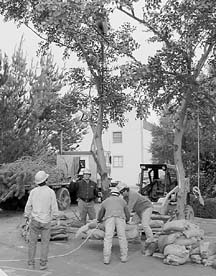
Creating a forest on a parking
lot.
Why Ferndale?
![[photo of Tom Walsh]](cover0315-artdir.jpg) THE MAJESTIC'S
ART DIRECTOR, TOM WALSH, has done extensive work in television
and film. Among his credits are John Carpenter's Vampires,
Hush, The Apostle, Flipper, The Handmaid's Tale, Speed and
the pilot for the TV series, "My So-Called Life." THE MAJESTIC'S
ART DIRECTOR, TOM WALSH, has done extensive work in television
and film. Among his credits are John Carpenter's Vampires,
Hush, The Apostle, Flipper, The Handmaid's Tale, Speed and
the pilot for the TV series, "My So-Called Life."
His job these past few months
has been to turn Ferndale into Lawson, a sleepy seaside town
circa 1951. He has been overseeing construction of the Majestic
Theater, Mabel's Diner and Lawson's town hall along with changes
in signage and window dressings for Main Street stores and the
construction of interior sets at the fairgrounds. Actual filming
is set to start Monday.
Walsh took a few minutes out
of his busy day last week to speak with the Journal.
What does Ferndale offer
for an art director?
Ferndale has a natural environment.
It's a real place. The buildings are real, the architecture has
a lot of integrity. Movies are all about making things real,
so it's always great when you can start with something that is
real and then dramatically adjust it for the purposes of your
story.
Our script has some very specific
needs: It requires a movie theater; it requires a diner and sort
of a town hall, all in close proximity to one another at least
photographically. It turned out Ferndale had the spaces that
could accommodate those kind of sets. Sometimes you look for
a place that has all that going for it, but you almost never
can find everything in the place the camera would like it to
be. That's where design, compromise and ideals all come together.
You saw pictures of the town
and thought it would work for your purposes?
Well, I knew Ferndale. On vacations
in the past I had been through Ferndale and was familiar with
it. But (Castle Rock) hired a scout. The production designer,
Greg Melton, and a scout traveled up and down the California
coast last spring looking for an ideal environment. They shot
a number of towns in California, but when we went through all
of the location photos, Ferndale seemed to stand out as having
more sense of a continuity of place. There was enough community
pride within Ferndale to help them resist the modernizing that
so many towns go through. There isn't a McDonald's; there isn't
a Starbucks. It still has its own personal identity.
The film is set in 1951,
but the town doesn't really look like 1951.
The town has a timeless quality
about it which is great. It's a combination of 19th century,
early 20th century and midcentury structures. It gives it more
of a sense of reality as opposed to some movie sets where everything
is locked in one time zone. Ferndale has a nice mix of things,
which again, gives it more reality. The town in our story is
supposed to be on the coast, and we are obviously close to the
coast, but we're using the town in conjunction with other locations
to create a sense of a forgotten town off the main drag.
Besides the three buildings
you constructed, what else are you doing to the town?
You add signage and little details
to tie the community together, but it is pretty much a
set as it is. If we had to do that much more there would be no
reason to come here. You would just build your own town. What's
great about the Ferndale community is that a lot of it works
already and you just make some subtle adjustments and some not
so subtle adjustments to pull it together for the camera.
How has it been working with
the people of Ferndale?
It has been great. It's a very
supportive community and they've been very supportive of our
efforts. I have only good things to say about this town.
Will you be back?
Oh, absolutely.
IN
THE NEWS | CALENDAR
Comments? E-mail the Journal: ncjour@northcoast.com
© Copyright 2001, North Coast Journal,
Inc.
|