|
 
![Humboldt Unplugged [photo of David Katz]](cover0222-photohed.jpg)
by BOB DORAN
AS ENERGY PRICES SOAR CALIFORNIANS
ARE LOOKING AROUND answers. How did we get into this mess? How
do we get out?
On Thursday Assemblymember Virginia
Strom-Martin was in Eureka as part of the Assembly Subcommittee
on the Regional Impact of Electrical Deregulation. She heard
a litany of horror stories from area business leaders and government
officials -- fearful tales of shutdowns, layoffs, major business
deals delayed, whole industries threatened.
"We are indeed in the middle
of a crisis," said Strom-Martin in her opening statement,
"one that challenges us to deliver more than short-term
solutions. We're putting the state's financial clout into the
energy-buying business, but we need to look at long-term solutions
as well.
"Looking at ways to produce
energy from alternative technologies is obviously not something
that's new on the North Coast. We've been getting off the grid
through solar, wind and cogeneration for years. I'm sure we can
continue with those efforts and set an example."
![[photo of Michael Welch]](cover02222-welch.jpg) Among those in the audience was
Michael Welch (in photo on left), associate editor for Home Power
Magazine and head of the renewable energy advocacy organization,
Redwood Alliance. Welch says when it comes to alternative energy,
Humboldt County is a hotbed of activity. Among those in the audience was
Michael Welch (in photo on left), associate editor for Home Power
Magazine and head of the renewable energy advocacy organization,
Redwood Alliance. Welch says when it comes to alternative energy,
Humboldt County is a hotbed of activity.
"There are more people
living off the grid with renewable energy here than in any other
region in the world," he told the Journal in a conversation
at Redwood Alliance headquarters in Arcata last week.
David Katz, founder of Alternative
Energy Engineering in Redway, figures Welch is right, at least
when it comes to the southern part of the county. "We're
assuming there's about 5,000 people off the grid in Southern
Humboldt," he said. "And we know there are 2,200 people
in Redway and Garberville on the grid. We figure about 50 percent
of those living south of Myers Flat are off the grid."
Why the concentration?
"It's because we have a
40-acre suburbia surrounding Garberville," said Katz. "And
it has a lot to do with marijuana."
Welch agrees with Katz.
"No. 1, a lot of people
came to the county in the '60s and '70s as back-to-the-landers.
They were looking for a way to play their Grateful Dead music.
They started buying batteries to run their tape decks and ended
up with solar panels.
"The other contributing
factor is that these people living in the back country were growing
various crops that allowed them to afford solar."
Charlie Wilson is one of the
back-to-the-landers who moved here in the '70s. He bought land
in Whale Gulch and set up his own electric system using the power
of the sun and the wind. In 1980 he was hired by Katz to help
run his fledgling alternative energy business.
![[photo of David Katz and Charlie Wilson in front of Alternative Energy building]](cover02222-alt.energybldg.jpg) David Katz and Charlie Wilson of Alternative
Energy David Katz and Charlie Wilson of Alternative
Energy
Engineering in Redway, and Wilson's dog, Remy.
"David had
a VW auto repair place called Red Star Automotive," Wilson
recalled. "He got into alternative energy because people
were coming in wanting to have a second battery installed in
their car so they could drive up to their cabin, plug in an umbilical
cord and power a couple of lights and a radio or some kind of
sound system, typically a 12-volt auto stereo. That led into
selling 12-volt light fixtures that were made for RVs and it
just kind of grew from there."
Katz moved from Alameda to Southern
Humboldt in 1977, leaving behind a job as an electrical engineer
for the naval air facility's Electrical Warfare Department. He
says he did not get into solar power because he wanted to change
the world.
"Now that I'm in it I realize
that's [doing the right thing]," he said, "but I never
really thought about it when I was getting involved in it. It
was just something people around here wanted. I think I'm naturally
oriented toward business. Even when I worked for the Defense
Department I had a Volkswagen parts business on the side."
That said, he admits that he
was "sort of a lefty protester kinda guy" in the '60s
and '70s.
"I was definitely anti-government,
anti-corporation." The logo for his business included a
"power-to-the-people" raised fist holding a lightning
bolt and an electric cord pulled from the wall.
![[logo]](cover02222-energylogo.jpg) Many of the solar panels, wind generators and associated
hardware that power Humboldt's off-the-grid homes pass through
the Redway warehouse. But local sales are a minor part of the
business. Many of the solar panels, wind generators and associated
hardware that power Humboldt's off-the-grid homes pass through
the Redway warehouse. But local sales are a minor part of the
business.
"Probably 80 percent or
better is wholesale," said Wilson. "We ship stuff to
every continent including Antarctica. That's been our bread and
butter. In many ways the Third World is a bigger market for renewable
energy than the First. They don't all have the money, but some
do and those who do have a tremendous amount of money. And they
want the amenities that the First World has."
Mergers
& acquisitions
Alternative Energy Engineering
has grown considerably since its humble beginnings. By 1998 it
was doing $4 million a year in sales. In March 1999 the company
was purchased by Idacorp, parent company of the electric company
Idaho Power. AEE was the last of four companies purchased by
Idacorp. The consortium took the name Applied Power.
"In '99 after the buyout
we, along with the three other companies, did $22 million,"
said Wilson, "and most of that business was shipped out
of this warehouse. We would fill the UPS truck to the point where
the driver was damn near standing on packages when he left the
parking lot."
Being part of a large corporation
changed a few things: 15 new employees doubled the staff and
those working full-time received raises and benefits including
health and dental insurance, a 401(K) plan, paid holidays and
vacations.
"The down side to it was
we were dealing with a large corporation," said Wilson.
"I think the theory in the original buyout was to put this
large corporation together, show a profit and then go public
(with an IPO). Idacorp thought they would sell shares and keep
a large percentage, making far more than they paid for the companies."
There was a flaw in the plan.
Idacorp's growth projections were based on an unusual period
in the history of alternative energy. At the end of the century
there was a spike in the graph caused by what Wilson calls "Y2K
hysteria."
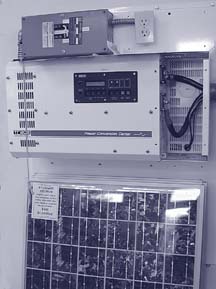 At left is an inverter bypass switch, Trace inverter
and 100-watt solar panels in AEE showroom.
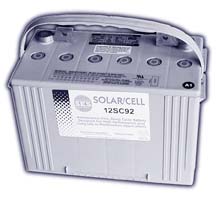
Below is a deep cycle storage battery that
holds about 1 KWH.
"We did $22 million in
business in 1999. Idacorp figured we would do $50 million in
2000 and $100 million in five years."
They figured wrong.
"What they didn't take
into account was the fact that '99 was an unusual year with a
lot of business driven by media hysteria. A lot of people honestly
thought the world was going to come to an end at midnight on
New Year's Eve. The lights were going to go out, the water was
going to stop running and anarchy was going to be at hand. It
didn't happen."
Idacorp's mistaken alternative
energy growth dream coincided with a major drop in the NASDAQ
as high tech IPO fever waned. There was also an increased demand
for the cheap hydroelectric power that was Idaho Power's bread
and butter. Applied Power was put on the market and a buyer was
found, one from overseas.
At the end of January Applied
Power was purchased by the Schott Corp., the North American division
of the international company, Schott Glas. The Southern Humboldt
operation is now officially known as Schott Applied Power Redway.
Schott
in the arm
Schott Glas was founded in 1884
when glassmaker Otto Schott and optics expert Carl Zeiss joined
forces to make microscopes.
Today the company has over 19,000
employees worldwide and around 3,600 in the United States. Last
year Schott's international sales totaled $1.8 billion, American
sales were around $500 million.
"Schott has been making
specialized glass systems and components for more than 100 years,"
said Barbara Augenblick of Schott Corp. in a call from New York.
"As times have changed our focus is still on special glass,
but we are involved in other emerging new materials as well."
Schott's space-age glass technology
includes perfection of a glass formula impervious to heat and
cold. The 16 North American subsidiaries make products ranging
from the glass tops for modern electric ranges and the shelves
for refrigerators to lenses for Ray-Ban sunglasses and huge parabolic
mirrors used in telescopes like the one atop Mauna Kea in Hawaii.
"Photovoltaics is designated
as an area where Schott wants to become more involved,"
said Augenblick. "Applied Power was a market leader in certain
parts of that field so that's why it was attractive to us."
"Their plan is to start
making solar panels," said Wilson. "Whether they'll
make them in the states or Germany remains to be seen. Once they
start making them, we'll be selling them and shipping them."
The "we" he refers
to includes other Schott Applied Power companies in less remote
areas. "We're in the middle of nowhere. So it's likely the
major warehousing will be somewhere else," Wilson conceded.
But the Redway operation will
still be a key part of the business. The sales and technical
staffs have an advantage in this growing industry: They've been
at it for years.
"We've been told several
times that the reason we were bought is because this area is
where you find the expertise. Most of the people who work here
live off the grid," said Wilson.
"You're not going to find
people who have been working with solar electricity as long as
we have in an urban center. There's no reason for that technology
to be there. It's the kooks in the hills who pioneered renewable
energy."
The
AEE's UPS
The Alternative Energy Engineering
building in Redway is run on a standby power system known in
the industry as a UPS -- "uninterruptable power system."
It's a complex composite, an on-the-grid/off-the-grid hybrid
called an intertie.
Attached to one wall of the
small AEE showroom in a device called a Trace inverter.
"Essentially we're using
it as a battery charger," Wilson explained as we walked
into another room to see the rack of batteries. "This battery
bank will store about 80 kilowatt hours of electricity, enough
to run the business, if we're careful, for about a week. It's
connected to a 12,000-watt sine wave inverter that makes the
DC power into AC power. That's what's powering all the computers,
all the plug-in appliances in the building right now."
And there are plenty of computers
upstairs where the sales staff is hard at work and "phone
techs" field "How does it work?" calls from around
the world. Wilson explains, because of the battery system, "If
the grid goes down the computers won't crash. You won't even
know the power is out."
The building is designed to
use natural light. What lighting there is runs directly on DC
power. The system is connected to PG&E, but there are also
about 2,000 watts worth of solar panels on the roof generating
power that helps feed the batteries.
"When the batteries are
full our extra solar power goes back to PG&E," Katz
said. "We give it to them for free."
Wilson said recent rolling blackouts
have led to an increase in inquiries about standby systems. In
general the energy crisis has spurred a new burst of interest
in various forms of renewable energy.
But Katz is quick to point out
that switching to solar power is not a cheap and easy solution.
"PG&E is a bargain,"
he said. "Even with the current rates, it's still a bargain.
People don't realize that. They think those living off the grid
just spend a few thousand to put in a system then that's it.
But just the battery replacement costs add up to about 30 cents
a kilowatt hour -- about twice the going rate for electricity
-- and you still have to buy the other equipment."
Jump-starting
the solar era
Solar systems are still not
cheap in part because there is not enough demand to drive prices
down. There is money in sales, but the companies making panels
are not turning a profit.
"There's a lot of research
and development going into solar. It's still growing, but it
doesn't make money. There isn't enough use," said Katz.
One way to increase solar usage
-- and decrease the demand on the grid -- is through tax incentives
and rebates.
"In Germany there are lots
of tax breaks for putting solar up," said Katz, "so
it's a very big business."
After the hearing in Eureka,
Strom-Martin faxed the Journal a list of over 100 energy
bills being considered by the Legislature in its emergency session.
Among them are five that would reduce the cost of renewable energy
through income tax credits, loan guarantees, dropping the sales
tax on solar panels or retrofitting public buildings with alternative
energy technologies. There's already a state program in place
offering rebates to customers of PG&E.
"The California Energy
Commission will give you up to $3 per watt if you offset utility
power using solar or wind," said Katz. Established in 1998,
the program drew little interest until the crisis hit. Now they
can hardly keep up with the applications.
Wilson says the increase in
interest is good news and not just because it will help business.
He sees his work as more than just a job it's a mission.
"You see these bumper stickers
on the back of RVs, `I'm spending my children's inheritance'?
Well, we're doing just that. We're spending our grandchildren's
inheritance. We're burning their carbon, we're polluting their
atmosphere, we're screwing up the world for them. We'll be dead
and it will be their problem.
"I think solar and renewable
energy is one way we can start paying the bill ourselves and
not just roll it off with interest onto our descendents."
 by ARNO HOLSCHUH by ARNO HOLSCHUH
Redwood
Alliance
Michael Welch has been with
nonprofit Redwood Alliance since shortly after it formed in 1978
in connection with the movement to permanently shut down PG&E's
Humboldt Bay Nuclear Power Plant. Since succeeding in that fight
the group has actively participated in devising decommissioning
plans for the plant.
According to Welch, "We
have finally gotten PG&E to deal with the nuclear waste and
reactor in just the way we want. Soon, we will not have to worry
about earthquake dangers at the plant." Since then the group
has moved forward to work on alternatives to nuclear and fossil-fueled
power.
"We're an environmental
organization that works strictly on energy issues," said
Welch in a conversation at the Alliance office which ironically
is located in what was once the Arcata PG&E office. "We
use education and advocacy to promote the use of renewable energy.
I'm a volunteer with Redwood Alliance. My for-pay job is as associate
editor for Home Power Magazine."
Redwood Alliance will be holding
workshops starting in May to teach folks how to implement solar-made
electricity in their homes.
Six
Rivers Solar
![[photo of Michael Eckhard]](cover02222-eckhard.jpg) When the Journal showed
up at Six Rivers Solar Co. in Eureka, manager Michael Eckhard (photo at left)
was too busy unloading solar panels to talk. Half an hour later,
when he had time to sit down for a few minutes, he explained
that business has been brisk. When the Journal showed
up at Six Rivers Solar Co. in Eureka, manager Michael Eckhard (photo at left)
was too busy unloading solar panels to talk. Half an hour later,
when he had time to sit down for a few minutes, he explained
that business has been brisk.
"Since the insanity with
PG&E we've seen three times as many people come through here,"
Eckhard said. The panels he unloaded were worth about $60,000
-- and were all sold before they even arrived.
Founded by Norman Ehrlich in
1980, Six Rivers offers a variety of solar solutions from photovoltaic
to designing and building sunrooms and skylights. The company
builds solar heaters with solar roof collectors that use the
sun to heat water that then drains down pipes running back and
forth under house floorboards. Called radiant floor heating,
the system is "the industry standard" for efficiency,
Eckhard said.
"We do complete systems
ready to go," Eckhard said. "You can educate yourself
and hope you've learned enough to design and install a solar
system," he said, "or you can go to a company that
has been doing it for 20 years."
Peltz
Power
![[photo of Jay Peltz]](cover02222-peltz.jpg) Unless you have professional training
or superhuman intelligence, "It's almost impossible to just
buy the parts" of a solar system, said Jay Peltz (photo at right),
an alternative energy consultant. He should know. He has designed
systems for homes for six years (including four years at Alternative
Energy Engineering) before deciding in late 2000 to get into
hands-on installation work. Unless you have professional training
or superhuman intelligence, "It's almost impossible to just
buy the parts" of a solar system, said Jay Peltz (photo at right),
an alternative energy consultant. He should know. He has designed
systems for homes for six years (including four years at Alternative
Energy Engineering) before deciding in late 2000 to get into
hands-on installation work.
Peltz is one of several individual
alternative energy advisers in Humboldt County. They provide
the expertise and time required to make sure the system you buy
works and is appropriate for your home.
His first advice to people looking
at going solar has nothing to do with photovoltaic cells. "For
most people it will be way cheaper to reduce consumption than
to produce energy," he said. A solar system that will produce
1,000 watts could cost around $10,000, and "you may be able
to reduce your loads for a lot less."
Many people get caught up in
the hype about the state's rebate program, Peltz said. The program
promises to pay for $3 a watt of solar energy or 50 percent of
the system, whichever is less. In reality, Peltz said, it rarely
pays for more than 30 percent.
"It's just like a sale
at the mall," Peltz said. "The ad says 30 to 50 percent"
-- but all you ever get is 30. People need to realize the rebate
program won't give them 50 percent so that they can make the
best choices, Peltz said. "They should put solar on their
roof, but they need to do both" power production and conservation,
he said.
Sun
Frost
![[photo of Larry Schlussler]](cover02222-schlussler.jpg) When Larry Schlussler (photo at left) was
a graduate student at UC Santa Barbara in the late '70s, he got
a grant to design an energy efficient refrigerator. After school
he worked on incorporating solar energy into homes in Willow
Creek. Then in 1984 Schlussler said he "ran out of work,
moved to the coast, and needed something to do," -- so he
combined his two areas of expertise. When Larry Schlussler (photo at left) was
a graduate student at UC Santa Barbara in the late '70s, he got
a grant to design an energy efficient refrigerator. After school
he worked on incorporating solar energy into homes in Willow
Creek. Then in 1984 Schlussler said he "ran out of work,
moved to the coast, and needed something to do," -- so he
combined his two areas of expertise.
"I heard about people living
in the hills in solar-powered homes. I knew they needed an energy-efficient
refrigerator that was wired for solar." That wiring was
very different in the early days of solar power because photovoltaic
cells produce DC (direct current), like a battery, instead of
AC (alternating current), like a standard home's wiring.
Today you can install an inverter
to convert DC to AC, but in the early days solar-powered homes
required solar-specific appliances. So Schlussler started Sun
Frost, which manufactures refrigerators for both solar and conventional
home use -- all several times as efficient as commercial models.
The company sold just one refrigerator
in its first year and three in its second. Sales have gradually
increased and last year Sun Frost sold about 1,000 units.
Sun Frost refrigerators cost
around $2,500, more than regular factory-built models. But like
all energy-efficient investments, they will eventually pay for
themselves in reduced energy costs.
Schlussler said 80 percent of
his customers are solar consumers, but they're not all back-to-the-landers
living in the hills. In the last 10 years, Sun Frost has begun
manufacturing refrigerators for distribution in the Third World.
The refrigerators are very small, very efficient and specifically
designed to store heat-sensitive medical supplies. Sun Frost
vaccine refrigerators are "in over 50 developing countries,"
Schlussler said.
Schlussler hasn't pushed the
company's growth. His Arcata plant, a labyrinth of corridors
and rooms filled with refrigerators in various states of construction,
would make Henry Ford wince. Assorted parts and tools line the
walls, workers wander back and forth between projects, and there
isn't a conveyer belt in sight.
It may not be the most productive
system, but Schlussler has good reason for keeping his company
unautomated: He doesn't like debt. Building a conventional refrigerator
factory would require "investing quite a few million,"
he said. By keeping his production process labor-intensive, he's
been able to "bootstrap" the company into success without
ever borrowing a dime.
HotPro
![[photo of Steve Murphy]](cover02222-murphy.jpg) Steve
Murphy (photo at right)
noticed something while vacationing
in Mexico in 1976 that changed his life. Steve
Murphy (photo at right)
noticed something while vacationing
in Mexico in 1976 that changed his life.
"I was staying in a little
cabin in the mountains and it had this wood-fired water heater."
It heated enough water for a short shower in about 15 minutes
burning only scrap wood or trash.
He was so impressed that he
sought out the heater's inventor, Señor Jesus Bravo, in
Mexico City. Murphy sold the heaters in the United States until
1984, when Bravo died. He dropped the idea until 1995, then redesigned
the heater and entered the U.S. market. He's been building them
in Eureka for five years.
But those days are done, he
said. Like other manufacturers before him, he has found the cost
of making and shipping his product on the North Coast to be prohibitive
and is moving south to Mexico. He said it cost $400 to make a
water heater in his plant on Broadway in Eureka; it will cost
$150 in Mexico.
"At the prices we have
to charge now, hardly anyone can afford them," Murphy said.
"The cost of manufacturing here makes it impossible."
Unplugged
on the Web
As you might guess most Humboldt
Unplugged businesses are on the Web.
Alternative Energy Engineering's
online catalogue is at www.solarelectric.com,
Redwood Alliance is at www.igc.org/redwood.
The links page there will take you to more information including
www.homepower.com. Then
there's www.sixriverssolar.com,
www.sunfrost.com and www.hotpro.com. Details on
the state's Emerging Renewables Buy-Down Program are at www.energy.ca.gov/greengrid.
IN
THE NEWS | CALENDAR
Comments? E-mail the Journal: ncjour@northcoast.com
© Copyright 2001, North
Coast Journal, Inc.
|