|
 
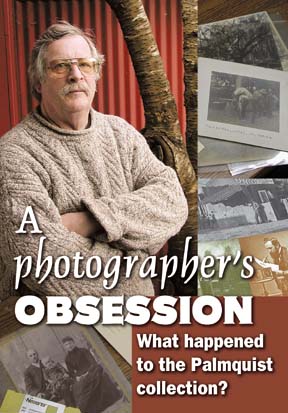
Story by BOB DORAN
PETER PALMQUIST IS A MAN obsessed
-- obsessed with learning all he can about the lives of photographers.
Over the course of the last three decades, he fed his obsession
and amassed a collection -- amazing in its size and uniqueness
-- of around 250,000 images with extensive notes to accompany
them.
Working out of his home in Arcata,
Palmquist built his private archive, one that rivals the collections
of public institutions. With 85,000 images by Humboldt County
photographers, it is a major resource for those with an interest
in local history.
But anyone interested in seeing
these slices of time will have to travel to do so, at least for
the immediate future. Palmquist sold all of his photos and notes
to Yale University last year. Most of the material has already
been shipped to New Haven, Conn., where it will be permanently
archived at the university's Beinecke Rare Book and Manuscript
Library.
It
began with a handful of old photos. It was 1971 and Palmquist
was browsing in a McKinleyville antique store.
"The woman who ran the
place asked me what I was looking for, what I collected,"
he recalled. "I said, `Nothing.' She asked, `What do you
do?' and I said, `I'm a photographer.' She said, `Well, surely
you should collect photographs.'
"Before I left she gave
me a double fistful of carte de visites, photographs by
people I had never heard of, all from the Arcata-Eureka area,"
Palmquist said. "I was intrigued. I wanted to learn more
about them."
And that seed of curiosity about
the photographs and the photographers who shot them continued
to grow. While learning everything he could about Humboldt County's
pioneer photographers, Palmquist expanded his investigations.
By the end of the century the self-taught researcher had become
one of the foremost authorities in his field, an internationally
respected expert not just on Humboldt's photographers but about
the history of photography on the American frontier.
![[photo of Judge S.M. Buck]](cover0124-judgebuck.jpg) ![[photo of little boy]](cover0124-boy.jpg) 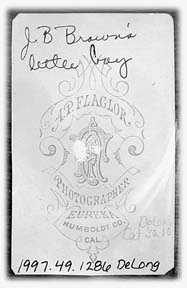
Carte de visites from the Humboldt County Historical Society photo
collection.At left, is Judge S. M. Buck, attorney. In the middle
is a young boy identified on the back side (right) as "J.B.
Brown's little boy,"
along with other collection information.
Palmquist's
rustic home is nestled among trees not far from his former place
of employment, Humboldt State University. From the outside, the
building behind the house doesn't look like a world-class library.
But inside floor-to-ceiling bookshelves are crammed with books
on photography and volume after volume of bound notes.
Over the course of last year
trucks from Yale made a regular pilgrimage to the Palmquist repository
and what remains today is mostly material connected to another
of his obsessions, the Women in Photography International Archive.
A few old photos in sleeves
sit on a worktable. Nearby is a thick book, Pioneer Photographers
of the Far West: A Biographical Dictionary, 1840-1865, "the
bible on the subject," he calls it. While it seems comprehensive,
it's just volume one of what Palmquist projects to be a five-volume
set.
Assembled with help from New
York-based editor/house painter Thomas Kailbourn, the 1,216-page
Pioneer Photographers tome was published last spring by
Stanford University Press. In November Palmquist and Kailbourn
received the Denver Public Library's Caroline Bancroft History
Prize, an award given annually to the authors of non-fiction
books about Western history.
As an expert on the lives of
photographers, Palmquist is used to putting together biographic
sketches. How does he describe himself?
"This is my 53rd year as
a photographer," he begins, and then pauses. "I'm local,"
he says after a moment of reflection.
Local, but not native. Born
in Oakland, Palmquist moved to a "side-hill shack"
on Boone's Creek in the hills above Ferndale when he was 8, his
father intent on a "back-to-the-land experience."
The fact that they had gravity-fed
water and no electricity didn't stop him from developing an interest
in photography.
"When I was about 12 I
started using my mother's box camera. There was nobody in the
community who did photography who could show me what to do, so
I just read about it. I went to Wing's Pharmacy in town and bought
chemicals mail order. By the time I was in high school, I was
really into it. I became the resident expert."
After graduating from Ferndale
High, he took his photo skills to the military. From 1954-59
he was stationed in Paris, home of the Supreme Headquarters Allied
Powers Europe, the military arm of NATO, a position that had
him photographing generals, presidents, movie stars, princes
and queens.
When his stint ended he was
offered a position in Brazil, but with a wife and a new baby
he thought it might not be a good idea. Instead he returned to
Ferndale and found work as a census taker.
After enrolling at Humboldt
State in 1960, courtesy of the GI Bill, he learned that the school's
photographer had quit.
"I took the job and kept
it for 23 years," he said as he quickly moves to a topic
more dear to his heart: research.
Just as he taught himself the
fundamentals of photography as a boy, Palmquist's entry into
the world of historical research was for the most part without
guidance. He has a college degree -- in ceramics, not history.
"I use methods that would
not be taught in universities, but they're effective. I find
stuff no one else can find because I don't know any better. When
you gather material endlessly, you gain a lot of insight,"
he said.
Palmquist pored over books looking
for clues, read every census record and "most of California's
newspapers and magazines through 1870 and some through the 1940s."
The Humboldt Room at HSU was
a starting point, but they were just beginning to gather historic
photos.
"In fact I was instrumental
in bringing the Ericson plates there," he said, referring
to a turn-of-the-century Arcata photographer who was the subject
of Palmquist's first book, Fine California Views: The
Photographs of A.W. Ericson.
"I had met the family and
helped them salvage some of the plates from an old barn,"
he explained.
He was already building a collection.
At a glance it might have seemed unfocused since it dealt with
such a broad subject: "the lives of photographers."
"I'm not passionate about
collecting photos of ships, not passionate about railroads. I
want to know who the photographer was," said Palmquist.
"And I've profited from staying in the field. I've been
the beneficiary of people who have died and given me their stuff.
I have research notes from colleagues and collectors, things
they left me. As you combine all this information a larger picture
comes into focus, one that benefits from the work of a lot of
people. I don't find every clue myself, but I accumulate them."
He shared his discoveries in
countless articles for scholarly publications and historical
society newsletters and put together more books. (His 63rd was
"on the press" when we spoke last month.) And he mounted
exhibitions.
In 1981, while doing research
for a major project, Palmquist met George Miles, newly hired
curator of the Western Americana collection at Yale's Beinecke
Rare Book and Manuscript Library.
"Peter was working on his
first big Carlton Watkins project, a book and a show that was
done in conjunction with the Amon Carter Museum," said Miles
in a call from Yale. "He came here to look at our things,
about which he knew much more than I did. So from the first I
began to learn from Peter."
When it comes to the history
of the West, the Beinecke is one of the major players. You want
to read the field notes from the Lewis and Clark expedition?
The originals are there, along with the original field maps.
"We're clearly one of the
best in the world when it comes to the history of the West up
until about World War I. Once you get past that we can't begin
to hold a candle to the sorts of collections that state universities
and state historical societies have built up for their particular
regions."
When Miles learned that Palmquist's
collection might be for sale he was interested. When he talked
with Peter and learned just how extensive it was, he became very
interested.
Why is it significant?
"It is probably the largest
private collection of 19th century Western photography ever built,"
said Miles. "I don't know of a larger one. There are people
out there who pursue this with a passion, and there are interesting
private collections that come up, But Peter's is on another order
of magnitude.
"There's more to it than
that," Miles continued. "It also is extraordinarily
thorough in certain areas. Peter was simply comprehensive in
collecting Northern California work, particularly Humboldt County,
from the earliest days of photography through to the mid-20th
century. Peter went out of his way to find the work of every
major photographer and to be able to document not just the history
of the region but the history of photography as it was practiced.
"I would also say that
part of what interested me about Peter's collection is not only
the original material he collected, but all the background research
that he did and compiled. The details he gathered are just staggering."
Each
photo in his collection offers a small glimpse of the past. While
Palmquist's intent has always been to look at history from a
photographer's point of view, other historians see different
things in his collection.
![[photo of Matina Kilkenny]](cover0124-matina.jpg) Among
them is Matina Kilkenny, [in
photo at left] research and collections
manager of the Humboldt County Historical Society. "There's
a story of the community that's part of each photograph, and
I think that it goes beyond who took the photograph. We value
them for what they can tell us about a time and a place,"
said Kilkenny at the society's headquarters in a Eureka Victorian
converted into offices and archives. Among
them is Matina Kilkenny, [in
photo at left] research and collections
manager of the Humboldt County Historical Society. "There's
a story of the community that's part of each photograph, and
I think that it goes beyond who took the photograph. We value
them for what they can tell us about a time and a place,"
said Kilkenny at the society's headquarters in a Eureka Victorian
converted into offices and archives.
Like many in the community,
Kilkenny sees the sale of the Palmquist collection as the loss
of an irreplaceable historical resource.
"The historical society
has a wonderful collection, more than 20,000 photos. It's nothing
compared to Peter's collection. But what I regret the most is
the loss of information, explicit information about individual
images," she said.
"Every picture we have
tells us something about our history. We need information to
interpret that history. We know more if we have the writing on
the back of the photo. It might be a note that came with the
photograph that says who the people were or the address of a
building. That's what left with the collection.
"A good example is the
picture you've seen on a poster recently with three postmen.
[below right] A woman had seen the photo and thought one of the
men might be a relation. She asked Peter if he had any information
about it. He knew who the people were; it was information that
had not been given out before. He emphasized how lucky she was
to get that information because that photo was being boxed up
the next day [for shipment to Yale]. I have to say that made
me mad."
![[poster of postmen]](cover0124-postmen.jpg) Palmquist
is well aware of the fact that there are many in the community
who were dismayed when they learned he had sold his collection
to a university back east. Palmquist
is well aware of the fact that there are many in the community
who were dismayed when they learned he had sold his collection
to a university back east.
"I take it your story is
about how this stuff has escaped Humboldt County," he said
at one point in our interview. "And I'm regretful,"
he added.
"There are all sorts of
critics who feel that the collection should stay here. If it
were to remain here, who's going to have it? Let's say the Historical
Society got it. They have limited staff. They have no provisions
for maintaining a historical record for the stuff with their
system. They might not put all the Ericson photographs together
because they sort by subject matter. Suddenly they're confronted
with putting all the trains in this pile and the Indians in that
pile. That would destroy what I've done."
Kilkenny points out that it
was Palmquist who devised the historical society's catalogue
system. Was there ever a chance that the collection could have
gone to the historical society?
"He never gave us any impression
that he was interested in donating one photograph to this collection,
much less 85,000. He's never donated a picture to us that I can
think of.
"Peter is an information
broker. It's that simple," Kilkenny continued. "And
I don't think that people who gave photos to him and shared photos
with him thought that they were selling the information that
went with them; they didn't know it was going out of the area."
In his own defense Palmquist
emphasizes his reputation.
"Reputation is everything.
You can imagine that there are others like me in the world. Some
of them can't be trusted. Those who are in the system know who
can be trusted and who can't. People will give me things they
wouldn't give anyone else because they trust me. I can't say
I have no critics, but most of my critics are people who just
don't know the circumstances, who don't understand what I'm doing."
He dismisses the idea that any
local institution has the resources even to deal with the portion
of the collection on Humboldt photographers.
"There are 85,000 photographs
(in the Humboldt portion). Are they going to put them in archival
sleeves, in archival boxes, find shelving space for them, space
where the temperature and humidity are completely controlled?
"Finding the proper respectful
home was essential. It's not like these are all Humboldt pictures
or pictures of Nevada City or pictures of Hawaii. The point is,
if you divorce them from the intellectual effort, the information
I've gathered about all the relationships the photographers have
one to another, you don't have a core collection. If it was dispersed
it would be pointless. It would destroy it."
Did he consider selling to the
Bancroft at UC Berkeley, another library with an extensive collection
on Western history?
"How long would it take
them to deal with my collection? It wouldn't happen in my lifetime,"
Palmquist replied.
"Part of Peter's concern
was to try to find an institution that had the wherewithal to
manage the collection effectively," said Miles, Yale's Beinecke
curator. "I would respectfully say that there are only a
handful of institutions in the country with the resources to
house the collection, appropriately maintain it and handle readers'
needs over a period of time. I'm fortunate to work at one of
them."
While Miles would not say how
much Yale paid for Palmquist's collection, he emphasized that
the photographs could easily have been sold for two or three
times as much money if it had been broken up and sold over a
period of time.
"The point is, it wasn't
about the money; it was really about preserving the collection
for scholarship," said Miles. And he contends Yale is in
the forefront when it comes to studying the West.
"One of the constant issues
for those of us collecting Western history here at Yale is, `Why
are you taking that stuff east?' It's a question we hear over
and over again."
His response: The history of
the Far West is an important part of the history of America.
Yale has demonstrated its commitment to the field by producing
many leading scholars who go on to teach at colleges and universities
in Western states.
Palmquist said he chose the
Beinecke in part because it's "on the corridor for students
doing research."
"That's something that's
lacking here. I'm next to a university, but the students never
see this place. They don't realize that cutting edge stuff is
being done right in their back yard. No one here understands
it."
What
happens to the collection now that it's at Yale? Palmquist has
suggested that with digital technology it will soon be possible
for people in Humboldt County to view the collection online.
"We're making efforts in
the digital field to put our collections up on the Web where
they can be more accessible for students, scholars and interested
amateurs from around the world who can't ever get to Beinecke,"
said Miles.
"But," he added, "I
don't want to make rash promises." Because of the vastness
of the Palmquist archives and because of the broad range of collections
at Yale, it will be some time before the collection is digitized.
"The Beinecke Library runs
from papyrus right through to modern literary manuscripts and
is extraordinarily strong in many fields. The communities of
users around the world are all interested in how digital technology
will make their life easier.
"We're all trying to figure
out what works best and how to make it happen, but we do have
a commitment to broad access. We collect material so it can be
used, not to lock it up."
Despite the sale, Palmquist's
research hasn't stopped. He's still hard at work studying women
photographers, still gathering photos and filling files with
notes.
He rests easier now that his
life's work is secure "in one of the finest rare book libraries
in the world."
"The collection will live
there in perpetuity. The facility itself is like a cathedral
with translucent marble panels so you have this beautiful soft
light. It's almost a mystical experience to walk in," Palmquist
said.
The way he sees it, the photos
he gathered now have a secure place in history.
"I'm simply a curator.
These things pass through my hands, but they belong to society."
![[photo of book]](cover0124-book.jpg)
Some of the 63 books
edited or written
by Peter E. Palmquist
A Collector's Obsession: Photographs
Of Humboldt County, California From The Peter E. Palmquist Collection. 2001.
Pioneer Photographers Of The
Far West: A Biographical Dictionary, 1840-1865 Peter E. Palmquist and Thomas R. Kailbourn.
2001.
Giants in the Earth: The California
Redwoods by Peter Johnstone
editor, Peter E. Palmquist photo editor/photographer 2001.
Women Photographers: A Selection
Of Images From The Women In Photography International Archive,
1850-1997 Peter E. Palmquist
and Gia Musso. 1997.
Shadowcatchers: A Directory
of Women In California Photography two volumes 1990/1991.
Camera Fiends & Kodak
Girls: Selections By And About Women In Photography, two volumes edited by Peter E. Palmquist.
1989/1995.
Return To El Dorado: A Century
Of California Stereographs From The Collection Of Peter Palmquist. 1986.
The Photographers Of The Humboldt
Bay Region Peter E. Palmquist
with Lincoln Kilian. - 1985.
Carleton E. Watkins: Photographer
of the American West
1983.
With Nature's Children: Emma
B. Freeman, 1880-1928 Camera And Brush 1977.
Fine California Views: The
Photographs Of A. W. Ericson
1975.
|
![[photo of Arcata Plaza]](cover0124-plaza.jpg)
Other Photo Collections
With over 20,000 images, the
Humboldt County Historical Society (703 8th St., Eureka)
has the largest public collection of historic photographs remaining
in Humboldt County. For more information got to: http://www.humboldthistory.org/
- The Humboldt Room at HSU
holds 2,000 plus images. Infromation about the collection is
available online at: http://library.humboldt.edu/infoservices/humco.html
497 plates from the Ericson photograph collection have
been digitized and can be viewed online at: http://humboldt.octavo.com/humboldt/index.html
[Above is a photo of the Arcata Plaza, by A. W. Ericson,
courtesy of the Humboldt Room, HSU Library]
- The Humboldt Room at the Eureka
branch of the Humboldt County Library (1313 3rd St.) has
a few hundred photos including "Shades of Humboldt,"
a small archive of photos copied from family collections. The
Clarke Memorial Museum (3rd and E sts., Eureka) also has
a small photo collection.
- Chromogenics in Fortuna (1130 Main St.), a business
run by Greg and Penny Rumney, has what seems to be the largest
remaining private photo colection: over 50,000 images, most of
them from Humboldt. Call them at 725-1200.
- Beinecke Rare Book and Manuscript
Library website is at:
http://www.library.yale.edu/beinecke/brblhome.htm
It includes a searchable database of around 21,000 scanned images
from the Beinecke's collections: http://highway49.library.yale.edu/photonegatives/
- Peter Palmquist's Women in
Photography International Archive is online at: http://www.sla.purdue.edu/WAAW/Palmquist/
|
IN THE NEWS | EDITORIAL | CALENDAR
© Copyright 2002, North Coast Journal,
Inc.
|