|
 
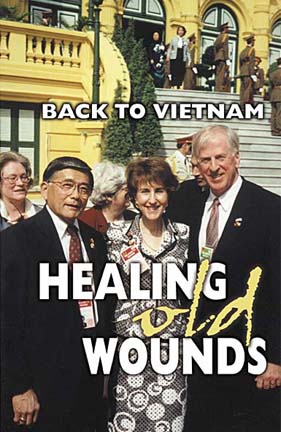
photos by MIKE THOMPSON
Interview by BOB DORAN
On Nov. 7 and for the five weeks that followed, the U.S. presidential
elections had a stranglehold on newspaper headlines in this country
and abroad. Coverage of President Clinton's trip to Vietnam in
mid-November was bumped to the inside pages. But that didn't
mean the journey was any less historic. It was the first official
visit by an American president since the end of the Vietnam War
in 1975.
Clinton was joined by his
daughter, Chelsea, and wife, Sen.-elect Hillary Clinton as well
as a congressional delegation that included 1st District Rep.
Mike Thompson.
In a conversation Dec. 18
with the Journal -- the
day before Thompson joined Secretary of the Interior Bruce Babbitt
on another historic trip -- down the Trinity River in a dugout
canoe -- the congressman shared his reflections and recollections
of the journey back to Vietnam.
Thompson, like many in the
congressional delegation who travelled with the president, is
a Vietnam veteran. He had not been back to the country since
the war but had been trying to arrange a trip for years.
![[photo of Mike Thompson]](cover0111-thompson.jpg) "When
B.T. Collins was in the state Assembly he and I were going to
go, but he became ill and we lost him," Thompson said. Brian
Thomas "BT" Collins died in 1993 of a sudden heart
attack."I tried another time to go with some friends from
Napa who were Vietnam veterans, but my work schedule didn't allow
it." "When
B.T. Collins was in the state Assembly he and I were going to
go, but he became ill and we lost him," Thompson said. Brian
Thomas "BT" Collins died in 1993 of a sudden heart
attack."I tried another time to go with some friends from
Napa who were Vietnam veterans, but my work schedule didn't allow
it."
Thompson sits on the Armed
Services Committee and last year he approached the chairman about
leading a congressional delegation. The idea was approved, but
the trip postponed due to full agendas in the busy election year
-- until Clinton decided the time was right.
"It was a quick trip,"
Thompson said.
The congressional entourage
flew to Hanoi, linked up with the president and his family, Sen.
Bob Kerrey of Nebraska and Reps. Vic Schnieder of Arkansas, Loretta
Sanchez of Orange County, Calif., and Earl Blumenhaur of Oregon.
"The assistant secretary
of veterans affairs and the secretary of veterans affairs, the
head of the Vietnam Veterans of America and the founder of AOL
were also there -- all of them Vietnam vets," said Thompson.
Journal: How did you end
up going with the President?
I think everybody
knew that if there was a Vietnam trip coming up I was one of
the people who wanted to go. Then, kind of in the 11th hour,
the president decided to go and I was invited to go along.
Why were you interested in
going?
Well, I served there.
I was in the war in Vietnam -- we call it the Vietnam War; the
Vietnamese call it the American War -- and I wanted to go back.
I wanted to see the country. I remembered it as being a very
beautiful place and I was always disillusioned that I was viewing
the country under the cloud of war. I really didn't get a chance
to see it in a different way, to meet the people. I wanted to
do that. I guess another part of it was closure for me. I wanted
to go back for that reason.
![[photo of US and Vietnam presidents]](cover0111-clinton.jpg) President Clinton
of the United States and President Clinton
of the United States and
President Trân Dúc Lùóng of Vietnam
walk in the color guard ceremony.
Did you volunteer for the
Army?
I did, when I was
18.
Did you enlist knowing you
would go to Vietnam?
I don't think I knew
I would go. I was pretty young. It was 1969 so I should have
known, but as I said, I was young and probably didn't put that
together. It was 1970 before the reality struck me that I was
going.
What was your experience
over there?
I was a sergeant.
I served as a squad leader, as platoon sergeant. But because
of attrition, I was a platoon leader for the majority of time
I was there. I was in combat -- in country -- packing an M-16
rifle and leading a platoon.
You ended up with a Purple
Heart.
I was wounded over
there which cut my trip short. The total time in country and
in the hospital was about six months. I got hit by a booby trap
and came home.
You stepped on a land mine?
It wasn't a land mine,
but it was something explosive. Someone in front of me hit it
and it blew up.
![[photo of ceremony]](cover0111-flags.jpg) "Out in the courtyard the Vietnamese
and American flags were flying and the president of the United
States and the president of Vietnam were standing there while
Vietnamese Army Band played "The Star Spangled Banner." "Out in the courtyard the Vietnamese
and American flags were flying and the president of the United
States and the president of Vietnam were standing there while
Vietnamese Army Band played "The Star Spangled Banner."
--Mike Thompson
What was it like going back?
It was wonderful.
The countryside was as beautiful as I remember it. It's strange
when you're in war and there as a young soldier. You know intuitively
that it's a beautiful area -- especially if you come from a rural
area and have experienced open countryside -- you know it's beautiful,
but your view is obfuscated by the conditions under which you're
serving. You don't have time to fully appreciate the beauty of
the country if you're trying to make sure you don't get hit with
a booby trap.
And I always had the
sense that the people were wonderful. But again, when you're
a soldier you've always got your guard up. Visiting there I found
that my instincts were right; the people were just marvelous.
Everyone recognized
that this was an historic visit, the first time an American president
had been there since the war. If we had two events two blocks
or even 20 miles apart, the street would be lined with people.
When we went to an event in a little bitty hamlet in the middle
of nowhere, there were thousands of people who came out to see
us and to see the American president.
I think the authorities
were a little concerned about that. When you have a Communist
country, the last thing you want is thousands of people on the
same street corner. I think the fact that they were all interested
in this great democracy sent a message. I think you're going
to see changes coming quickly over there. They want to westernize
and get out from under the control they live with daily.
Another thing that
was almost overwhelming was an event on one of the first days
at the Presidential Palace in Hanoi. We participated in the color
guard. We were just blocks away from the little house that Ho
Chi Minh used during the war. I could look over my shoulder and
see Ho Chi Minh's house, then look out on the parade ground and
see the Vietnamese Army assembled in full uniform. Out in the
courtyard the Vietnamese and American flags were flying and the
president of the United States and the president of Vietnam were
standing there while Vietnamese Army Band played "The Star
Spangled Banner." That was overwhelming. Later we went back
to the Presidential Palace and had dinner with both presidents.
![[photo of delegation]](cover0111-group.jpg) Sen. Bob Kerrey stands next to Loretta
Sanchez as the delegation poses in front of the presidential
palace. Rep. Mike Thompson stands in the center next to Rep.
Earl Blumenhaur. Sen. Bob Kerrey stands next to Loretta
Sanchez as the delegation poses in front of the presidential
palace. Rep. Mike Thompson stands in the center next to Rep.
Earl Blumenhaur.
Below, Sen.-elect
Hillary Clinton
and daughter, Chelsea.![[photo of Hillary and Chelsea Clinton]](cover0111-firstlady.jpg)
Is there residual ill will
toward Americans?
I don't think there
is. Someone on the trip was making a speech and quoted a Vietnamese
general who said, "If you have one enemy, it's too many.
And you can never have enough friends." I think that's probably
advice that we could all try to live by. It's clearly a belief
that they maintain.
The other thing working
in our favor is that 60 percent of the population is under 40
years of age and only 5 percent is over 60. So most of the people
there don't remember the war. They were just children. There
is still a lot of influence from wartime, but there has been
a lot of change since the war. Some of the projects we visited
were emblematic of that.
We visited an excavation
site, a spot where a U.S. airplane was shot down. They were sifting
through the pieces to be able to identify it.
As part of the search for
MIAs?
Right. We're working
with the Vietnamese government to find our missing soldiers.
And we've been sharing the documentation that our military intelligence
has, to help them find their missing in action as well.
This particular project
was a cooperative effort between the Vietnamese government and
the U.S. government and there were actually Vietnamese digging
through this rice paddy, sifting out the pieces to be able to
identify the aircraft and the pilot. And the two sons of the
pilot were there with us.
![[photo of excavation]](cover0111-excavation.jpg) "Notice that the Americans are
wearing boots. The Vietnamese are bare-foot. Each bucket holds
a shovel full of the mud, they pass them bucket- brigade style.
They push the mud through screens in the boxes and what's left
are pieces of the plane." "Notice that the Americans are
wearing boots. The Vietnamese are bare-foot. Each bucket holds
a shovel full of the mud, they pass them bucket- brigade style.
They push the mud through screens in the boxes and what's left
are pieces of the plane."
--Mike Thompson
So they knew specifically
what plane it was?
They knew who it was;
they were all but positive. They had eye witnesses who saw it
go down. The people who were flying alongside this particular
pilot saw him go down. They were trying to take out a railroad
bridge and they saw the explosion, estimating it was 300 yards
from the bridge.
It was 30 years ago,
but they know it was the plane. The parts that they've picked
up so far, if you spread them all out, would fit on this desk.
And none is anywhere close to as big as this little tape recorder.
I think the biggest piece was a rod that was no bigger around
than this pen.
When the plane crashes
it creates a crater. The first thing that happens is the village
folks come out and take all the salvageable stuff from the wreckage
to use in their day-to-day lives. The second thing that happens
is they fill in the crater so they can continue to farm.
When we were there
they said they had about a meter (39 inches) to go before they
would find the major wreckage. Yet from the small pieces they
had, they were able to identify the type of aircraft and bracket,
within a three-year period, the model of aircraft. Each one of
the teams includes a forensic expert and an anthropologist.
![[photo of women excavating]](cover0111-color.jpg)
Are these types of operations
going on all over Vietnam?
I believe there were
about seven or eight taking place. They showed us a map of the
different sites. We also saw another sign of the war -- the de-mining
program. They're going out and locating land mines, unexploded
ordinance, and removing those. Then there's a prosthetics component
where they fit people who have been victims of explosions with
prosthetics.
There's an interesting
juxtaposition. You've got the excavation program taking place,
an effort to heal old wounds in both communities, but particularly
the American community. Then you've got the de-mining program,
an effort to prevent new wounds.
Are there still a lot of
mines lingering?
If there's one, it's
too many. It's a terrible, terrible tactic to deploy, one that
lingers after the war is over to kill and maim innocent people.
It's mostly children and old people who get hit by these things.
We need to stop using land mines, but in the interim, we need
to help them get these things taken care of.
Didn't the United States
decide not to sign the international treaty on land mines?
You're absolutely
correct. When I was in the state Senate I was the principal coauthor
of a resolution asking the Congress to sign on to the treaty
and to start doing away with these mines. It's something I bought
into lock, stock and barrel.
![[photo of Clinton at the excavation]](cover0111-clinton2.jpg) President Clinton at the excavation site. President Clinton at the excavation site.
"The kid
in the light shirt and the kid in the dark shirt are the children
of the pilot who was shot down."
-- Mike Thompson
Who is digging up the mines?
It's an NGO -- non-governmental
organization -- with funding from the private sector and the
public sector.
Wasn't the trip also some
sort of trade mission?
Part of the reason
for the trip was to advance the efforts to normalize trade relations.
We talked to a lot of people who were very much in favor of that.
As a matter of fact I didn't talk to anyone who wasn't. Of course
when you go on a trip like that -- no matter how much you try
and probe -- there's a certain element of the trip that's going
to be sanitized. You're meeting the people they want you to meet.
In this case, Loretta
Sanchez, who came with us, has been an outspoken critic of the
Vietnamese government and its lack of democratic dealings. She
has been there a number of times herself, so she snuck off and
met with a group of political dissidents. She told us even the
dissidents want this trade agreement. They understand that the
only way they will be treated fairly is if their country becomes
more participatory.
I met separately with
some folks in academia and they were very critical of the government
and I spent some time in the agrarian communities to see what
they were facing. I just straight up asked them, "Will normal
trade relations help or hurt?" They said, "If we don't
have them, we don't have a chance."
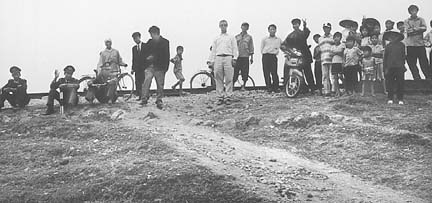 This is the railroad track leading to the bridge they tried to
bomb. When we arrived there was no one there but scary-looking
guys with binoculars and guns -- Vietnamese military guys. When
we finished, we walked up there, Blumenhaur was talking with
some of the local folks. I'm not sure if they were showing us
they want peace or they won. "
This is the railroad track leading to the bridge they tried to
bomb. When we arrived there was no one there but scary-looking
guys with binoculars and guns -- Vietnamese military guys. When
we finished, we walked up there, Blumenhaur was talking with
some of the local folks. I'm not sure if they were showing us
they want peace or they won. "
-- Mike Thompson
What's the status of the
effort to normalize trade?
At the time of the
trip there was a bill before Congress. My suggestion to the president
was that we should try to get it done before the end of the session,
given the fact that Congress had not finished the work that we're
supposed to do, and that two leading Republicans, Sen. Roth and
[Rep.] Archer in the House, who are both retiring, had both worked
as hard toward pushing this as the Democrats. He thought it was
a good idea, but because of all that happened with the election
it was not a front-burner issue. I suspect it will be passed
quickly in the 107th Congress.
![[photo of "Hanoi Hilton"]](cover0111-hanoihilton.jpg) "We went to the `Hanoi Hilton' where
John McCain and Pete Peterson, "We went to the `Hanoi Hilton' where
John McCain and Pete Peterson,
the U.S. ambassador to Vietnam, were both held prisoner during
the war.
It was all very powerful."
-- Mike Thompson
Do you think the visit changed
anything?
It changed a lot.
I believe we were able to prevail upon the government that they
need to treat their people differently. If they heard once, they
heard 50 times, if they want normal trade with the U.S., we have
to be able to support doing that. The way that happens is we
have to be able to assure people that human rights will become
a top priority.
IN
THE NEWS | ARTS! ARCATA | CALENDAR
Comments? E-mail the Journal: ncjour@northcoast.com
© Copyright 2001, North Coast Journal,
Inc.
|