|

COVER STORY | IN
THE NEWS | STAGE
MATTERS
DIRT | TALK
OF THE TABLE | THE
HUM | CALENDAR
March 23, 2006
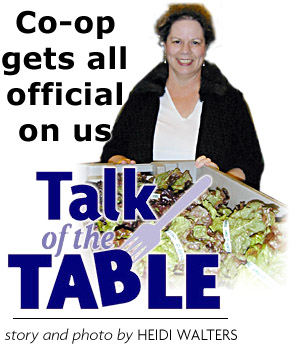
Used to be, I'd walk into any old grocery store
when I had to pick up a few fruit-like objects to meet my obligatory
weekly -- er, daily -- allowance of good-for-yous. It didn't
matter too much what the little sticky label said on the apples,
for instance, although if it said "pippin" I admit
I'd get more excited than if it said "golden delicious."
But then along came organics, and then more organics.
Pretty soon, I was picking up an organic apple here and a bag
of organic lettuce there, just like the growing number of my
fellow lackadaisical shoppers who, whether from budget constraints
or pesticide-induced apathy (note: not a scientifically proven
condition, as far as I know), had previously not thought twice
about buying a conventionally grown pear. As an emerging convert
to organic ingestion, I was paying closer attention to the little
sticky labels. After all, who wants to willingly eat bananas
nurtured with toxics? Not me -- gimme the bugs, by golly, along
with the fruity pure goodness.
Still, sometimes I wondered if what I was getting
was really organic, and how far the process went to make it better
than a conventionally grown item.
I've been thinking about that even more lately,
ever since I started hearing the North Coast Cooperative's ad
on the radio saying it has just been approved as a certified
organic retailer by the California Certified Organic Farmers
(CCOF). An organic store? Yep, the Co-op is the first
food co-op on the West Coast, and the only food retailer in California
north of the Bay Area, to be certified organic, said the Co-op's
Karen Brooks in a news release.
Monday afternoon, sitting at a table on the upstairs
employee break balcony at the Arcata Co-op, where the odor of
fresh-baked pizza and brownies floated up tantalizingly from
below, human resources manager Terri Clark explained the difference
between carrying organic produce and being a certified organic
retailer.
"A lot of people are confused and think it
means the whole store is organic," she said. That isn't
the case -- if it were, she said, the certification process would
have been much simpler. What "certified organic retailer"
means, rather, is that the unpackaged organics in the store are
stored, displayed and processed separately from the conventional
foods. It also means that the Co-op has verified and meticulously
documented the organic certification of its suppliers and confirmed
that products labeled organic really are organic. And all 155
employees at the Co-op's two stores, in Eureka and Arcata, have
been taught the proper protocol in dealing with organics. (The
new Eureka Co-op store, under construction, also will be certified.)
"It means that we know how to handle organic
products correctly, from the loading dock to the shopping cart,"
said Clark.
General Manager Len Mayer, a thin, youngish brown-haired
man with light blue eyes, came upstairs to join the conversation.
He said while the application fee for the certification cost
$3,000, the amount of staff time involved "easily surpassed
that" cost. Clark, for instance, went around the store with
a notebook all year long asking "lots and lots of questions."
"I was the head nag," said Clark, a tall
woman with a gentle, but definitely managerial, presence, with
her wavy brown hair scooped up in a loose bun. She doesn't look
"nag," but she does look official. "I had to go
and talk to everybody, ask them how they were doing everything,
take notes. We looked at hundreds and hundreds of labels."
She and others also talked with the store's vendors, and in two
instances they found suppliers who were labeling their products
organic but couldn't produce the certification. Those products,
said Mayer, had their organic labels removed.
After the Co-op submitted its application, a CCOF
inspector came to the Co-op's two stores on Feb. 1 and 2 and
wandered the aisles and back storeroom and asked questions. Then,
a couple of weeks ago, the Co-op received word that it had passed
certification. Once a year, now, the Co-op's stores will undergo
a follow-up inspection. "But the little kicker is, at any
time they could do a spot inspection, unannounced," said
Clark. "And that's good."
That said, the Co-op didn't really have to change
its ways very much to gain the certification, says Mayer. Like
the ad says, the Co-op was already doing most of the things certification
requires. "The big change between pre-certification and
post-certification is writing it down: Here are the rules,"
said Mayer.
So, if you walk into the Co-op now, you probably
won't notice anything new. But there are subtle changes. In the
bulk foods section, for instance, the bins with the organics
are on top of the bins with non-organics, so that conventional
foods won't leak into organic foods. In the produce department,
unwrapped organic fruits and vegetables are shelved apart from
conventional produce so that customers won't confuse the two.
A little more behind the scenes, in the meat department,
organic chickens have to be processed on a separate cutting board
with separate equipment from that used on conventional meats.
And in the storeroom where the back stock is kept, again, the
organics have to be shelved above the non-organics. And when
produce gets washed before being shelved, organics have to be
washed before non-organics. Even the surfaces on which the organics
are stored must be cleaned a certain way -- with non-toxic cleaners
that don't leave a residue.
Even deeper behind the scenes is how the Co-op
deals with pests, both inside the stores and out in the parking
lot. To be a certified organic retailer, the Co-op must use the
least toxic methods of pest control. Or, rather, its pest control
vendor must use them.
"For example, there's a pheromone-based trap
we can use to deal with insects," said Mayer. The non-toxic
scent lures the pests in, and they can't get out.
"On the perimeter of the stores, we have rat
traps -- we can't put poison bait on them," added Clark.
Instead, the pest control vendor must use mechanical means to
catch the critters, preferably live traps. "We did have
some of the traps baited, before. But not now."
So why go to all this trouble? Clark said it's
a matter of accountability. "I think of the certification
of the store as fulfilling a contract with the customers,"
she said. Mayer added: "We know we sell more organic food
on the North Coast than anybody else, and we want to make sure
we're doing what we think we're doing."
Mayer said the Co-op sees 2,000 customers a day
at the Arcata store and 1,000 at the Eureka store. He and Clark
allow that the certification makes for good advertising, as well.
Doubtless, it gives the Co-op a leg up on the competition.
Over in Eureka at the Eureka Natural Foods store, produce manager
Juan Gagné offered circumspect praise for the Co-op. "This
is very positive for the entire community," he said. "The
Co-op is our friendly competition and we wish them well. When
they do good, it's good for us too."
He said that when Eureka Natural Food's new store,
just about to begin construction next door to the current store,
is built, it will seek organic retailer certification. "It's
something we have intended to do all along," he said. "And
it will become more important because we'll have a full seafood
and meat department in our new store. It's very good and it does
raise the bar for everyone."
It even raises the bar for us customers. I mean,
before today if I walked into the store and bought two organic
apples and a bag of conventional lemons coated in pesticides,
when I got home I would probably have unthinkingly tossed the
lot of them together in the big wooden fruit bowl on my counter.
Tsk tsk -- that sort of casual treatment sort of negates the
whole organics thing, doesn't it?

COVER STORY | IN
THE NEWS | STAGE
MATTERS
DIRT | TALK
OF THE TABLE | THE
HUM | CALENDAR
Comments? Write a
letter!
© Copyright 2006, North Coast Journal,
Inc.
|